


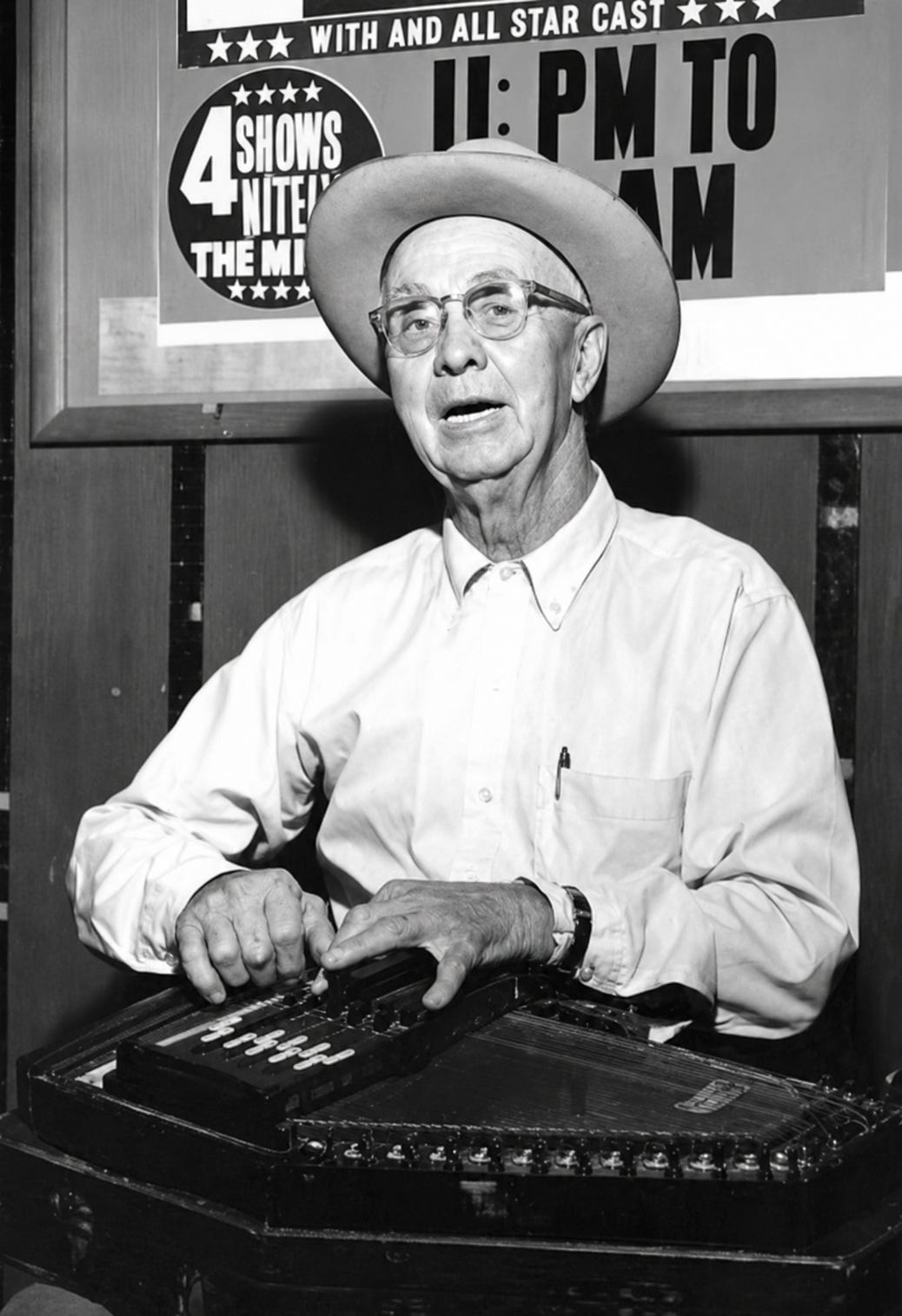
There is a throne in Country Music. It has sat empty for a hundred years, occupied only by a myth — and like all myths, it was built to serve someone else’s story. Two families laid claim to it before any of us were born. One got the monument. One built the road. And history, as it always does, chose the better publicist.
This is the case for both. You decide who sits down.
Act 1: The Case For The Stoneman Family
They were there first, and they proved it could sell.
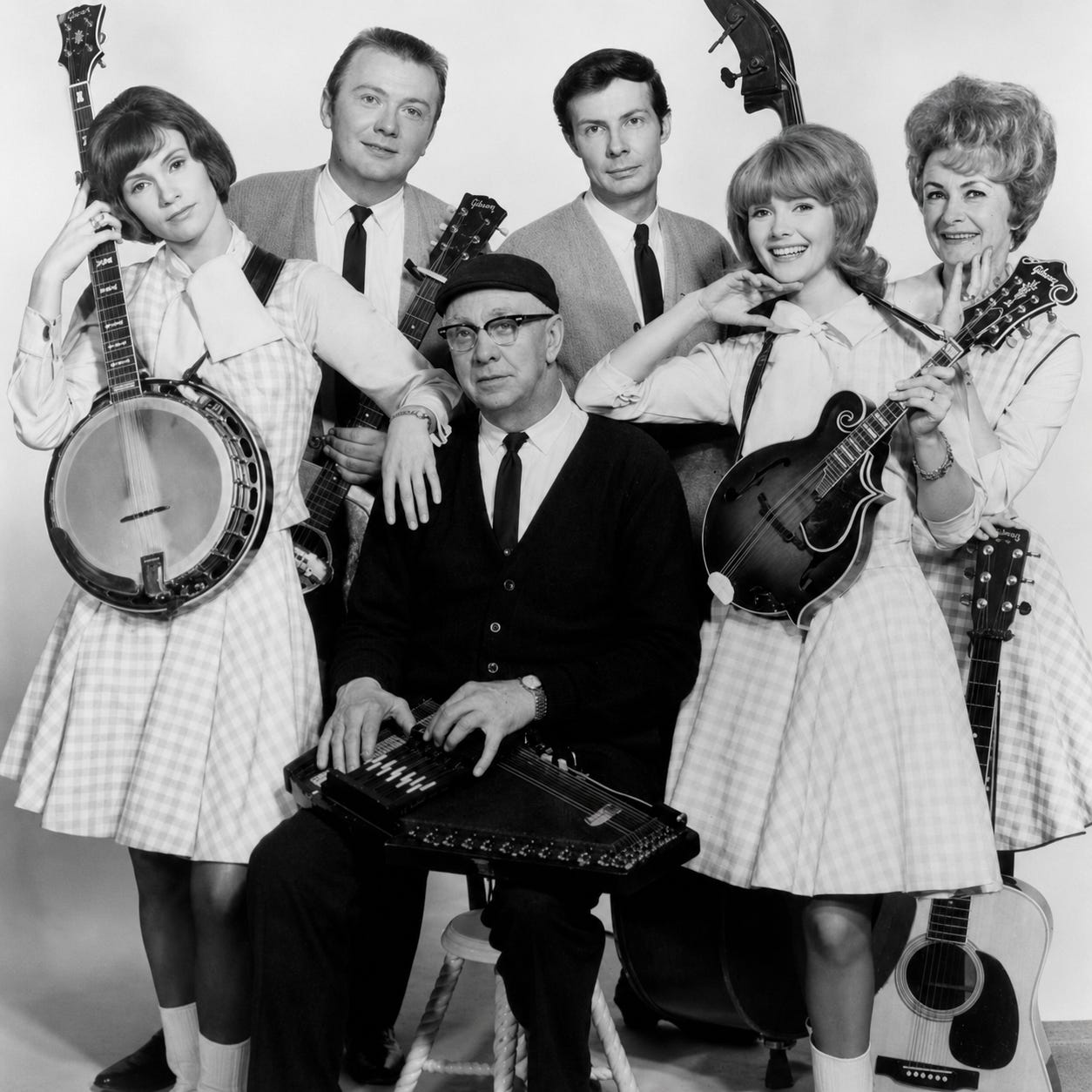
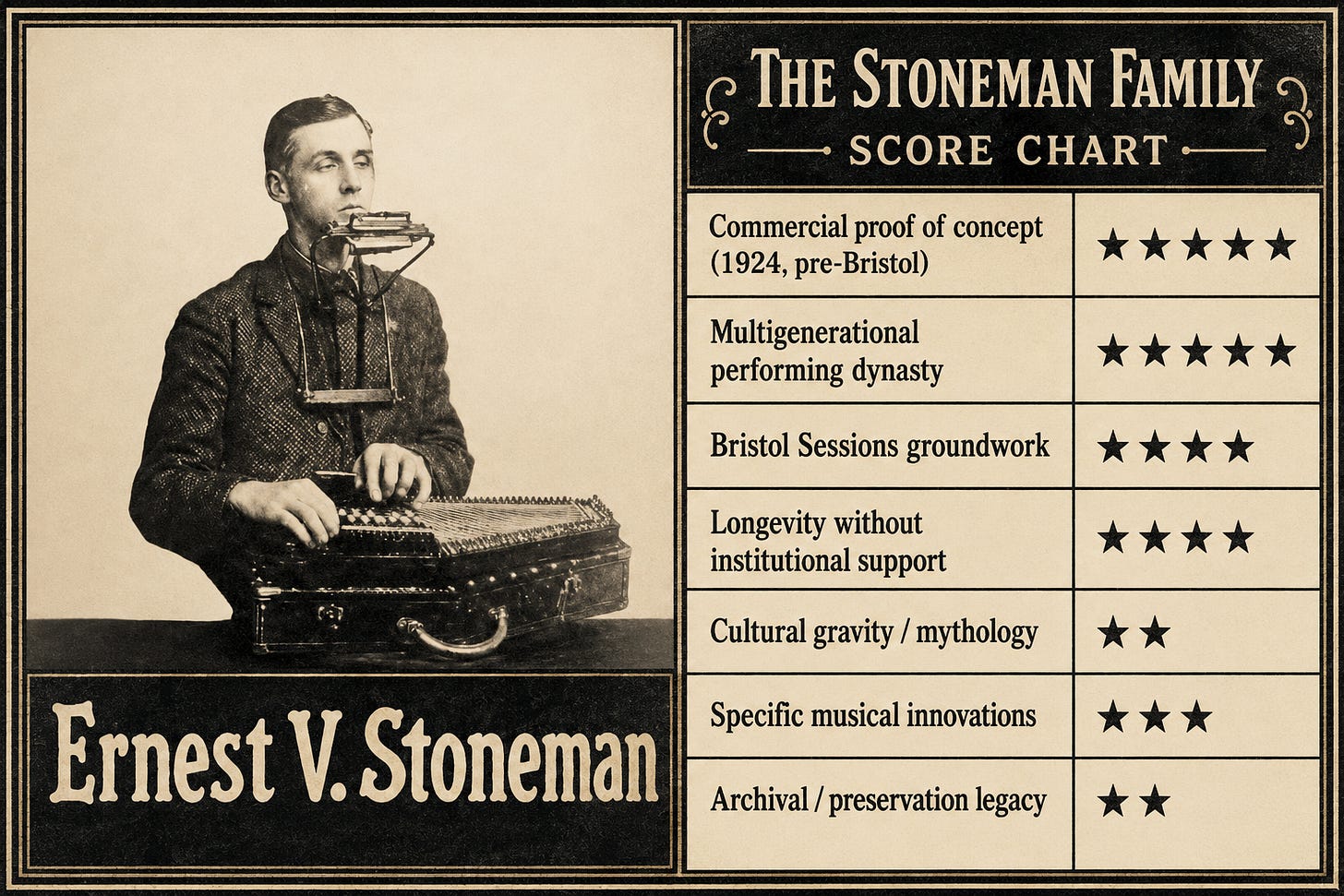
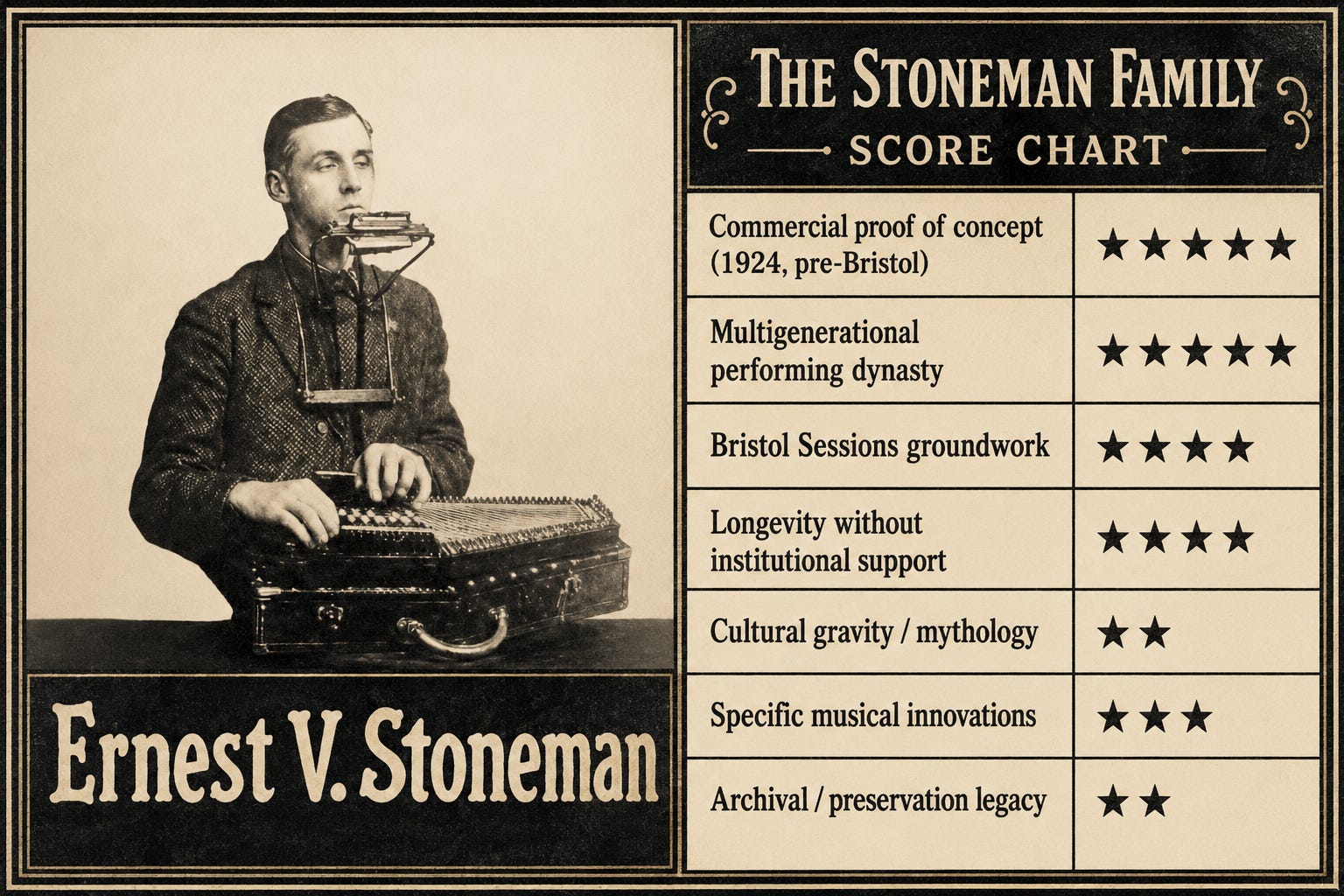
In 1924, a Virginia farmhand named Ernest “Pop” Stoneman walked into a recording studio and cut “The Sinking of the Titanic” for OKeh Records. It sold an estimated 200,000 copies. There was no genre called country music yet. No chart. No Nashville. Just a man, a song, and a number that proved ordinary Americans would spend money to hear music that sounded like them.That was three years before the Bristol Sessions. Three years before Ralph Peer pointed a microphone at Jimmie Rodgers and the Carter Family and told the world that he had discovered American roots music. Pop Stoneman did not discover country music. He just proved it already existed.
Bristol was Peer’s play, and “Pop” Stoneman set the stage.
The Bristol Sessions of 1927 are treated as the Big Bang of country music. The story goes: Ralph Peer drove to Bristol, Tennessee, set up his equipment, and the genre was born. What that story quietly omits is that Peer already knew Ernest Stoneman. He had already recorded him. He used Stoneman’s regional credibility, his knowledge of local musicians, and his reputation in the community to draw artists to those sessions.
The Carters showed up because of the Bristol Sessions. The Bristol Sessions happened because of Stoneman. The man who built the stage was erased the moment the show began.
The dynasty argument is unmatched.
The word “family” in First Family is not decorative. It is a claim about legacy, bloodline, continuation. By that measure, no family in the history of country music comes close to the Stonemans.Pop had twenty-three children. Thirteen of them became professional musicians. The Stoneman Family performed together as a working unit from the 1920s through the 1970s and beyond. They won the Country Music Association’s Vocal Group of the Year in 1967. They had a syndicated television program. Multiple generations. Multiple eras. One unbroken line. The Carters are mythologized as a dynasty. The Stonemans actually were one.They survived without the machine.
The Carter Family had Ralph Peer’s institutional support, Victor Records’ distribution, A.P. Carter’s obsessive song-collecting, and — crucially — the folk revival of the 1960s, which resurrected and canonized them for a new generation. The Stonemans had none of that. No revival. No canonization. No Joan Baez covering their songs on a college campus. They kept going anyway. Through the Depression, which nearly destroyed them financially. Through decades of obscurity. Through the full machinery of Nashville ignoring them. If survival without mythology is a measure of anything, the Stonemans pass that test in ways the Carters were never required to.
The erasure is the story itself.
Ask yourself why you know the Carter Family and do not know the Stonemans. Then ask yourself who benefits from that arrangement. The answer involves the mechanics of how country music history gets written, who controls the narrative, and the simple human preference for a clean origin story over a complicated true one. The Carters are easier to mythologize. A trio. A specific sound. A tragic dissolution. An iconic guitar technique. The Stonemans are messy — large, unglamorous, numerous, difficult to package into a legend. History prefers the story it can sell. The Stonemans were never easy to sell. Just saying.
Act II: The Case for the Carter Family
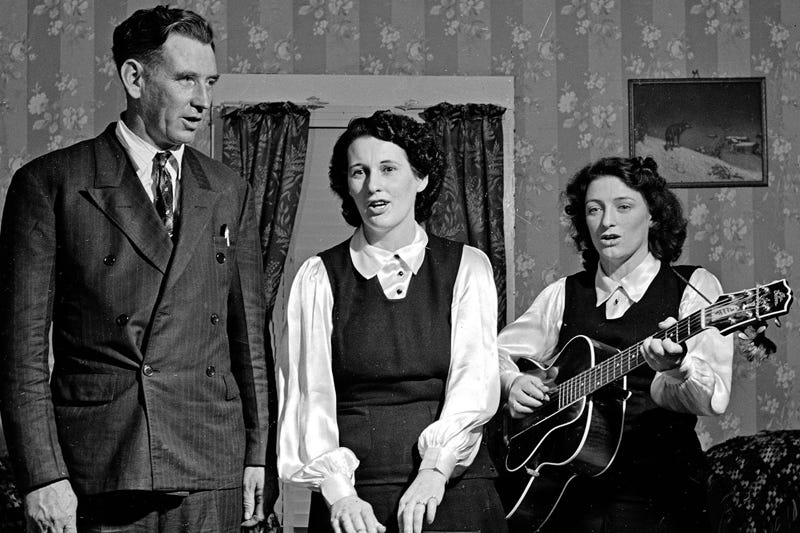
Maybelle Carter changed how the guitar was played.
This isn’t a myth. This is a technical fact. Before Maybelle Carter, guitarists in traditional American music used the instrument primarily as a strumming rhythm tool. Maybelle developed what became known as the Carter Scratch — playing the melody on the bass strings with her thumb while her fingers brushed the treble strings for rhythm. It sounds simple. It was revolutionary. It separated melody from accompaniment on a single instrument and became the foundational picking technique for virtually every country and folk guitarist who followed.The Stonemans do not have an equivalent. No single musical innovation of that magnitude can be attributed to them. Maybelle did not just perform country music. She re-engineered how it was physically played.
A.P. Carter was a one-man archive.
A.P. Carter spent years walking the mountains of Virginia, Tennessee, and Kentucky collecting songs. He went into hollows and up ridges where no recording equipment had ever been and would never go. He wrote down what he found. He brought it back. He recorded it. Many of those songs — songs that predated the Carter Family by generations — exist today only because A.P. Carter was obsessive enough to find them before they died with the last person who knew them. That is not just for entertainment, but for preservation. The Carter Family’s catalog is a historical archive of American music that would be substantially smaller without A.P.’s work. The Stonemans recorded. They did not collect. Just wait until I get into the story of Lesley Riddle.
The Bristol Sessions were a genuine cultural movement.
Yes, Peer had worked with Stoneman. Yes, the Bristol Sessions were a calculated business move by a recording executive. None of that diminishes what actually happened in Bristol in August 1927. Two acts — the Carters and Jimmie Rodgers — emerged from those sessions with performances that defined the entire subsequent trajectory of country music. The Carter Family recordings from Bristol are not footnotes. They are cornerstones.
The argument that Stoneman set the stage for Bristol does not subtract from what the Carters built on it. Two things can be true simultaneously.
The Folk Revival made them a living tradition.
In the early 1960s, when American folk music had its great renaissance, the Carter Family name was invoked again and again as a source, a root, a point of origin. Maybelle Carter performed at folk festivals. The Carter Family catalog was studied and covered by a generation of musicians who then carried that influence forward into rock and roll, folk, and country. Think of the hippie movement and Jerry Garcia. June Carter Cash brought the family name into the mainstream of country music throughout the 1960s and 1970s through her marriage to Johnny Cash. The Stonemans also had a 1960s revival — the CMA award, the television show — but it did not generate the same cultural cascade. The Carters became a living influence on popular music in a way that the Stonemans did not.
Cultural Gravity is not something that can be manufactured — it has to be earned.
The counterargument to Carter mythology is that it was built by publicists and folk revivalists with an agenda. That is partially true. But the reason the story took hold is that there was something genuine underneath it. Sara Carter’s voice was not a PR invention. Maybelle’s guitar technique was not invented by a record executive. A.P.’s mountain songs were real. The mythology attached to something real because something real was there.
The Carters carry cultural gravity because they earned it, even if others helped broadcast it. That is not nothing. That is, arguably, everything.
The Verdict — Or The Question:
Here is what the evidence actually shows.
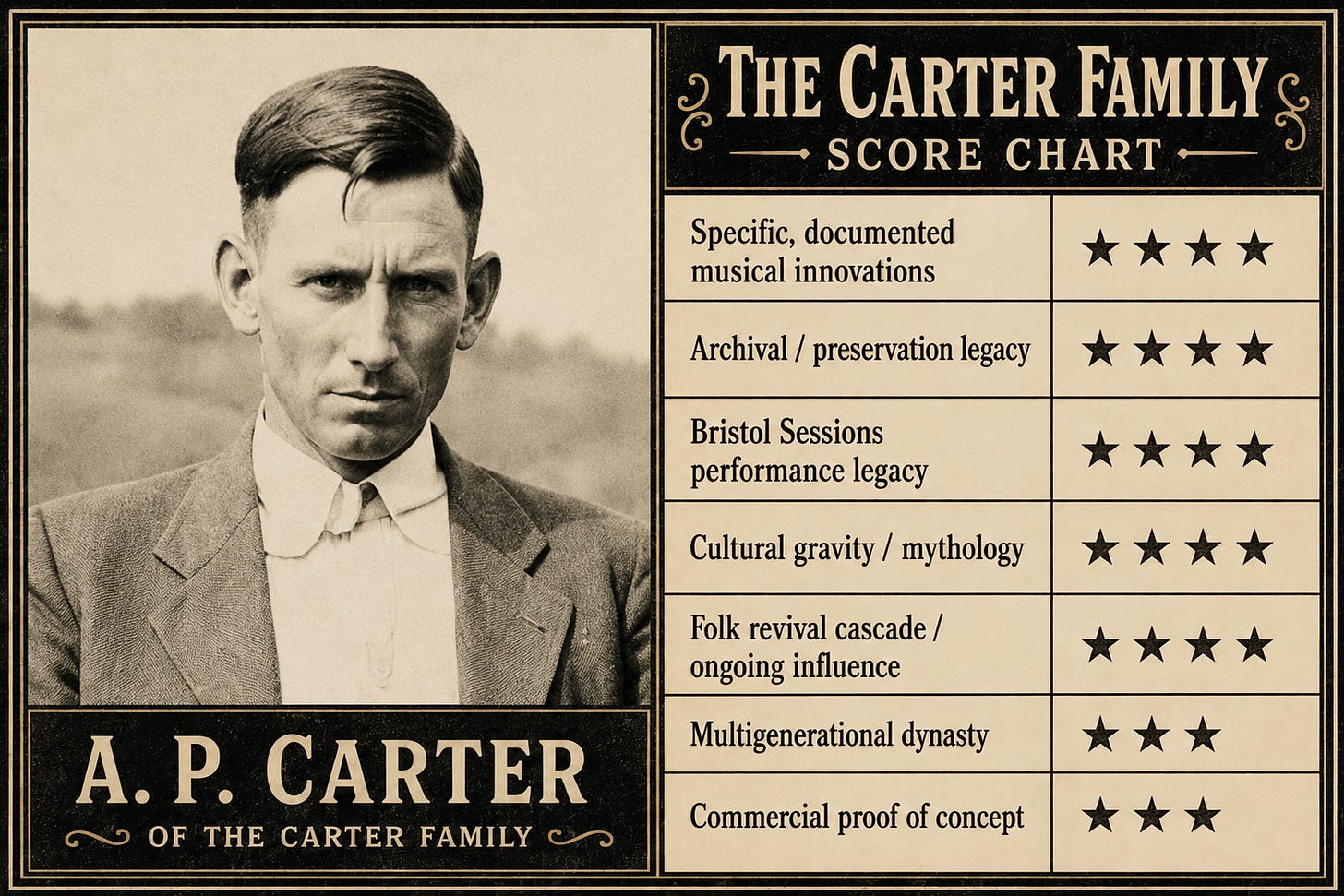
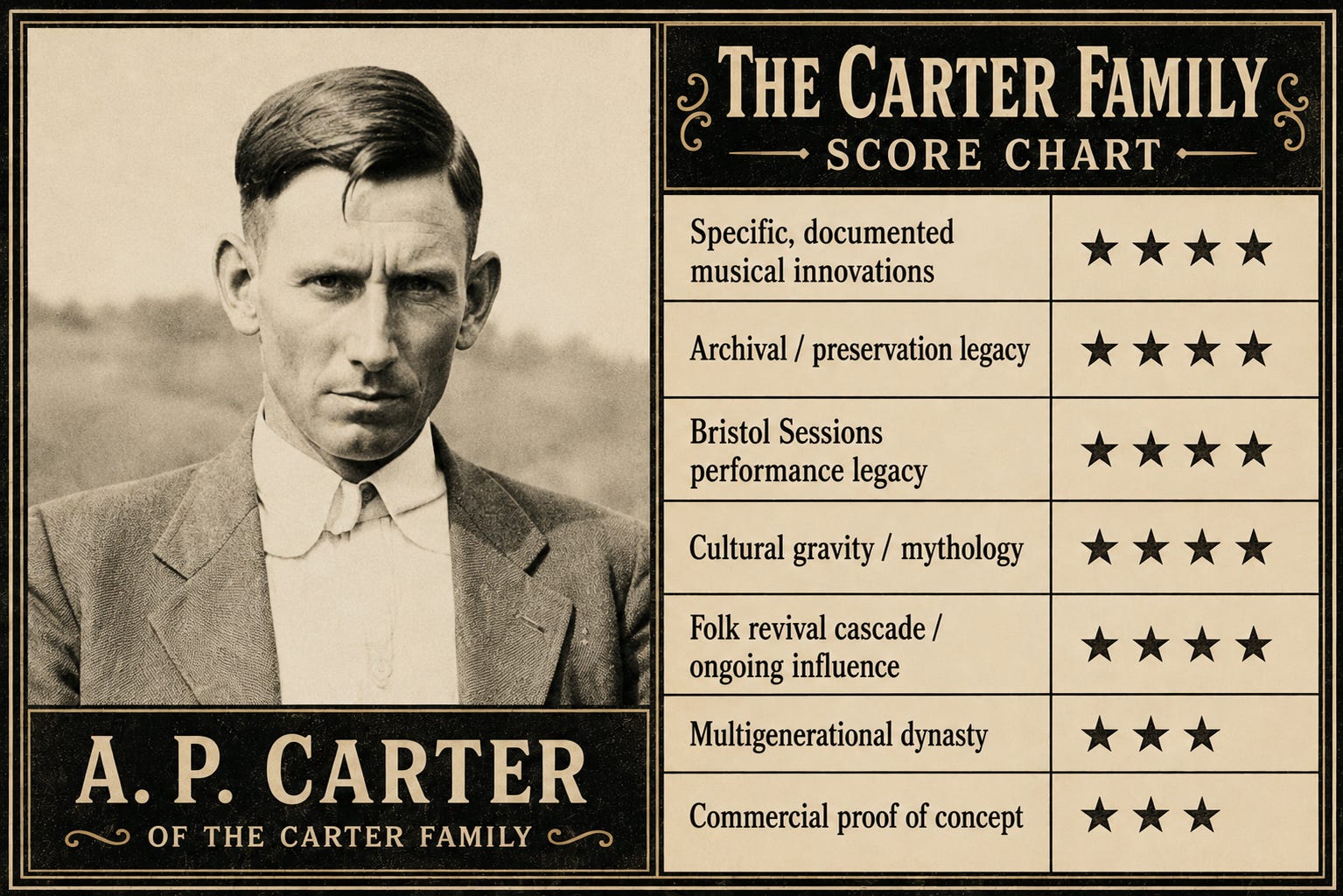
The Stonemans were first. They were there before Bristol, before Peer’s mythology machine, before the genre had a name. They built the largest performing dynasty in the history of country music by any structural measure. They were erased by a history that preferred a cleaner story, and they survived that erasure with more dignity than most families survive success.
The Carter Family changed how the music was made. Not just who made it, or when — but the physical language of the guitar, the preservation of the repertoire, the connection between Appalachian tradition and popular American culture. Their influence is not just historical. It is still inside the music every time someone plays a country song.
The Carters got the monument. The Stonemans built the road. The question is what you think a First Family actually owes you.
If it owes you priority — the literal first — the Stonemans win.
If it owes you innovation — a permanent change in the music itself — the Carters win.
If it owes you dynasty — blood, generation, continuation, the living embodiment of a tradition passed down — the Stonemans win.
If it owes you cultural weight — the reason the music has a story at all — the Carters win.
Country music history is not a single dynasty with a rightful occupant. It is a graveyard full of people who deserved better markers. The Stonemans have a small stone at the edge of the property. The Carters have the mausoleum.
That’s just how it is.
ABOUT THE AUTHOR:
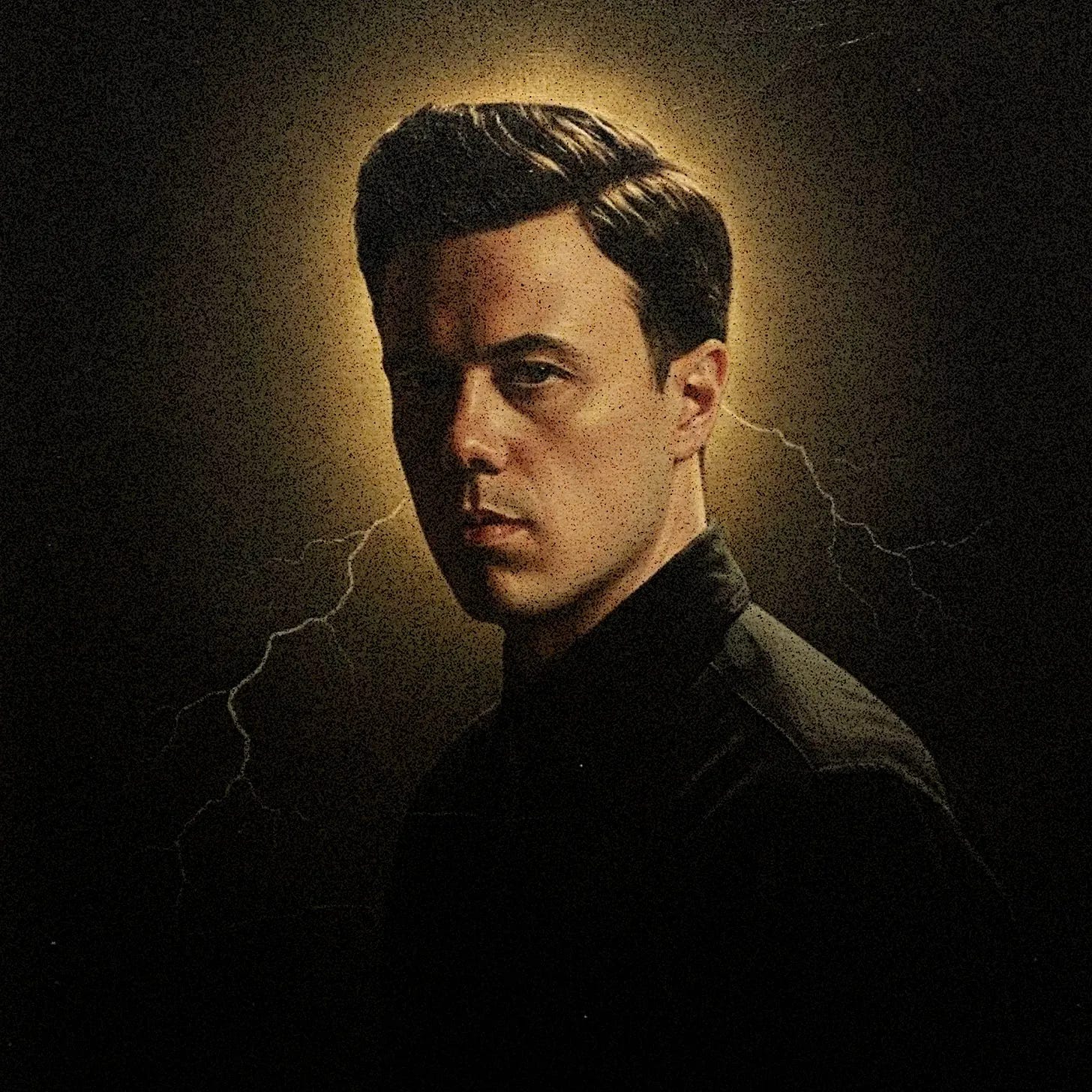
My name is Zachariah Malachi. I’m a full-time, self-employed honky tonk musician in Nashville, Tennessee. This Substack Publication was created for the purpose of sharpening my mind on more Nashville and Country Music history to share with the honky tonk patrons downtown during my shows - but I wanted more folks to benefit from the research so - it’s my gift to the country music fans of the world AND the people who WANT to be. Subscribe and come along for the ride.
With "The Sinking of the Titanic", the Stonemans also seem to have pioneered the type of historical songs popularized by Johnny Horton a few decades later.
My aunt was Tex Ann Nation, who was one of Merle Travis's wives and made records with him in the late 1940s. Country music history is interesting to me. Thanks!
An excellent breakdown of the argument. Thank you for your posts