


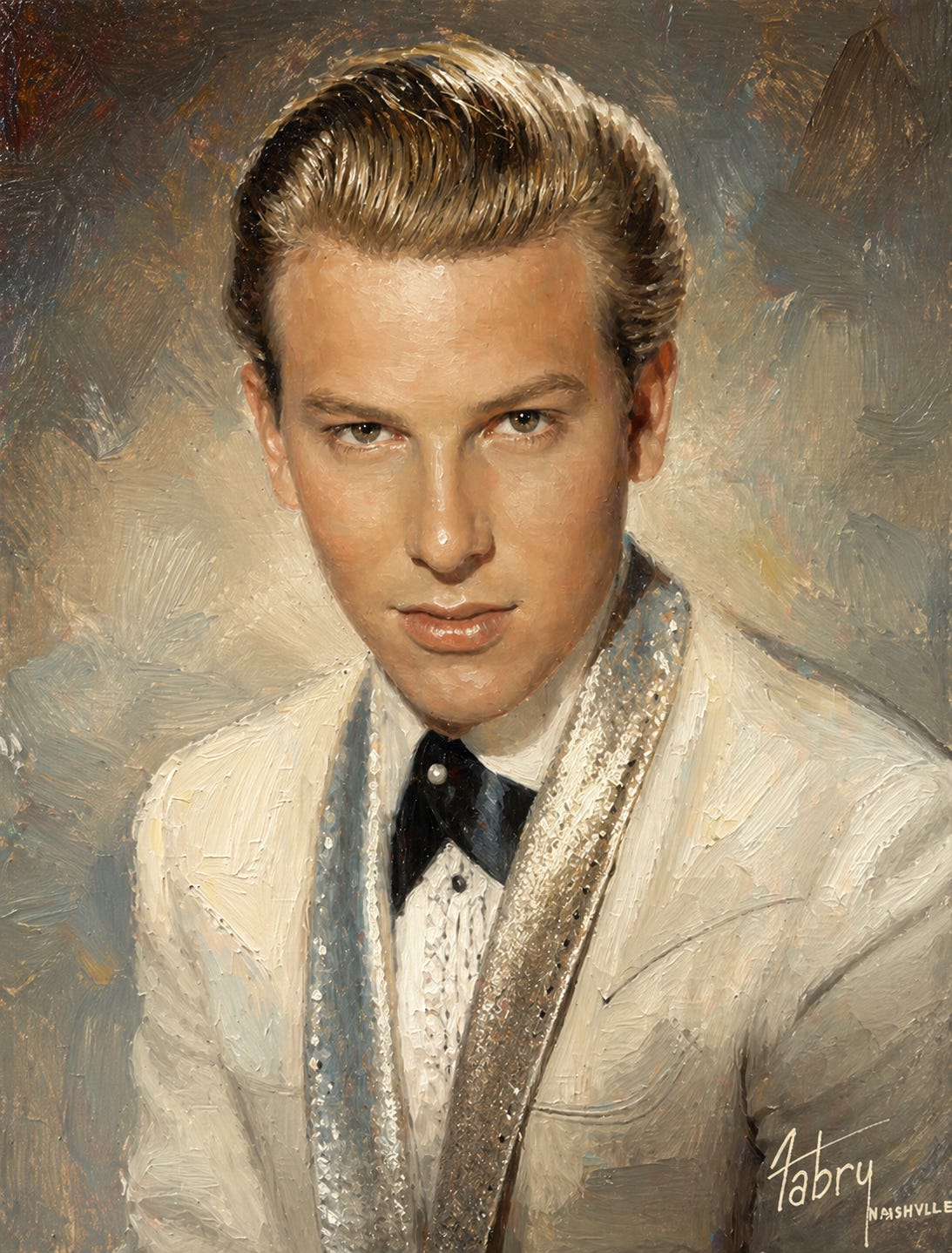
There’s a version of Hank Williams Jr.’s life that everybody knows. It’s the one with the beard, the dark sunglasses, the cowboy hat, the Monday Night Football theme, “A Country Boy Can Survive,” the rowdy friends settling down. That’s the Bocephus most people picture when they hear the name.
But that Hank Jr. — the one who finally got to be himself — didn’t really exist until after he fell off a mountain in 1975. Everything that came before was somebody else’s idea of who he was supposed to be. Mostly his mother’s. Sometimes his dead father’s. Almost never his own.
This is the story of those years. The kid years. The puppet years. The breaking-loose years. Birth to that 500-foot tumble down Ajax Mountain — the long, complicated, and frankly weird first act of one of country music’s most misunderstood figures.
A Boy Born Into a Shadow
Randall Hank Williams was born May 26, 1949, in Shreveport, Louisiana. His father — already country music’s biggest star and already coming apart at the seams — nicknamed him Bocephus after a ventriloquist dummy used by Grand Ole Opry comedian Rod Brasfield. There’s something almost too on-the-nose about that, isn’t there? A wooden dummy who only speaks when somebody else moves his mouth. The nickname stuck for life.
Hank Sr. and Audrey Mae Sheppard’s marriage was a war zone — booze, betrayal, restraining orders, and the kind of love that destroys both people involved. By the time little Randall was old enough to form a memory, his father was a ghost on a tour bus headed for a Canton, Ohio in the sky. On New Year’s Day 1953, in the back seat of that powder-blue Cadillac, Hank Sr. died at 29 of heart failure brought on by years of pills, whiskey, and an undiagnosed back condition that had him in agonizing pain since childhood.
Bocephus was three years old.
He doesn’t remember his father. Not really. He’s said as much in interviews for decades. What he remembers is the house full of his father’s records, his father’s clothes, his father’s guitars, and his father’s widow — and that widow had some plans.
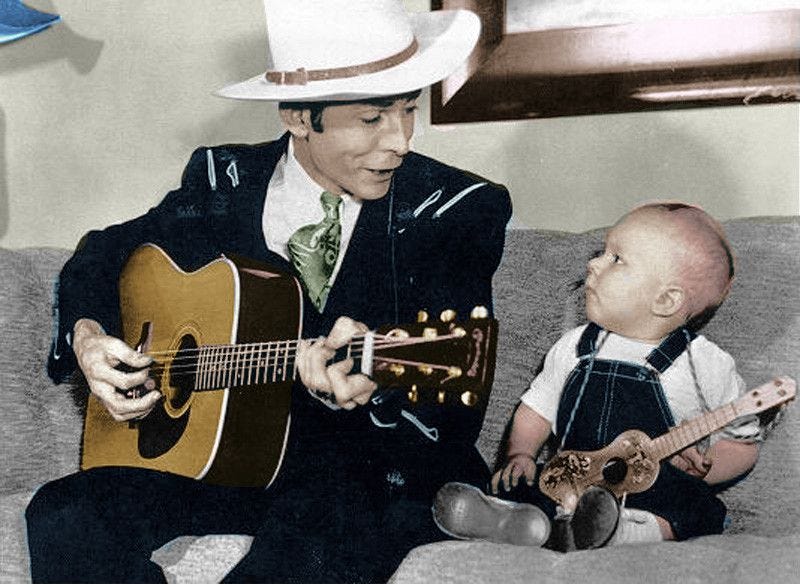
I have always thought these pictures were amazing. Little Bocephus and his daddy, gone too soon.
Audrey’s Master Plan
You can’t tell this story without telling Audrey’s, because for the first twenty-some years of Hank Jr.’s life, she essentially was the story. Audrey Williams was a woman who had been told, repeatedly and humiliatingly, that she couldn’t sing. She had wanted a career in country music more than anything, and Hank Sr. had carried her along on the strength of his own genius — but the records made it clear who had the talent and who didn’t. When he died, she lost not just a husband but the only vehicle she’d ever had for her own ambitions.
So she found a new vehicle: her son.
By the time Hank Jr. was eight years old, Audrey had him on stage doing his father’s songs. Eight. He played the Grand Ole Opry at eleven, in 1960, and the audience wept openly to see Hank’s boy up there singing “Lovesick Blues” in a voice that was already, eerily, his daddy’s voice. By fourteen he had a hit record — “Long Gone Lonesome Blues,” 1964, which is one of his father’s songs, of course, because in those days he wasn’t allowed to be anything but a junior.
That same year MGM made the biopic Your Cheatin’ Heart with George Hamilton playing Hank Sr. Hank Jr. — fourteen years old — sang every song on the soundtrack. He was, in a very real and very strange sense, ghost-singing for his own dead father in a movie about his father’s life, while his mother stage-managed the whole production.
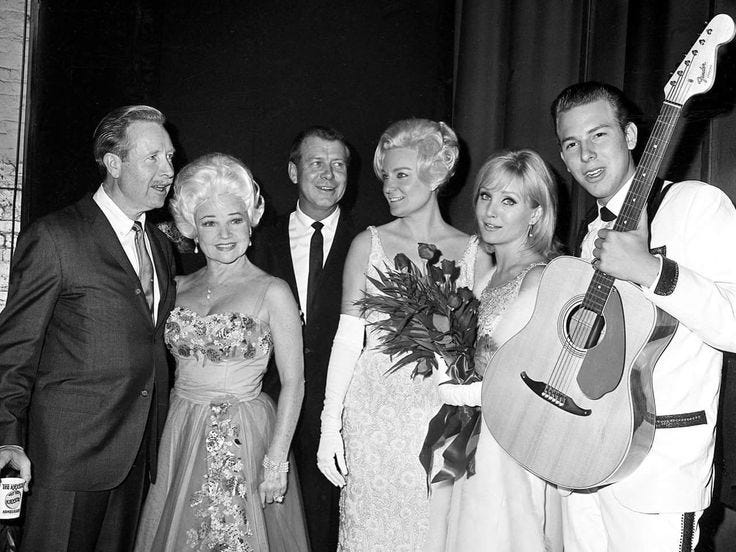
Arthur O'Connell (actor), Hortense Petra, Gene Nelson, Audrey, Susan Oliver (actress) and Hank Jr at the Loew's theater for the premiere of "Your Cheatin' Heart" on November 6, 1964.
The relationship between Hank Jr. and Audrey was the central fact of his childhood, and it was poisonous in the way that controlling-mother relationships can be — the love was real, the damage was real, and he couldn’t separate the two until much later. She drank. She spent money like it was on fire. She put her grief and her thwarted ambition on his shoulders and called it inheritance. By the time he was a teenager, he was making money she was burning through, singing songs he hadn’t written, dressed in suits picked out to remind audiences of a man he’d never known.
He has said, more than once, that he loved her. He has also said that she nearly killed him. Both things are true.
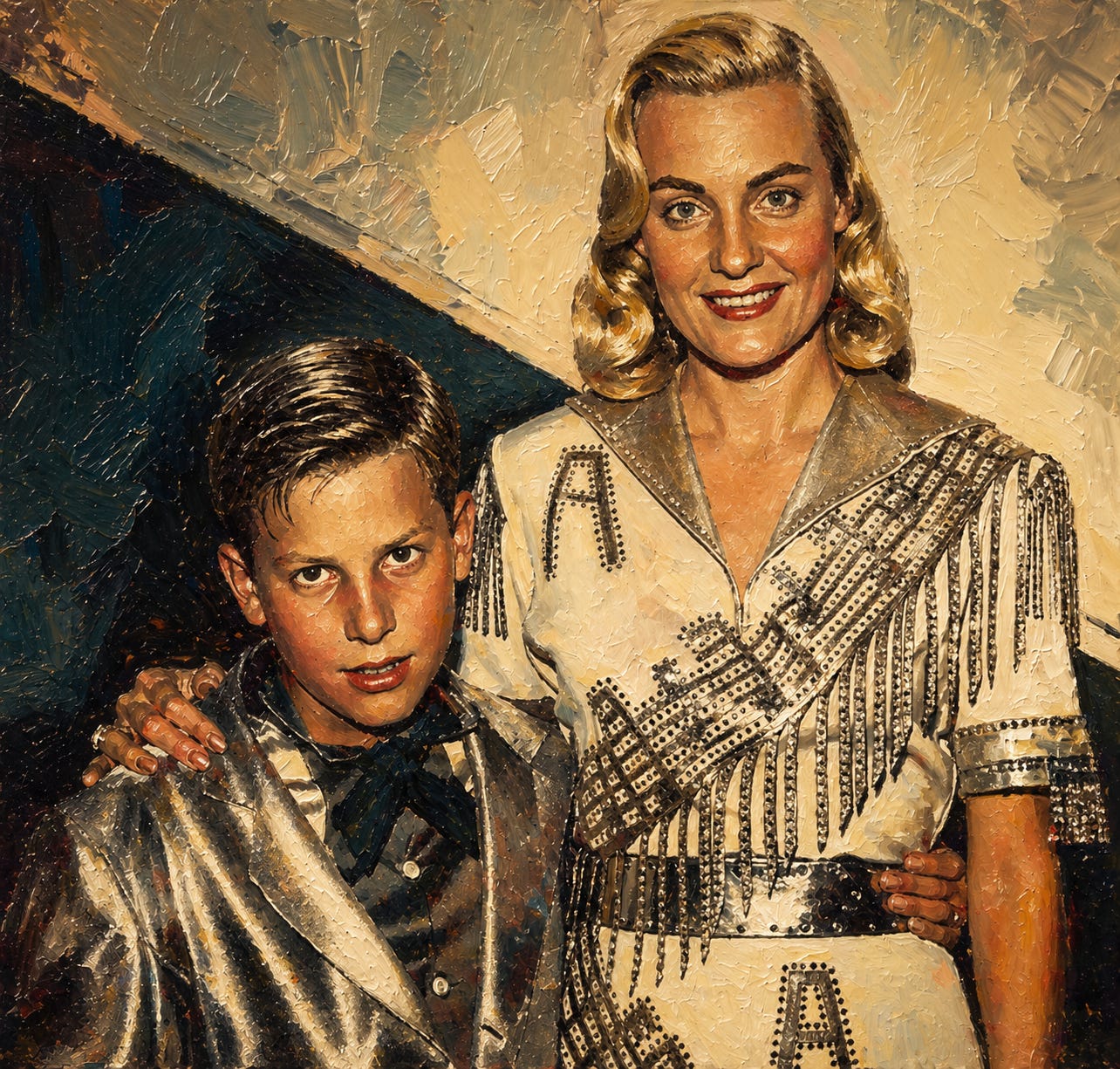
Young Bocephus and his mother, Ms. Audrey (what many called her). I have great respect for her, personally - regardless of what many people feel about Audrey Williams. I couldn’t imagine a Hank story without Ms. Audrey.
The Older Brothers He Picked Up Along the Way
Here’s the thing that saved him, I think: the country music world in the 1960s was small, and the men who had known and loved his father took an interest in the boy. Not in the puppet — in the boy.
Johnny Cash would come around. Waylon Jennings would come around. They’d take him fishing, take him out, treat him like a person and not a museum exhibit. But the two relationships that mattered most in those years were with Jerry Lee Lewis and Merle Kilgore.
Jerry Lee Lewis was a cousin-of-a-cousin in the cosmic sense — another Louisiana boy, another ferocious talent, another man whose appetites would eventually outrun him. Jerry Lee was a decade and change older than Hank Jr., and he treated him like a kid brother who needed corrupting. Which is exactly what a teenage boy raised by a controlling stage mother needs, frankly. Jerry Lee taught him things Audrey did not approve of — about pianos, about pills, about women, about not giving a single solitary damn what anybody thought. The Killer was a terrible influence and exactly the right one. Hank Jr. has talked over the years about playing piano with Jerry Lee, drinking with Jerry Lee, surviving Jerry Lee. Their friendship was real and lifelong.
— PS — I have A LOT to say about Jerry Lee Lewis, and that’s going to have to be in an article to come because.. it’s gonna be A LOT.
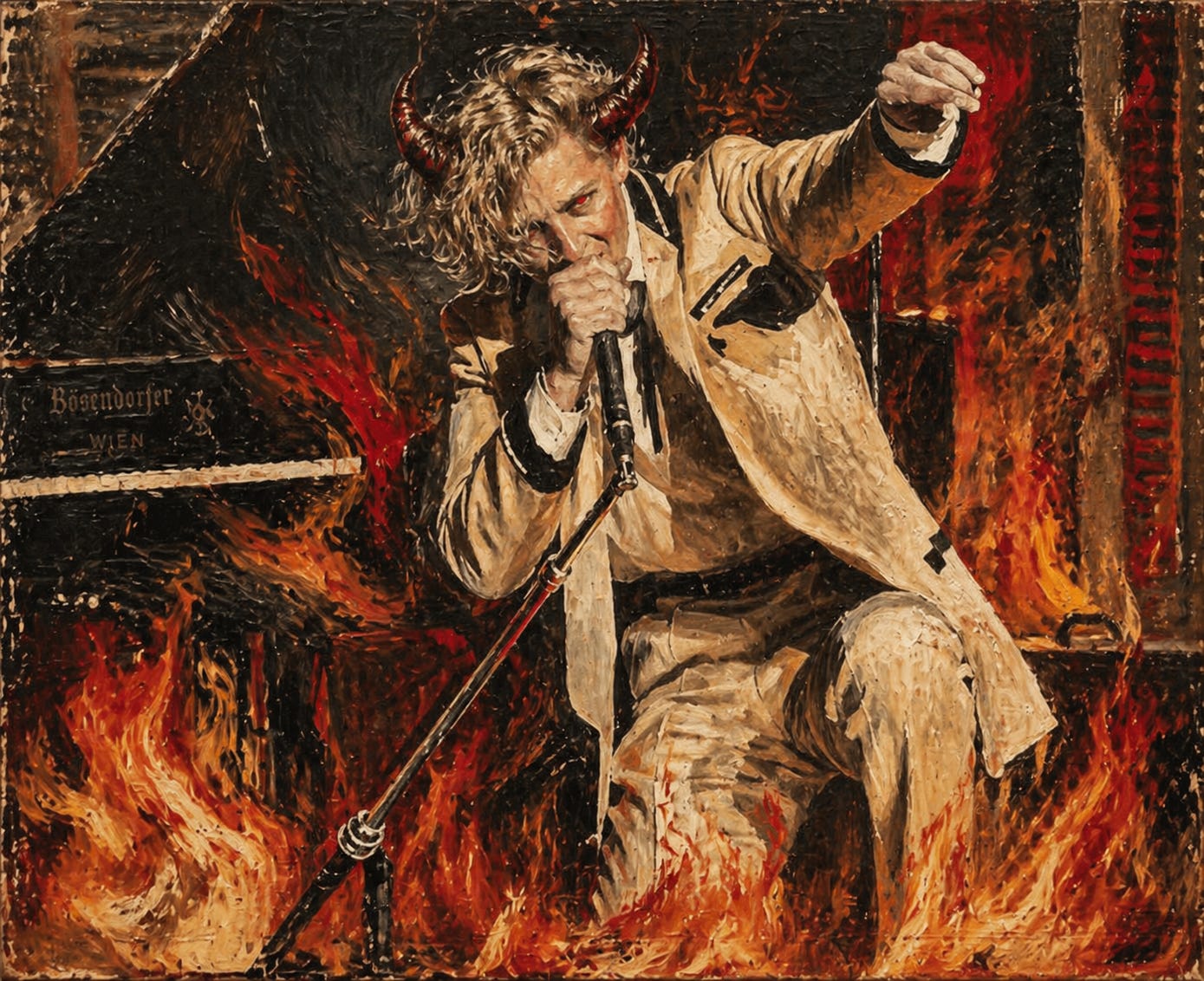
Yes, it’s Jerry Lee Lewis as the Devil. Why? Because — in lore, it’s not far off. Is that how I personally feel? No. But, man.. is it a good story to make people believe he may have been.
Merle Kilgore was the other one — and Merle is the unsung hero of this whole story. He was a songwriter (co-wrote “Ring of Fire” with June Carter, among other things), a Louisiana boy too, a larger-than-life character who became Hank Jr.’s manager, mentor, big brother, surrogate father, and best friend, and stayed in those roles for the rest of his life. When Audrey was suffocating Hank Jr. with the past, Merle was patiently telling him there was a future. When the suits at MGM wanted more of the same, Merle was quietly encouraging him to go off and find his own sound. When Hank Jr. needed someone to just be his guy — to take the calls, run the road, watch his back, tell him when he was being an idiot — that was Merle. The bond there was the real thing, and it lasted until Merle’s death in 2005.
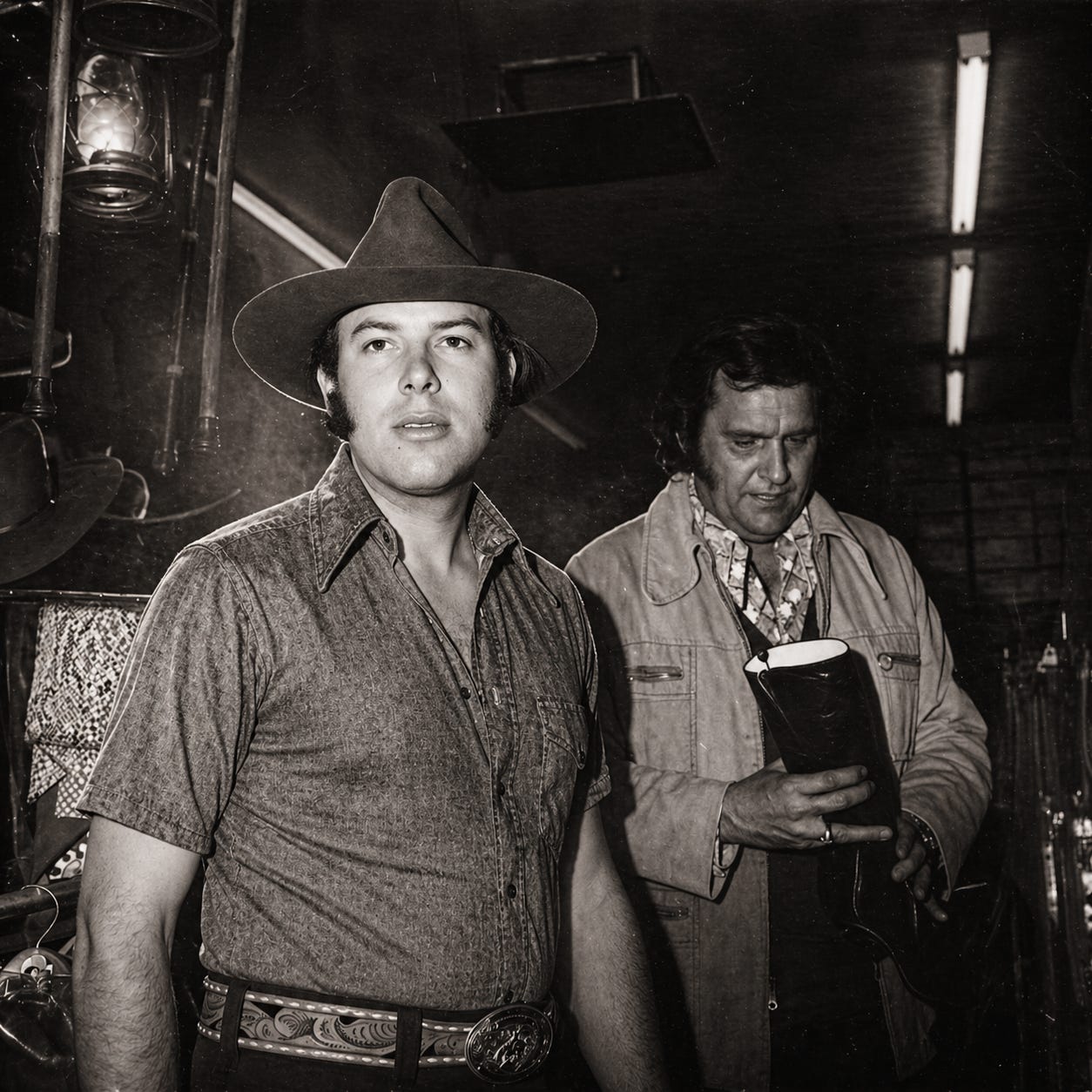
Hank Jr. and Merle Kilgore at Nudie’s Rodeo Tailors in Hollywood, California - 1973
If Audrey was the chain, Merle and Jerry Lee and Cash and Waylon were the older brothers and uncles who slowly, year by year, helped him saw through it.
Music Shenanigans
The music itself was a strange ride in those years. Officially, he was MGM’s Hank Williams Jr., the dutiful son carrying on the legacy. He cut record after record of his father’s material and his father’s style. The label loved it. Audrey loved it. Audiences loved it — especially the ones who had loved Hank Sr. and wanted to feel that ache one more time.
But Hank Jr. did not, in fact, love it. By his late teens, he was sneaking off into other rooms — literal and figurative. He played piano like Jerry Lee. He listened to Southern rock as it was being invented. He was hanging around with the Allman Brothers crowd, with the Marshall Tucker Band crowd, with Charlie Daniels. He played a mean blues. He could pick up just about any instrument in the room and make it work out for him — guitar, piano, fiddle, dobro, harmonica, drums. People used to think I was like that. Ha. No, Nashville humbles you greatly. But Hank Jr. He WAS/IS like that.
There were the usual shenanigans of a young, rich, famous, undersupervised musician in Nashville in the late ‘60s and early ‘70s. Drinking. Pills. Wrecked cars. Wrecked relationships. He married Gwen Yeargain in 1971, and they had a son in 1972 — Shelton Hank Williams, who you and I know as Hank Williams III — the ultimate crazed-country rebel — who looks so much like his grandfather it can give you the cold sweats. That marriage didn’t make it; they divorced in 1977.
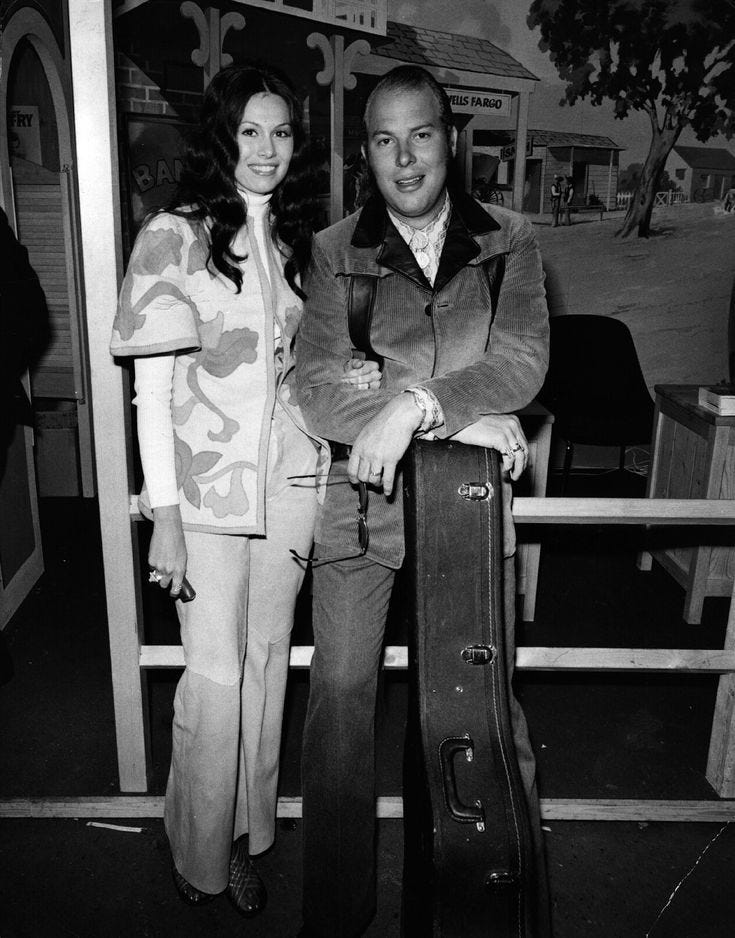
Rockin’ Randall Hank Williams Jr. and his first wife, Gwen Yeargain.
He had hits in this period — real ones, not just covers. “Standing in the Shadows,” from 1966, is one of the most affecting things he ever recorded, a song he wrote himself about exactly what he was living through: trying to be a man while everyone around him saw only his father’s outline. “All for the Love of Sunshine” went to number one in 1970. He was a working country star with a working country career. He just wasn’t, on the inside, anywhere close to okay.
What He Thought About His Father
This is the part that’s hardest to pin down, because Hank Jr.’s feelings about his father in those years were tangled up with his feelings about his mother, and his feelings about the audience, and his feelings about the music business that was using him, and his feelings about himself.
He revered Hank Sr. He had to. He’d been raised in a temple where the saint never had to come down off the wall and be a person. But he also resented the hell out of him — for dying, for leaving, for casting a shadow so long that there was nowhere a boy could stand and see the sun.
The songs from this era hint at it. “Standing in the Shadows” is the obvious one. Listen to that song now, knowing what you know, and it will rip your heart out. He’s not raging at his father — he’s pleading with him. He’s saying, I’m trying. I’m trying to be your son. I’m trying to be my own man. I don’t know how to do both.
The relationship with his father at this point in his life wasn’t a relationship at all. It was an absence shaped like a man, and everywhere he looked, somebody had filled in the outline with their own expectations.
The Breaking Point
In 1974, after years of being managed, marketed, prescribed, drunk, divorced, depressed, and squeezed from every direction, Hank Jr. tried to kill himself. Pills. He was 25 years old.
He survived. And in the long, ugly aftermath of that, something shifted. He pulled away from Audrey — who would die in 1975, the same year as the fall, broke and bitter and largely estranged. He leaned harder on Merle. He started making the album that would, finally, sound like him.
“Stoned at the Jukebox” is by far my favorite tune off of this record. Dig it.
That record was Hank Williams Jr. and Friends, released in 1975. He brought in Charlie Daniels, Toy Caldwell from Marshall Tucker, Chuck Leavell — the Southern rock crew. He played piano and guitar. He sang in his own voice, not his father’s. The album wasn’t a smash on release, but it was a declaration of independence, and everybody in the business who heard it understood that something had changed. The puppet had cut its own strings.
He was about to find out how much further down he could fall before the climb would start.
August 8, 1975
He was hiking in the Bitterroot Mountains in Montana — Ajax Peak — with a friend. Snow on the ground in places, loose scree in others. He stepped on the wrong patch and went over the edge.
He fell more than 500 feet.
His face hit a rock. His skull was split open. His forehead was crushed. He was conscious enough at the bottom to know he was dying. By all rights and physics, he should have. The fact that he didn’t is one of those stories that makes you think twice about whatever you happen to believe about why people are kept here.
The reconstruction took years. Multiple surgeries. They rebuilt his face essentially from scratch. The beard and the sunglasses and the hat that became his trademarks weren’t a costume choice — they were a way of living with what was left. The man who finally walked back out into the world looked nothing like the boy who’d fallen, and looked nothing like his father, and that, in the end, may have been the most important gift the mountain ever gave him.
When he came back, he was Bocephus. Not the ventriloquist’s dummy. The real one. The one who would, over the next decade, remake country music in his own image and finally — finally — get to be a man with a name of his own.
But that’s the next chapter, and that’s the chapter most people already know.
This one — the one before the fall — is the one I keep coming back to. Because everything Hank Jr. became, every Monday Night holler and rowdy-friend anthem, every defiant chord and middle finger to Music Row, every honest note he ever sang — all of it was paid for by the boy who spent the first 26 years of his life wearing somebody else’s face.
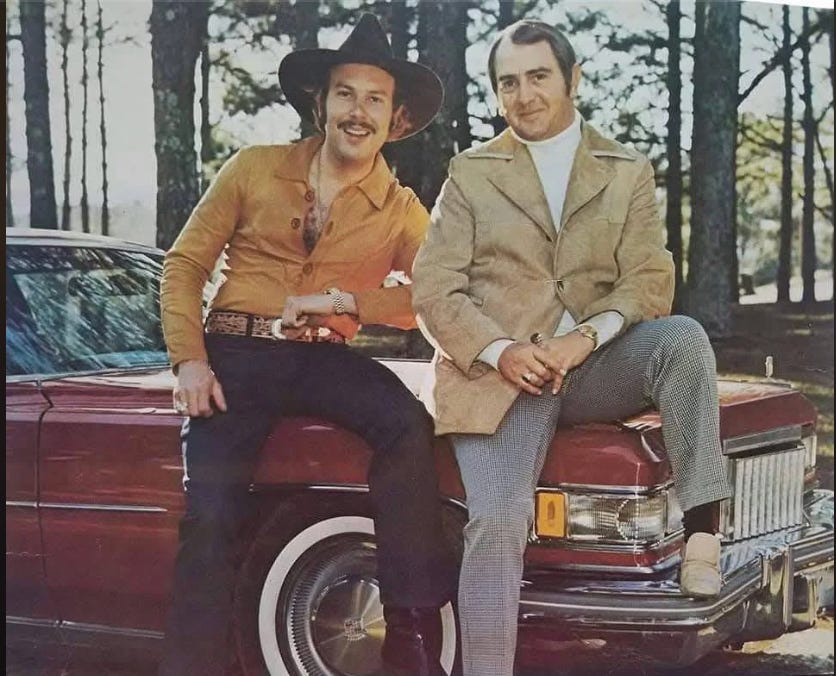
Here’s Jr with his Montana buddy, Dick Walley. This photo may be the last photo taken of Hank Jr. while his face still looked like this.
A Personal Note
I want to say a few things from my own corner of the room, because I think this story matters more the longer you sit with it.
I’ll be honest — I didn’t always like Hank Williams Jr. For a long time I couldn’t hear past the rowdy-friends caricature, the football-night version, the guy who’d become a kind of cartoon to people who’d never bothered to dig in. But age does something to your ears. Time does something to your ears. And somewhere along the way I went back and listened to the catalogue — really listened — and I had to admit I’d been wrong. It’s brilliant. It’s all brilliant. The early stuff, the middle stuff, the rough stuff, the swagger, the heartbreak, the gospel, the blues. The man made a body of work, and most of us slept on it.
Here’s what I believe now, and I’ll plant a flag on it: Hank Williams Jr. spoke the words his father couldn’t record. Hank Sr. died at 29. He didn’t get the years to say what a man finally figures out he wanted to say. Hank Jr. got those years — got the decades his daddy never had — and used them. The obvious differences between the two of them are the easy thing to point at, but they’re more alike than most people can admit. Same hurt. Same honesty. Same refusal to make the song any prettier than the truth was. In a real and unsentimental way, I think Hank Jr. did pick up where Hank Sr. left off. Not by imitating him — that part was Audrey’s project, and it nearly killed him — but by finally being honest the way his father had been honest, in his own voice, on his own terms.
And I think Bocephus is the byproduct of two men more than anyone else: his daddy and Jerry Lee Lewis. That’s a hell of a dynamic to be carrying around inside one body. The lonesome hillbilly poet on one shoulder and the wild-eyed Louisiana piano-pounding outlaw on the other. You hear both of them in everything he ever cut. The ache and the grin. The hymn and the holler. That’s not a contradiction — that’s the man.
The last thing I want to say is this: I’m grateful he made it into the Country Music Hall of Fame while he was still here to see it. Recognition that comes after a man is gone is a kindness to history, but recognition that comes while he can stand up and feel it — while he can know his work was understood — that’s a kindness to the man himself. Bocephus earned that. The boy who spent his childhood being somebody else, who fell off a mountain and rebuilt his own face, who fought for the right to sing in his own voice — he deserved to live long enough to be told he’d done it. And he was.
That, to me, is the real ending of the story that started in a Shreveport hospital in 1949.
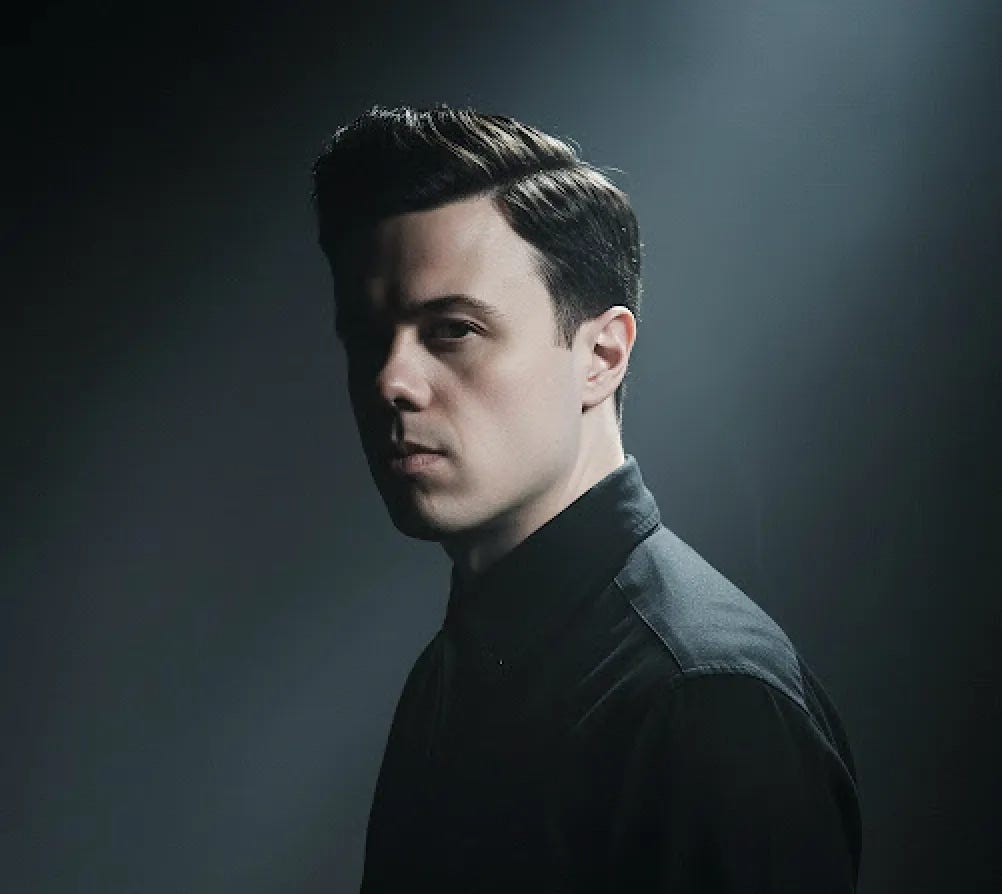
Zachariah Malachi — known as The Count of Country Music — is a singer, musician, actor, and writer based in Nashville, Tennessee. He works somewhere in the tradition between Hank Williams and the end of the world, and has a particular interest in the parts of country music history that the Hall of Fame keeps in the back room. Between working as Johnny Cash, Conway Twitty and Jimmie Rodgers in Nashville-production CountryRoadsUSA and playing music live 6+ times a week on Nashville’s Lower Broadway. He loves the dark and has been known to shapeshift..?
It was a while before age and time and the interweb did something to my ears too. In the last few years, I've seen some relatively recent acoustic duets and solos where Hank, Jr displays truly jaw-dropping singing talent, with unique "melismas" I think they are called.... perfect pitch, seamlessly meshing his voice with his awesome guitar playing. Well, he got it honest.
I’m from northwest Tennessee. Hank Jr. moved there when I was a kid. He had a club in Paris, TN, and his shows there were a big deal. Like you, I wasn’t a fan, but I’ve come around on him, too. I’ve heard some pretty funny stories about his interactions with the locals, although I never met him personally.