


I was maybe seven years old, sitting in the back of my Papaw’s 1974 Cadillac Eldorado. Navy blue. Long. The kind of car that made you feel like you were riding on a ship made of chrome and ambition. It sat in the driveway of his place in a 50s Detroit subdivision, and I remember the scorched-flesh feeling on the back of my legs when I’d sit on those dark leather seats in August. The car was mint—original, except for maybe some back paneling that needed to be replaced. Papaw loved that car the way some men love their children.
He had a box of 8-tracks in the backseat. Jerry Reed. Porter and Dolly. And Charley Pride. He’d let me choose the soundtrack for our drives, and I’d reach back there with my small hand and pull out whichever one called to me. Papaw loved Charley Pride. And who couldn’t? That smooth baritone voice, distinct and different—singing songs that he had given life to for the first time, and recharged hits like “Louisiana Man” and “Kaw-Liga” with something that felt true.
I didn’t understand then what it meant that my Papaw, a man in a Detroit subdivision in the 1970s, loved Charley Pride so freely. I just knew the music was good. I just knew that voice filled that car the same way the summer heat did. I didn’t know I was witnessing something that should have been impossible. Something that the machinery of American music had tried very hard to prevent.
I think about that Eldorado sometimes when I’m down on Lower Broadway. Charley Pride has become a part of my standards here, as he should be for anyone who calls themselves a country music artist in this town. When you sing country music in Nashville, you’re standing on the shoulders of giants. And Charley Pride is one of the giants. One of the biggest. He was so big that at one point, he outsold Elvis at RCA. That’s right. In RCA’s own house, on the biggest label in America, Charley Pride was moving more records than Elvis Presley.
A country music history without Charley Pride is American History without Abraham Lincoln. That’s not hyperbole. That’s arithmetic.
But to understand what that achievement really cost—what it took for him to get there—you have to understand the machinery that had to be built to make it possible.
The Architecture of Impossibility
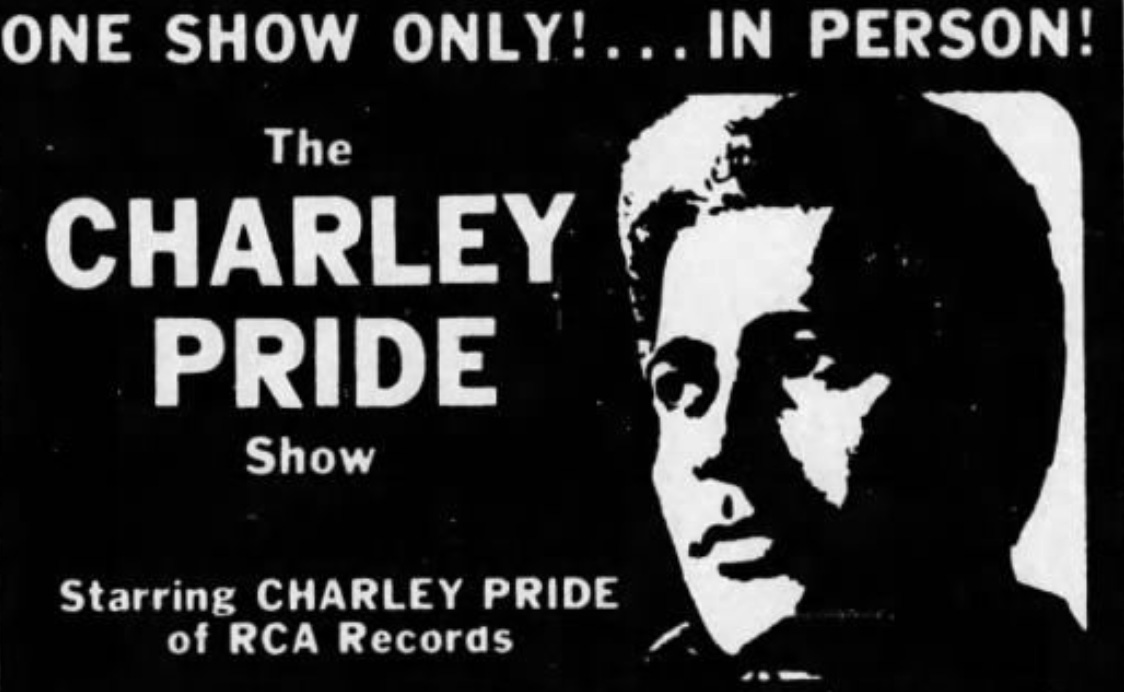
In the 1960s and early 1970s, the very idea of a Black country superstar was a kind of violence against the genre’s self-image. Country music belonged to rural America, according to the gatekeepers. It belonged to pickup trucks and sharecroppers’ sons. But apparently not to actual sharecroppers’ sons who happened to be Black.
Charley Pride was born in Sledge, Mississippi, in 1934. Cotton country. His father was a sharecropper. He grew up listening to the Grand Ole Opry on his family’s radio—the same Hank Williams, the same Ernest Tubb, the same honky-tonk tradition that every white country artist claimed. And when he finally got to Nashville in 1963, the city was on fire. Sit-ins. Racial violence. The moment in American history when we were being forced to confront what we actually were.
So when Charley Pride walked into the Cedarwood Publishing building on Music Row and asked for an audition, he was asking to do something that the music industry had decided—quietly, institutionally, completely—was not supposed to happen.
The Blank Label
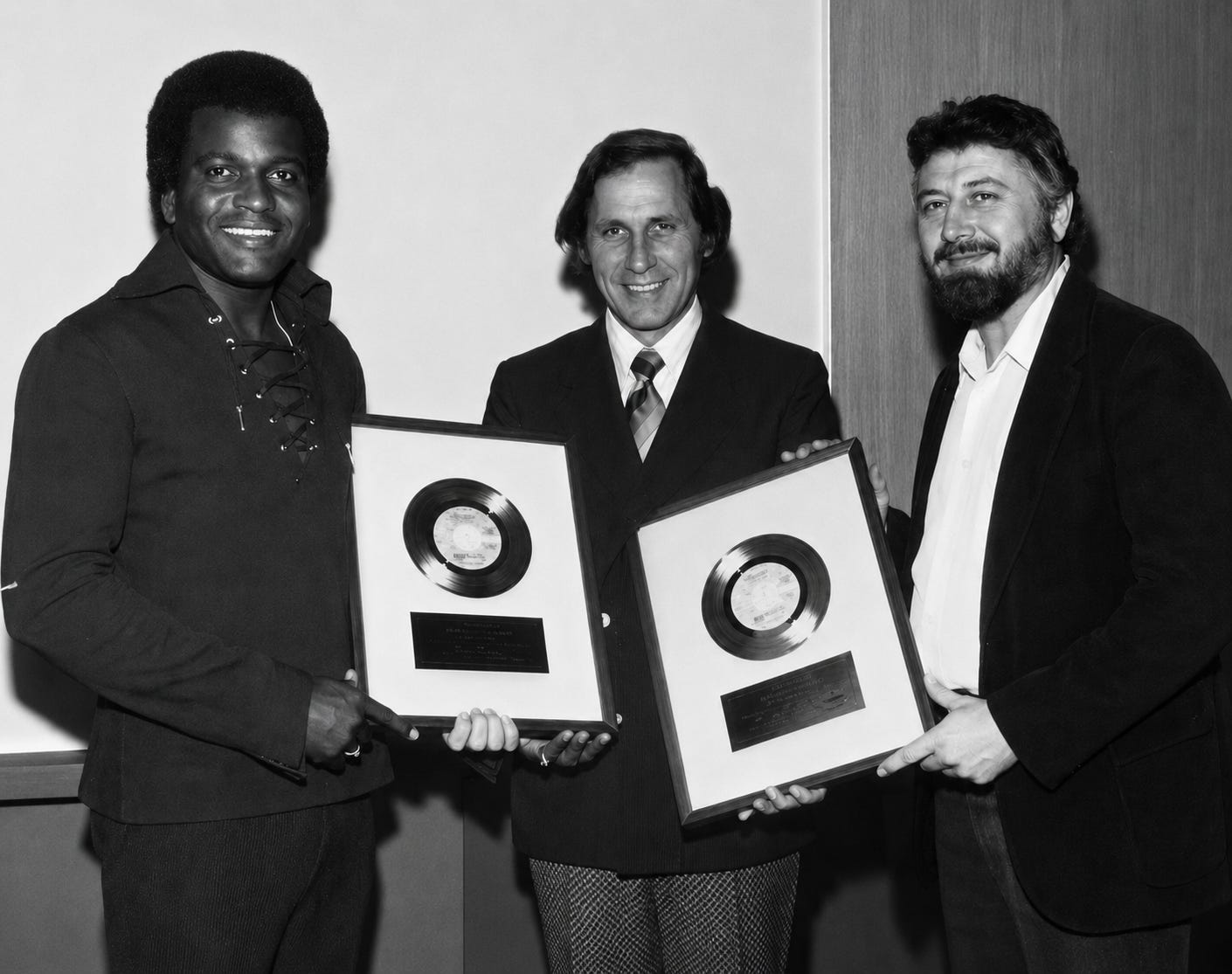
Pride’s break came through Cowboy Jack, a legendary producer who saw something in him. Clement took a demo to Chet Atkins, RCA’s Nashville chief. Atkins listened. And he was moved. He flew to the West Coast to convince the label brass to sign Pride.
But Atkins didn’t mention one thing until after the contracts were signed. Pride was Black.
Think about that. The music was good enough to sign. Good enough to invest in. Good enough to stake credibility on. But not good enough to be honest about it from the start. That tells you everything about what they believed and what they were afraid of.
When “The Snakes Crawl at Night” (written by Mel Tillis) shipped to radio stations in December 1965, the records came with blank labels. No photo. No biographical information. Just the music and a name. The logic was crude and transparent: if the DJs didn’t know what Pride looked like, they might spin the song. Once it took hold, once it had momentum, then the truth wouldn’t matter as much.
This wasn’t protection. This was capitulation. It was RCA’s way of saying: Your music is good enough for us to profit from, but not good enough for America if they know your face. And Charley Pride had to accept that bargain because that was the only way in. That’s what you need to understand. He didn’t break the system. The system broke him into it, piece by piece, on their terms.
So, How Many Giants Does It Take?
Blank labels only go so far. Radio DJs were gatekeepers, and gatekeepers could still say no. So RCA made a decision: they would assemble the most powerful names in Nashville production and put them all on one man’s records.
On albums like Songs of Pride, Charley That Is (1968) and Make Mine Country (1968), four names appeared as producers: Chet Atkins, Jack Clement, Bob Ferguson, and Felton Jarvis. These weren’t figurehead credits. These were the men who built the Nashville Sound. Atkins had made Jim Reeves. Atkins had made Skeeter Davis. Clement was Nashville royalty. Ferguson had his hands on some of the biggest records in country history. Jarvis was a legend in his own right.
When all four of their names appeared together on a Charley Pride album, it was a message to every radio programmer in America: We believe in this. All of us. Together.
Here’s what that really meant: We need all four of Nashville’s biggest names to make anyone listen to a Black country singer.
One name wasn’t enough. Two wasn’t enough. Three wasn’t enough. It took four. It took all of the firepower. It took every ounce of institutional credibility Nashville had to spare, stacked on top of one man’s voice.
And it worked. But listen to what that success required. It required multiple giants to vouch for one voice. It required the accumulated weight of the establishment to create just enough space for him to exist.
To be honest, that still bothers me.
Willie Nelson and the Kiss
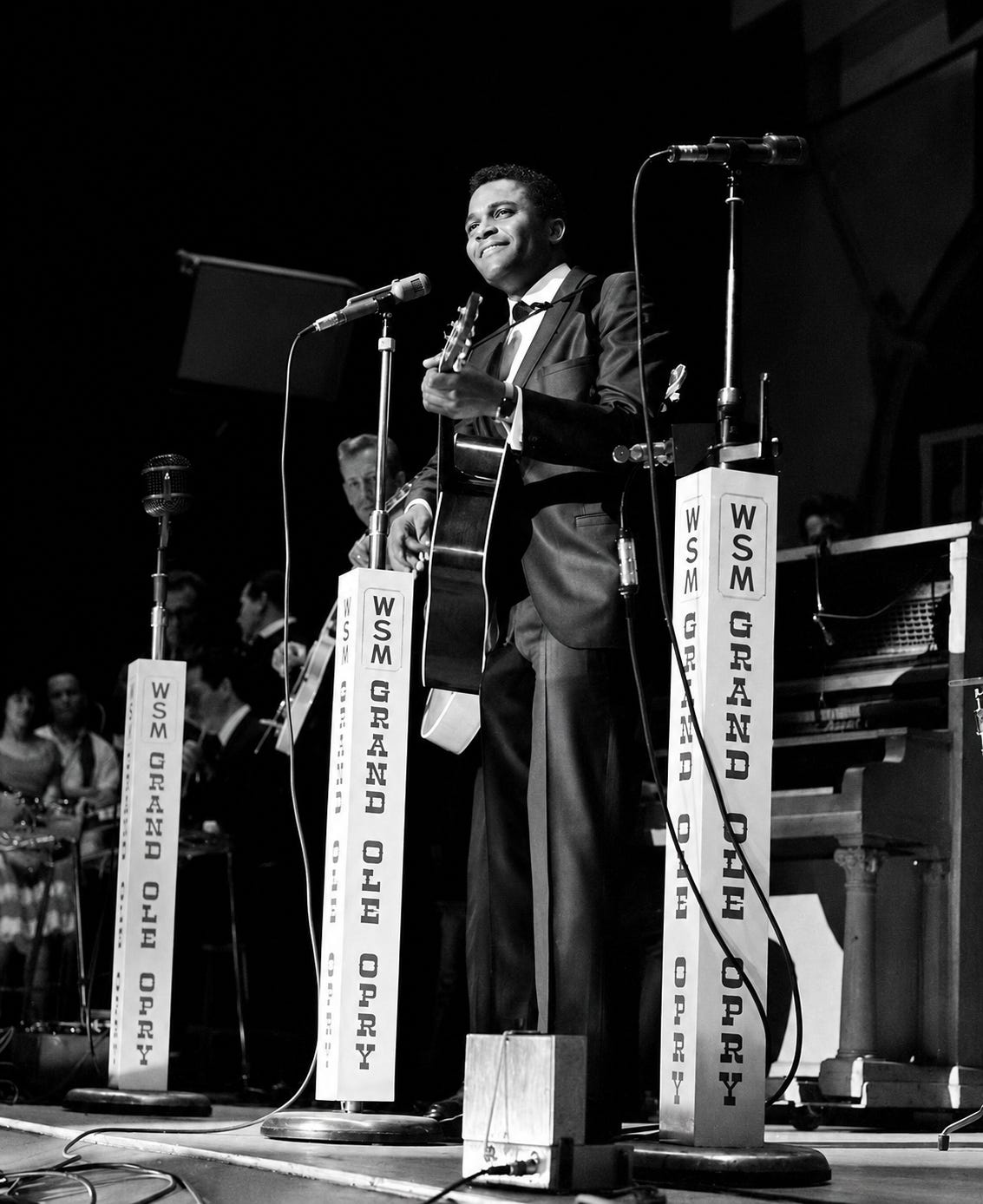
By the late 1960s, Charley Pride had momentum. He’d made his Grand Ole Opry debut on January 1, 1967—the first Black performer on that stage since DeFord Bailey in the 1920s. The moment was significant. The silence when he appeared was significant. Audiences would applaud before they saw him, then came that intake of breath. That moment of recognition. Then, sometimes, the applause would return.
But applause like that—conditional, surprised, earned through shock—isn’t the same as acceptance.
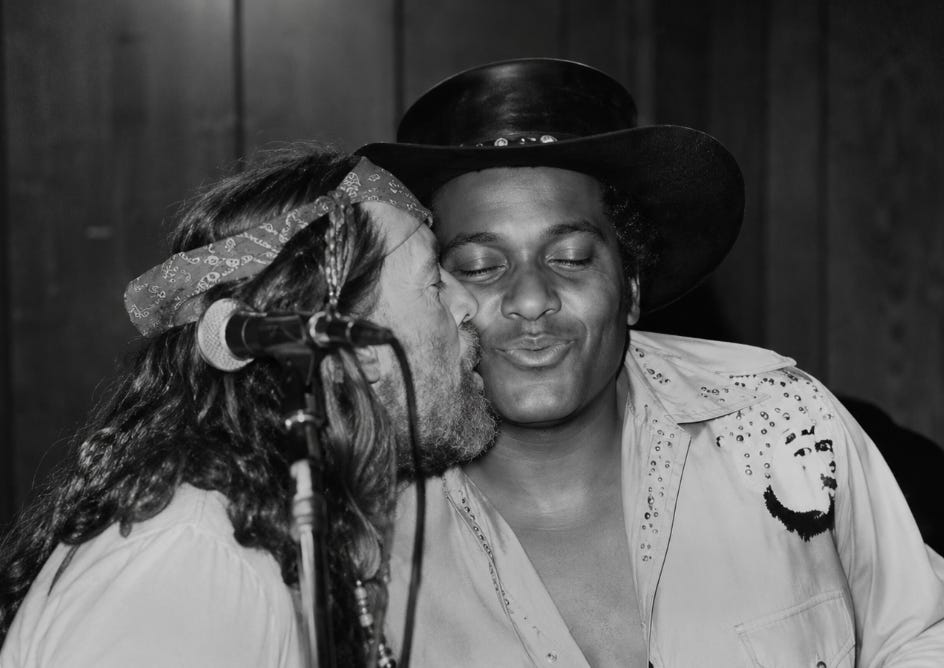
Then one night in Texas, at the Big D Jamboree in Dallas, something happened that seemed small but registered in the long run of things as.. quite seismic.
Willie Nelson walked onstage, over to Charley Pride, and kissed him on the lips. Full on the mouth. In front of everybody. Then he walked off.
The gesture hung in the air like smoke. It was a physical endorsement with a clarity that words could never achieve. Nelson was already a significant figure in country music. And he was saying, with his body, with this public intimacy: This man is my brother. This is country music. If you have a problem with that, that’s your problem.
It was the kind of moment that forced people to confront not the music, not the voice, but their own assumptions about what belonged where and who got to decide.
I think about that kiss. I think about what it meant that Willie Nelson had to do that. That it mattered that much. That one man kissing another man on the lips had to serve as proof that a Black man belonged in country music.
Lloyd Green and the Lawrence Welk Show
Television was a different beast altogether back then. On the radio, people could imagine Charley Pride. They could project whatever image felt safe onto that voice. On television, the collision was unavoidable. It would happen in living rooms across America, all at once.
Pride made his network television debut on the Lawrence Welk Show in 1967. But before he went on, he asked for something: he wanted Lloyd Green with him. Green was a Mississippi native like Pride, one of the finest steel guitar players in Nashville. They’d been making music together since the early sessions in 1966. But Pride’s request carried a weight that neither man probably wanted to articulate.
He wanted a white musician standing beside him on national television. Not to minimize his own presence, but to provide evidence. Proof that they made music together. A visual counterargument to every assumption America would make the moment they saw his face.
The producers agreed. On the Lawrence Welk Show, Pride was positioned in the frame with Lloyd Green, and in that positioning, viewers understood something: Black and white musicians were making country music together. The image was as important as the song.
I want you to sit with that for a moment. That’s what it took. That’s the calculation he had to make at every threshold. It wasn’t enough to sing well. He had to manage how he was seen. He had to arrange the stage. He had to position allies. He had to create visual proof of his belonging.
Every threshold required negotiation. Every room was a room he had to talk his way into.
Detroit: Ralph Emory and the Silence
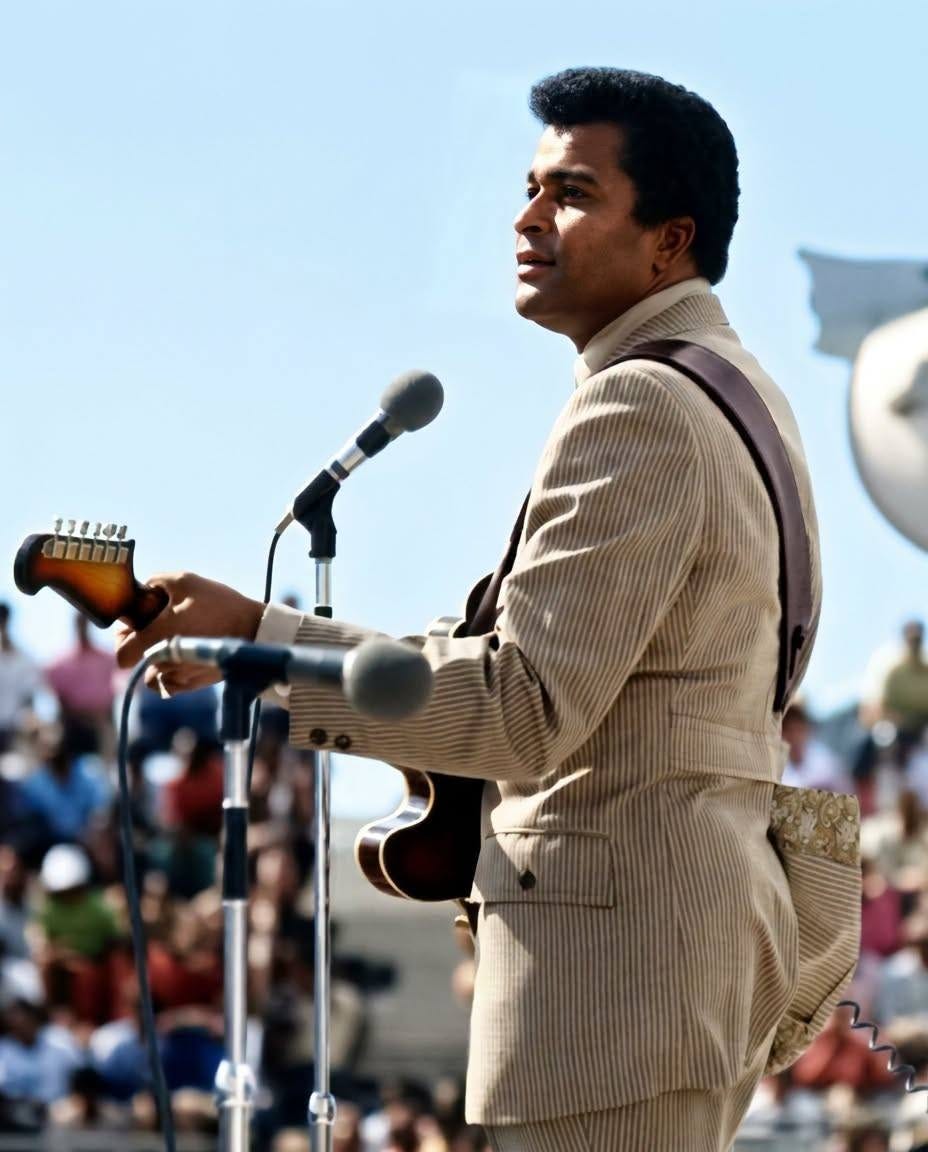
Ralph Emory was one of Nashville’s most powerful DJs, a man of the establishment (Go back to the Roger Miller Terrorizing Ralph Emory article). He had institutional weight. When he introduced Charley Pride at his first show in Detroit, that introduction was a credential. It was institutional permission.
The audience applauded as Pride took the stage. Then they saw him. The applause stopped.
In that silence, something happened. Pride didn’t fill it with anger. He didn’t pretend it wasn’t there. He acknowledged it directly:
“I realize that I’ve got that permanent tan, but my name’s Charley Pride and I am from Mississippi, my daddy was a farmer down there. And I sing country music. I want to entertain you if you’ll let me.”
He was naming it. Yes, I’m Black. We’ve established that. Now that we’ve all taken a breath and faced what you’re looking at, can we please listen to the music?
He started singing. The applause returned.
But the architecture of that moment—the silence, the need to explain himself, the necessity of defusing the shock of his own presence—that tells you everything about what Charley Pride’s career required. He had to be not just a great singer. He had to be a negotiator. A diplomat. A man who could take the room’s discomfort and transform it into music.
That’s exhausting. That’s what I’m saying. That’s what the system demanded of him.
The Real Price of Success
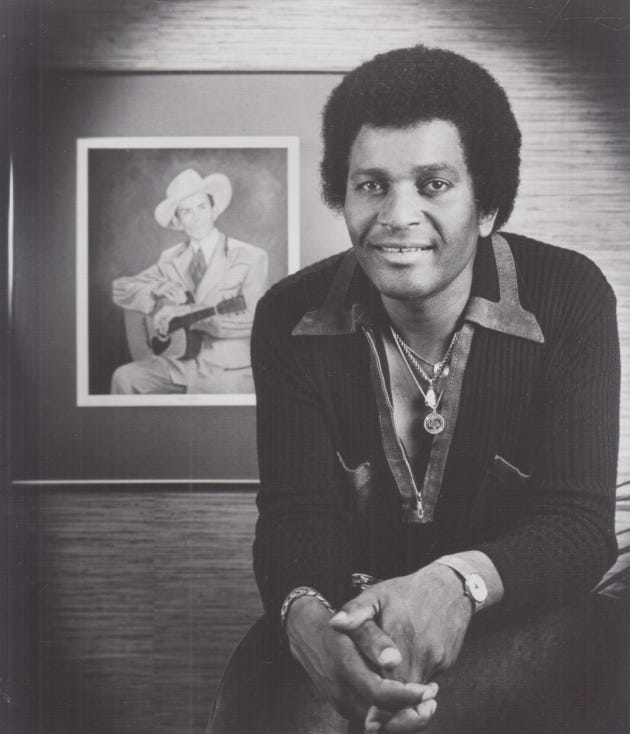
By 1969, Pride had his first number-one single: “All I Have to Offer You (Is Me).” By 1971, he was named CMA Entertainer of the Year and Male Vocalist of the Year. He went on to have 29 number-one country hits. He sold over 70 million records. He was inducted into the Country Music Hall of Fame.
He achieved what no other Black artist had achieved in country music. He became a giant.
But here’s what matters: he didn’t break the door down. The door was open for him. Carefully. Strategically. By men who believed in his talent and were willing to use their credibility to vouch for him. He was presented to America not as a revelation, but as a carefully managed fact that had to be integrated slowly, with all the supporting evidence arranged in advance.
It took four producers. It took a kiss from Willie Nelson. It took Lloyd Green onstage beside him. It took Ralph Emory’s introduction. It took Charley Pride himself, again and again, explaining who he was and asking for the chance to be heard.
That’s what it took for one Black man to sing country music in mid-century America. That’s the price tag attached to his success.
The Permanent Tan and the Permanent Legacy
What strikes me now, sitting in that imaginary Eldorado with my Papaw’s hand on the wheel and Charley Pride singing through speakers, is this: my Papaw knew. He already knew that this was extraordinary. He already knew that loving Charley Pride wasn’t just about the music. He already understood the landscape he was moving through.
And he loved him anyway without any hesitation. Without needing it to be explained or justified.
Charley Pride didn’t change country music’s fundamental relationship with race. After him came a few others—Linda Martell, Stoney Edwards, O.B. McClinton. But the door didn’t swing open. Pride was an exception, not a precedent. And the burden of being an exception is its own kind of exhaustion.
But what he did do was prove it was possible. What he did was sing with a voice so good, so distinct, so completely authentic that even a system built to exclude him couldn’t keep him out. What he did was create a memory that my Papaw could reach back for in the 1970s and play on an 8-track in a Cadillac while his grandson chose the soundtrack.
When I sing on Lower Broadway now, I’m singing in a tradition that includes Charley Pride. When I write about country music, his legacy is the foundation I’m standing on. He’s not a sidebar in the story of country music. He’s not a diversity note. He’s a giant. He’s Abraham Lincoln. He’s the proof that it could be done, even when everything was built to say it couldn’t.
To be honest, I think that’s what my Papaw understood. I think that’s why he loved him so freely.
And I think that’s why we have to keep telling this story. Not as a story of how far we’ve come. But as a story of how much work it took for one voice to be heard. How much machinery had to be built? How many names had to be stacked? How much patience. How much humor. How much dignity.
Charley Pride was one of the greatest country singers of all time. He deserved to be there on talent alone. But his journey—from blank labels to four producers to a kiss on national television to Ralph Emory’s introduction to the silence and then the music—his journey is the story of what it took to make America believe it.
And that story matters. That story is us.
ABOUT THE AUTHOR:
My name is Zachariah Malachi. I’m a full-time, self-employed honky tonk musician in Nashville, Tennessee. This Substack Publication was created for the purpose of sharpening my mind on more Nashville and Country Music history to share with the honky tonk patrons downtown during my shows - but I wanted more folks to benefit from the research so - it’s my gift to the country music fans of the world AND the people who WANT to be. Subscribe and come along for the ride.
Wonderful essay. I’d love to read what you have to tell us about DeFord Bailey.
I really enjoy reading all your stories.