


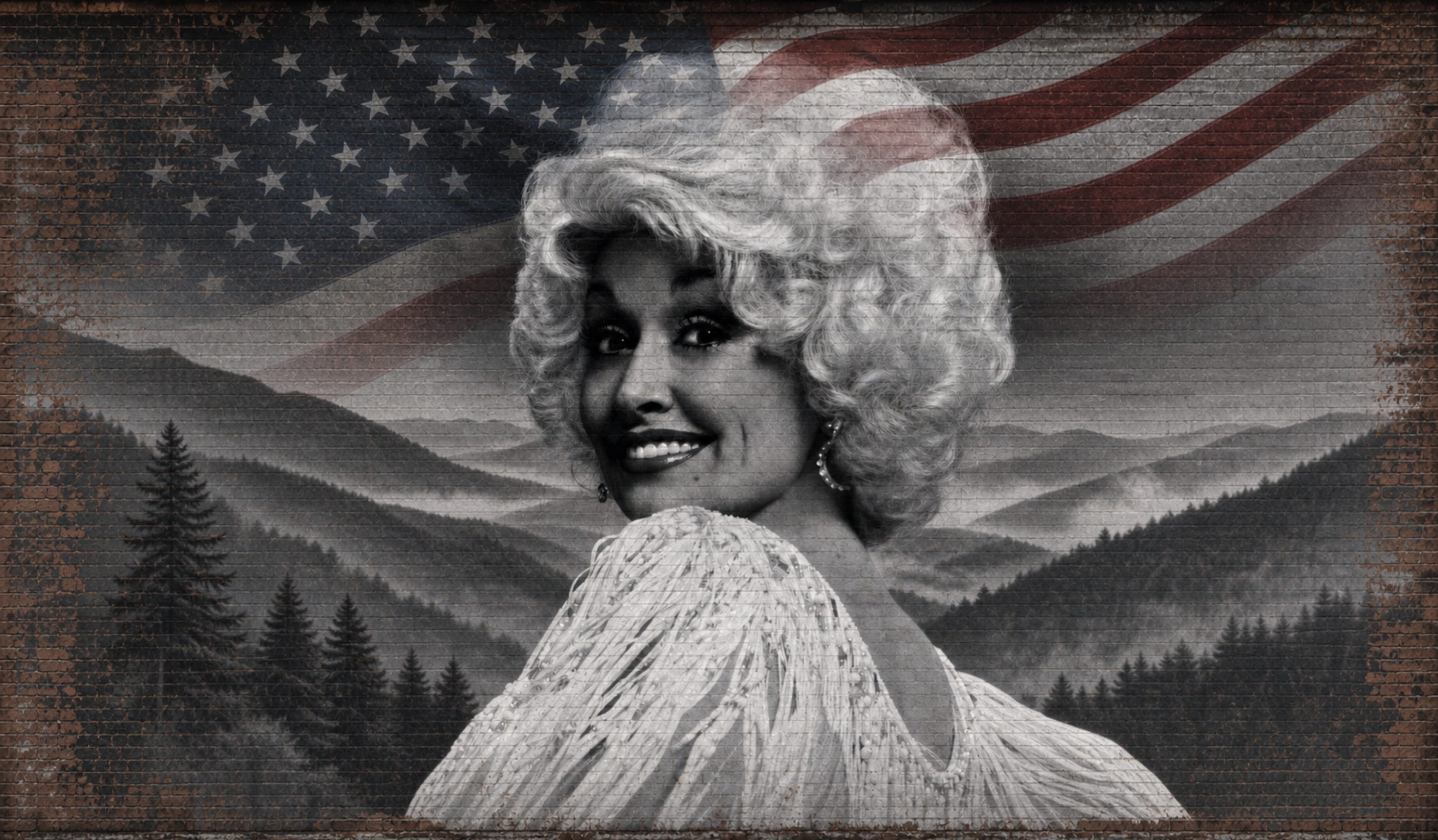
Every Saturday night on television screens across America, a tall, lanky man in a fifteen-pound rhinestone-encrusted Nudie suit would smile warmly, crack a rustic joke, and introduce a shapely, twenty-one-year-old blonde with a towering heap of hair and a shimmering mountain tremolo. Together, Porter Wagoner and Dolly Parton sang of old-time family values, tragic lovers, and sweet Tennessee mountain homes.
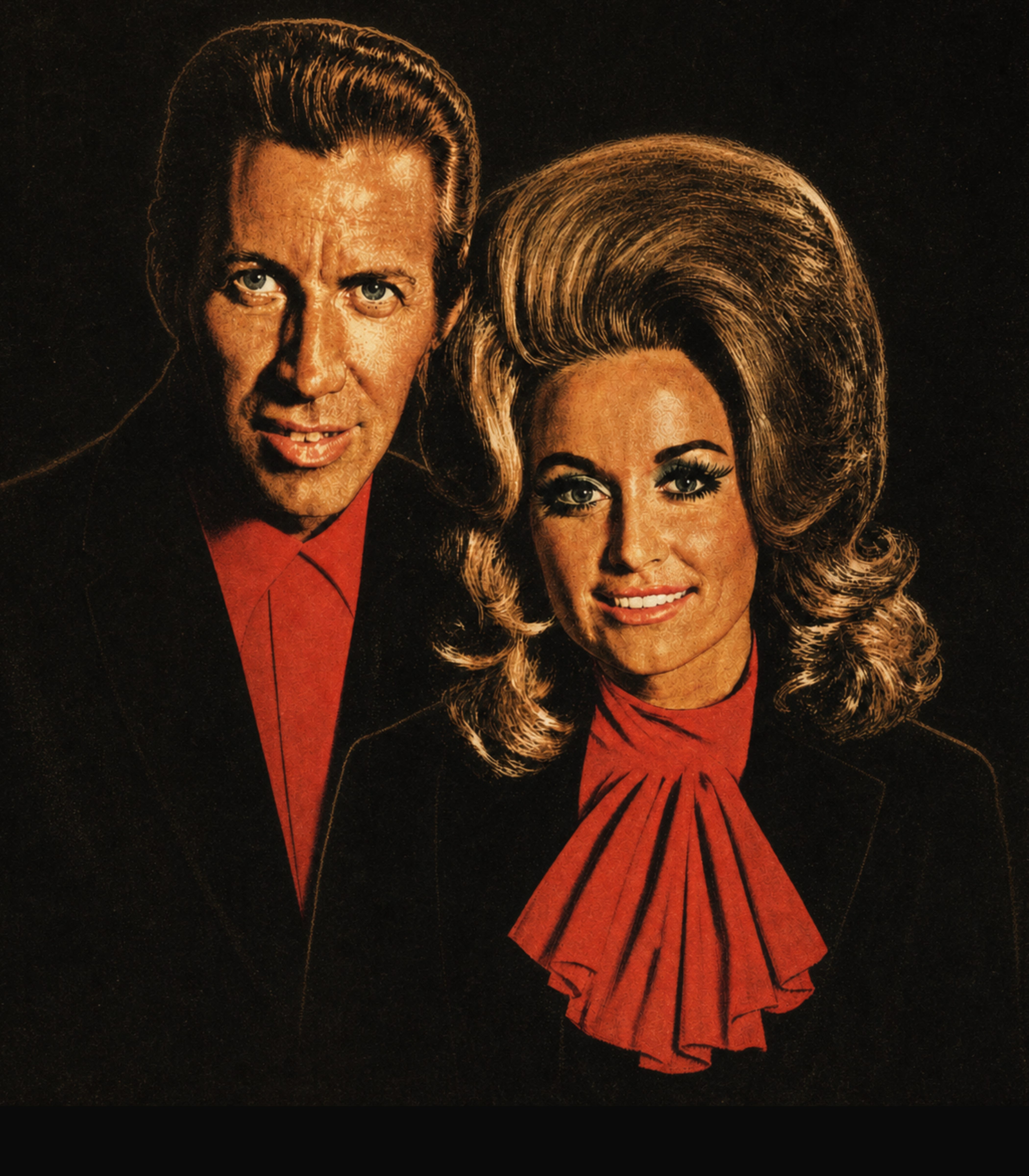
But behind the bright studio lights, beneath the blinding glare of Porter’s purple-and-silver spangles, lay something entirely different: a claustrophobic battlefield of ego, creative suppression, and what amounted to corporate hostage-taking.
This wasn’t a simple story of a benevolent mentor and a grateful protégé. It was a collision of two exceptionally stubborn forces fighting over millions of dollars and creative control. To Porter, Dolly was a subordinate—a highly profitable piece of property that belonged inside his sprawling organization. To Dolly, Porter’s television show was a velvet rope choking her to death. What followed was a high-stakes war that would end in a three-million-dollar lawsuit, years of bitter silence, and one of country music’s greatest songs ever written as a weapon of escape.
The Prophet of West Plains and His Girl Singers
To understand what broke this duo, you have to understand Porter’s absolute obsession with control.
Raised on a hardscrabble farm near West Plains, Missouri, Porter was a pure hillbilly who had clawed his way to stardom through an incredibly disciplined rehearsal routine, relentless touring, and a complete mastery of early television stardom. He signed with RCA in 1955, and his massive 1956 hit “A Satisfied Mind” became his permanent ticket to the Grand Ole Opry.
By 1960, he launched The Porter Wagoner Show, sponsored by the Chattanooga Medicine Company—makers of Black Draught laxative and Wine of Cardui. The thirty-minute program was designed as a highly structured, fast-paced variety segment showcasing hard-country fiddle players, clogging groups, and, crucially, a featured “girl singer.”
For seven years, a sweet-voiced Oklahoma woman named Norma Jean Beasler served as the show’s centerpiece. Norma Jean’s career peaked under Porter’s direction, but in 1967, she chose to get married, retire, and return to Oklahoma. Suddenly without his primary female costar, Porter went searching for a replacement.
He didn’t have to look far. A young woman named Dolly Rebecca Parton had recently arrived in Nashville by bus on the day after her high school graduation in 1964. Armed with a mandolin she’d taught herself to play at age six and a bottomless catalog of original songs, she had signed with Monument Records. The label spent two years trying to market her as a pop-rock singer before finally letting her cut a country record called “Dumb Blonde.” The song climbed the charts in early 1967. It was sharp and defiant—exactly the kind of track that caught Porter’s attention.
Recognizing her commercial appeal and her raw mountain vocal power, Porter brought Dolly to RCA and his television syndicate. He had found his new girl singer.
The Illusion of Harmony and the Topeka Rebellion
From the moment Dolly stepped in front of Porter’s cameras, a fundamental power imbalance defined their partnership. Porter was the established patriarch, the dandy of the Ozarks who wore suits so heavy with Nudie’s rhinestone patterns that they practically stood up on their own. Dolly was hired as a “girl singer”—a decorative, secondary voice meant to harmonize on Porter’s terms.
Musically, the formula worked like a goldmine. Between 1967 and 1974, they recorded a string of smash duets, releasing twenty-one charted singles with fourteen going straight into the Top Ten. They sang Tom Paxton’s folk classic “The Last Thing on My Mind” and matched each other note-for-note on driving country numbers.
But as Dolly’s solo career began to find its footing—particularly after her soaring rendition of Jimmie Rodgers’s “Mule Skinner Blues” hit Number Three in 1970—the backstage tensions became unbearable. Dolly was a prolific songwriter, a genuine genius with melodies and lyrics. But she deeply resented Wagoner’s heavy-handed attempts to control her career, dictate her musical direction, and stamp his own traditionalist imprint on her compositions. Porter viewed himself as the supreme star and expected Dolly to remain a grateful, compliant junior partner.
Dolly’s ego couldn’t handle the subordination. Porter’s stubbornness matched her own.
“We disagreed often,” Dolly recalled later about those claustrophobic touring years on their custom buses. “We’re both very creative, very stubborn in our beliefs. I felt a need to expand, to try my wings, to have my own organization.”
She told a reporter at the time that their constant bickering left her physically and emotionally “black and blue.” She said it plainly: “We just trampled around on territory that was real sensitive, cut each other about songs. I felt black and blue, and I just wanted to heal back up and mend myself back together and get on with my life.”
The stress occasionally boiled over into outright hostility on the road. During a grueling tour stop in Topeka, Kansas, Dolly walked into a Ramada Inn coffee shop in a state of absolute, simmering fury. She ordered a specific meal that wasn’t on the menu, announcing to the waitstaff that she would sit at the table and refuse to move until they cooked it for her. When the kitchen finally complied, Dolly immediately sent it back, claiming it wasn’t cooked right, and demanded something else.
While Porter behaved like a perfect gentleman to the restaurant workers, a waitress on the scene recalled: “Dolly was just miserable to us.”
It was the behavior of a woman desperately trying to assert control over any small corner of a life that was otherwise entirely dictated by Porter Wagoner.
There’s some rare Dolly dirt for you. But, the road makes you weary..
The Backroom Grab and the “Morning of Lies”
By 1974, Dolly was actively plotting her escape, but Porter’s grip on her contract and his influence with RCA executives made a direct departure nearly impossible. What followed was a series of dramatic, covert maneuvers that played out like a corporate thriller.
During Fan Fair in Nashville, Dolly decided to bypass Porter entirely. She called Jerry Bradley, the newly installed head of RCA Nashville (and son of Owen Bradley), and pleaded for a secret meeting. Dolly waited until Porter had gone on a fishing trip, then slipped into Bradley’s office on Seventeenth Avenue.
Bradley recalled that Dolly sat across from his desk “bubbling” with relief, rapidly laying out her plans to escape Porter’s organization, launch her own solo touring band, and take total control of her masters.
Then Bradley’s secretary rang in with a panicked warning: “Porter is here. He’s on his way up.”
Dolly’s face drained of color. Her vibrant confidence was replaced by sheer dread. The office door flew open, and Porter Wagoner stormed in, his eyes blazing with fury. “What the hell are you doing up here?” he snarled. Without waiting for an explanation, Porter marched across the room, grabbed Dolly by the arm like she was a little girl, and dragged her out of the RCA offices. Bradley attempted to intervene, shouting, “I beg your pardon, she’s an artist signed to me. I can talk to her any time I want to.” Porter ignored him, hauling his captive star down the hallway.
The next morning, at exactly ten minutes to nine, Jerry Bradley’s office phone rang. It was Dolly. Her voice was quiet, flat, and completely defeated.
“Jerry,” she said, “this is Dolly. Everything I’m gonna say in our meeting is a lie. Bye.”
Minutes later, Dolly and Porter walked back into the RCA offices, accompanied by Chet Atkins. Dolly sat quietly as Porter dominated the conversation. She recited a rehearsed script, stating how much she loved Porter, how deeply she valued his management, and declaring that if the label ever needed anything regarding her career, they should go directly through him.
A hostage delivering a statement with a gun pressed against her back.
The Resignation Song and the Three-Million-Dollar War
Dolly knew that she couldn’t escape Porter through lawyers, contracts, or executive appeals. She had to appeal to his ego, his sentimentality, and his vanity.
In late 1973, she went home to her estate outside Nashville. Sitting alone overnight, she poured her complicated, agonizing mix of gratitude and resentment into a singular, devastating acoustic ballad. The next morning, she walked back into Porter’s office on Music Row, guitar in hand, and asked him to sit down.
With tears welling in her eyes, she sang the song she had written just hours before:
If I should stay / I would only be in your way / So I’ll go, but I know / I’ll think of you each step of the way... and I will always love you.
The performance was a masterpiece of emotional manipulation. Porter was instantly brought to tears, completely disarmed by the beautiful tribute. He agreed on the spot to let her leave his show and launch her solo career, believing that he had been honored with the ultimate song of respect.
In April 1974, Dolly Parton officially walked out on Porter Wagoner. When conservative RCA executives and Nashville traditionalists accused her of abandoning her roots and selling out her country heritage, Dolly shot back with a legendary response:
“If you son-of-a-bitches learn how to sell a female Elton John with long hair and big boobs that dresses like a freak, then we’ll make some money.”
But the sentimentality of that office performance evaporated quickly. Porter was deeply, pathologically bitter about losing his primary crowd-drawer. In 1979, he struck back with a devastating blow—a massive three-million-dollar breach-of-contract and partnership lawsuit.
The lawsuit launched a brutal, multi-year cold war between them. They refused to speak. They avoided each other backstage at the Opry. They traded bitter barbs through their attorneys. Dolly was forced to pay Porter a massive financial settlement—upwards of one million dollars—to finally buy back her freedom and settle the dispute out of court.
The bitterness ran so deep that Porter spent decades claiming to anyone who would listen that he and Dolly had engaged in a passionate, highly physical affair during their years on the road. Dolly consistently denied any sexual relationship with Porter, insisting their bond was purely professional and creative. “We were lovers of music,” she countered, “and I suppose we had one of the world’s most unique relationships. We were not lovers as you know lovers.”
After the split, Porter openly sneered at her ambition, telling reporters: “Regardless of what it was or who it was—I mean her family, her own blood—she would turn her back to help herself.”
The Surrounding Shadows: Carl, Merle, and Elvis
The protective layers Dolly constructed around herself during this era extended far beyond her war with Porter. To survive the predatory, male-dominated ecosystem of 1970s Nashville, Dolly relied on a series of carefully constructed boundaries.
The Phantom Husband: Two days after arriving in Nashville in 1964, Dolly met a quiet, twenty-one-year-old asphalt contractor named Carl Dean at the Wishy Washy laundromat. They married on May 30, 1966. From the moment Dolly’s career took off, Dean avoided the public eye with fervor that bordered on obsessive. He refused to attend award shows or join her on tour. Dolly’s fans joked that Dean was a myth. Town gossip had it that his initials “C.D.” stood for Count Dracula because he only seemed to exist in the shadows of their private, sixty-five-acre Nashville estate.
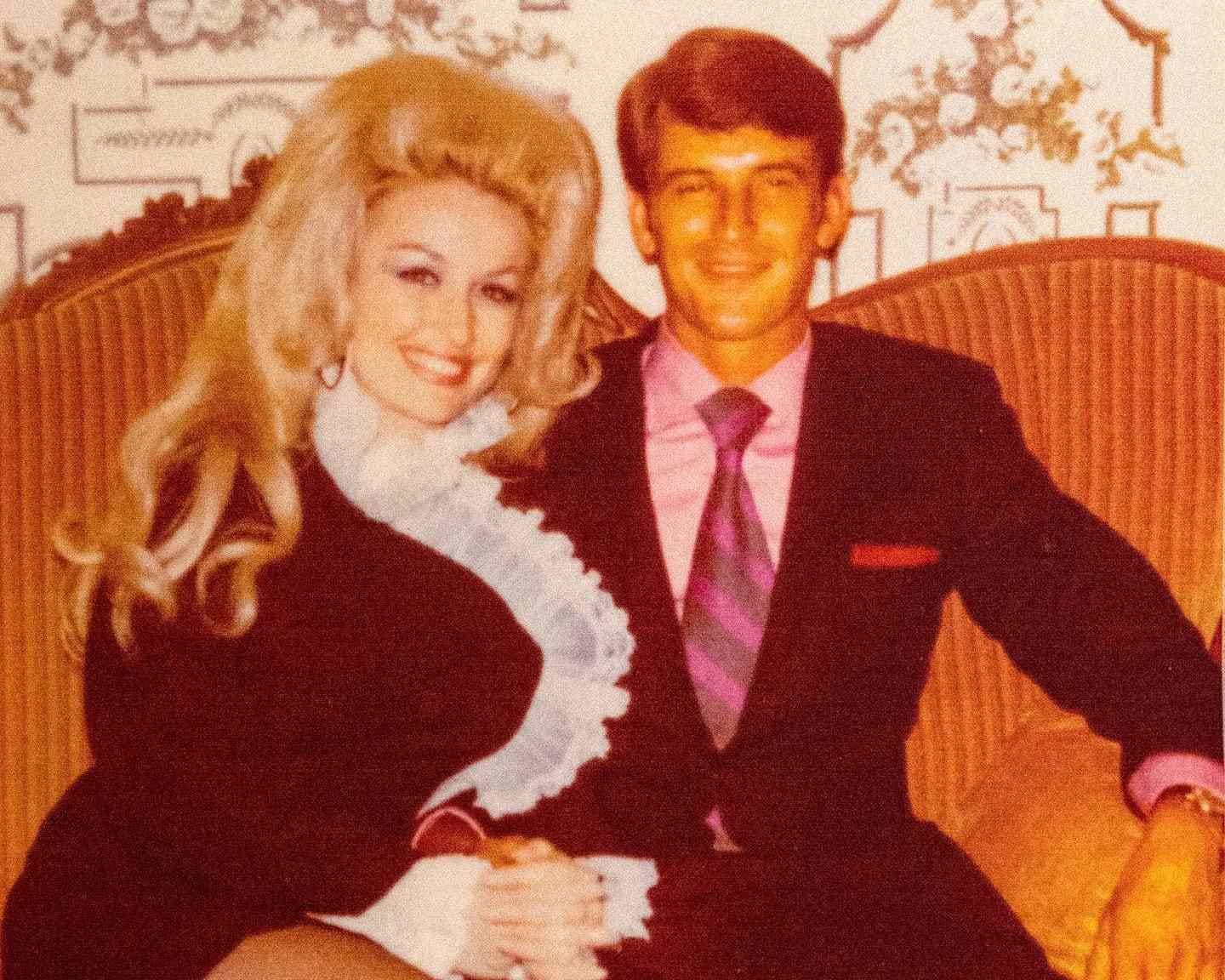
Yet Carl Dean was Dolly’s ultimate anchor—a private sanctuary that no manager, television host, or lustful touring musician could ever touch.
The Hag’s Pursuit: In the summer of 1974, immediately following her split from Porter, Dolly toured as the opening act for Merle Haggard. Haggard became instantly, pathologically obsessed with her, convinced he was deeply in love with the little blonde with the big voice. In 1973, Haggard wrote his pining masterpiece “Always Wanting You” about his unrequited desire for Dolly. At three o’clock in the morning, while his wife Bonnie Owens was sleeping next to him in bed, a drunken Haggard called Dolly’s home, waking up both Dolly and Carl Dean just so he could sing the track to her over the phone.
Dolly listened politely for a few minutes, then flatly hung up and went back to sleep.
Haggard chased her relentlessly on the tour bus until Dolly, tired of fending off his advances, walked off the tour entirely.
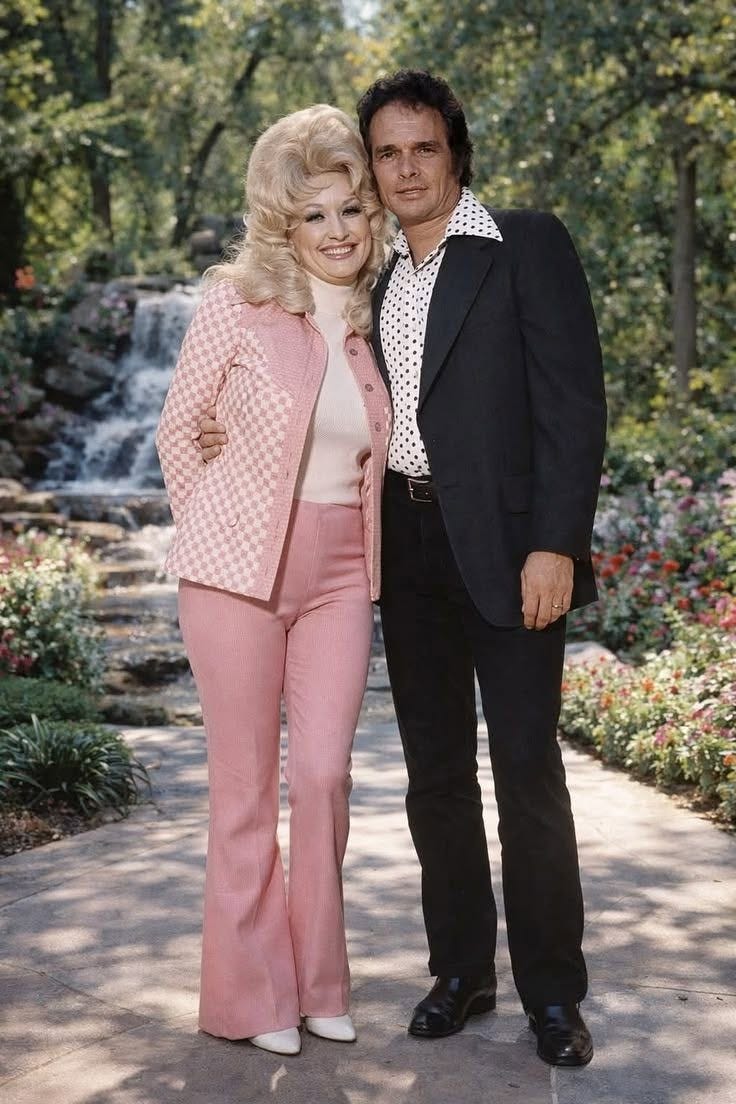
The Colonel’s Defeat: In the late 1970s, Dolly received word that Elvis Presley loved “I Will Always Love You” and wanted to record it. She was thrilled until Colonel Tom Parker informed her of the standard Presley contract terms: Elvis would not record any song unless he was granted fifty percent of the publishing royalties. It was an ultimatum that had forced dozens of songwriters to surrender their fortunes for a Presley cut.
But Dolly, having just survived her war with Porter, refused to be bullied. She told the Colonel flatly: “Well, in that case, I don’t guess Elvis is going to be recording ‘I Will Always Love You.’”
Industry insiders told her she was completely out of her mind. But Dolly’s iron-clad business sense was vindicated a decade later when Whitney Houston recorded the track for The Bodyguard (1992), sending millions of dollars in undivided publishing royalties straight to Dolly’s bank account.
Epilogue: The Death of the Partner
It took nearly thirty years for the ice to finally melt. As Porter Wagoner entered his twilight years, his flamboyant television empire faded into history. Dolly Parton, meanwhile, became a universally beloved, multi-million-dollar global icon.
In 2007, when Porter was diagnosed with terminal lung cancer, Dolly quietly slipped back into his life. She visited him in his Nashville hospital room, sitting by his bedside and holding his hand. Just days before the tall yodeler drew his last breath, Dolly sang to him one last time.
The song, of course, was the very one she had used to break his heart in his office thirty-three years before.
For Porter, the rhinestones had finally stopped glittering. For Dolly, the price of her freedom had been chiseled in the hard-won independence of a legendary career.
The Listening Lab: Behind the Rhinestone Curtain
Queue up these three tracks in your headphones to hear the transition from cage to creative autonomy:
“The Last Thing on My Mind” (1967) – Porter Wagoner & Dolly Parton
Listen to the tightness of that vocal blend. Porter’s booming baritone sits squarely in the center of the mix, while Dolly’s shimmering mountain soprano is pushed to the margins, acting as a decorative, bright frame for his delivery.
“Mule Skinner Blues (Blue Yodel No. 8)” (1970) – Dolly Parton
This is where Dolly broke the mold, for sure. Listen to the aggressive, whip-cracking audacity of that yodel. It’s a traditionally male song that Dolly completely colonizes with a fierce, “lady mule skinner” drive that only she could. She’s proving to RCA and Porter that she possessed a solo vocal power that could dwarf his own.
“I Will Always Love You” (1974) – Dolly Parton
Focus on the acoustic simplicity of the original tracking. It’s not an overwrought pop anthem; it’s a quiet, conversational mountain goodbye. Notice the trembling, spoken-word recitation in the middle of the track. That’s the sound of a woman choosing respect and freedom over security, writing her own exit ticket in real-time.
ABOUT THE AUTHOR:
My name is Zachariah Malachi. I’m a full-time, self-employed honky tonk musician in Nashville, Tennessee. This Substack Publication was created for the purpose of sharpening my mind on more Nashville and Country Music history to share with the honky tonk patrons downtown during my shows—but I wanted more folks to benefit from the research, so it’s my gift to the country music fans of the world AND the people who WANT to be. Subscribe and come along for the ride.
Great essay and tribute Zachariah
Ha! That “female Elton John” rant was gold.
Thanks for writing this piece - it’s quite timely. RIP Dolly.