


The Neon Smudge and the Safety Pin: A Collision of Worlds
By 1980, American culture had split down the middle. Nashville had Tammy Wynette—the “First Lady of Country Music”—wrapped in eighty-pound Bob Mackie gowns, her blonde hair shellacked into submission, her voice spelling out D-I-V-O-R-C-E for the children of the silently suffering majority. She sang about standing by your man, no matter what. She was the high-femme fortress of conservative domesticity, or at least that’s what her character was. If you know, you know.
San Francisco had the other side: sweaty, snotty, safety-pinned punk bands crammed into basement clubs like the Mabuhay Gardens, screaming two-minute assaults through three chords. To these kids, Tammy Wynette wasn’t just old-fashioned. She was a walking contradiction—the symbol of everything fake and manufactured about mainstream America, dressed up as virtue.
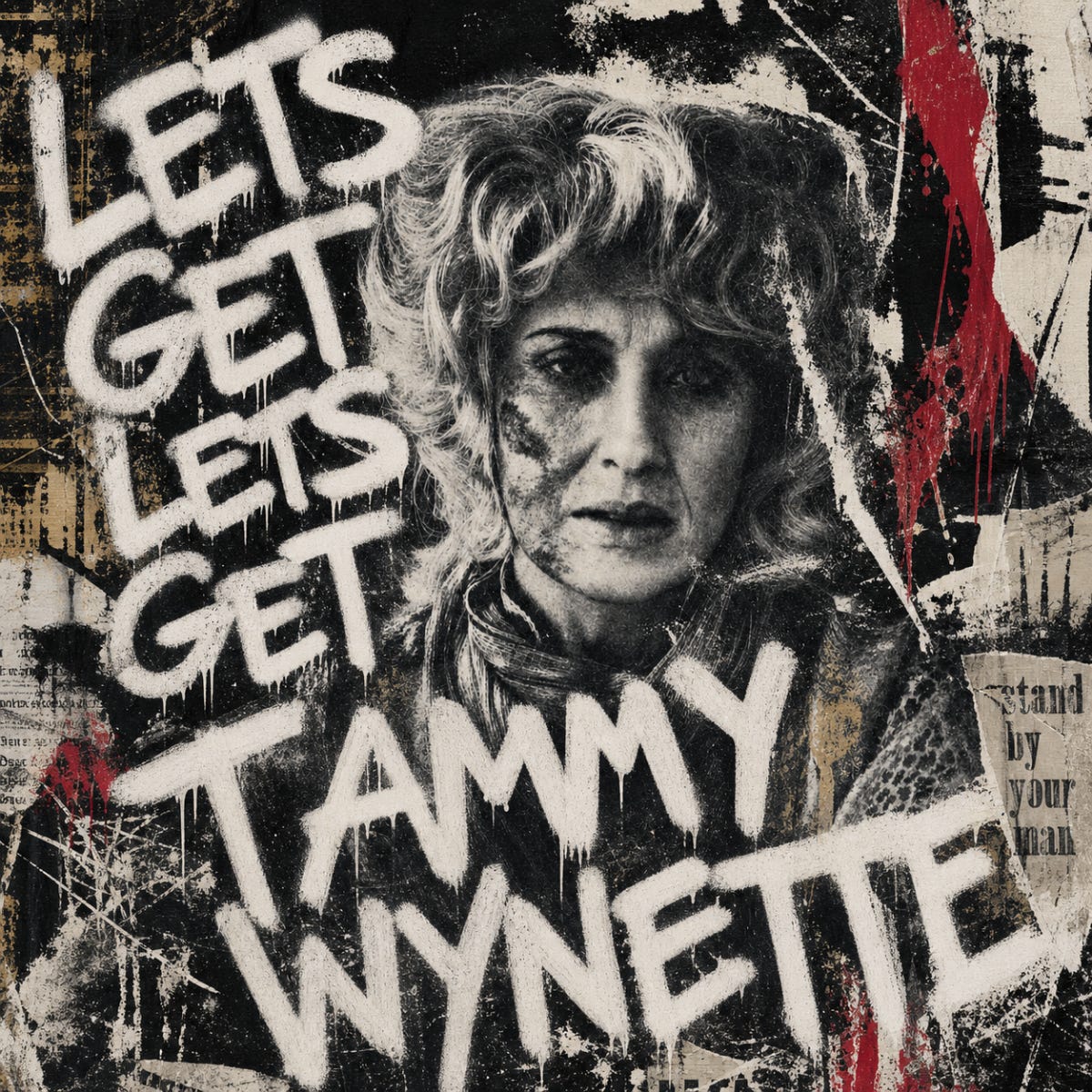
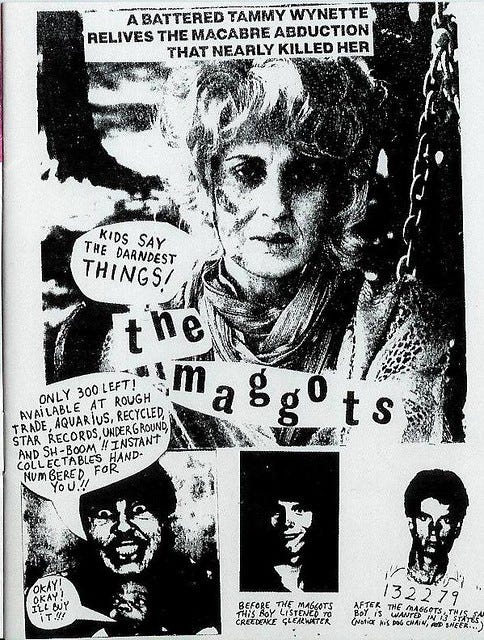
In 1980, the Maggots released a 7-inch called “(Let’s Get, Let’s Get) Tammy Wynette.” Fast. Abrasive. Disrespectful. But here’s where it got interesting: the cover showed a photograph of Tammy with her face swollen, her eyes glassy, bruises dark across her cheekbones. To punks in California, it was hilarious—pop-art subversion. To anyone who knew Music Row, that photograph meant something else entirely: it was a reminder of one of the darkest, most pathetic cover-ups in country music history—the faked kidnapping of October 4, 1978.
This is the story of how country music’s tragedy queen became a punk-rock punchline. And why the real tragedy was so much worse than the joke.
The Brown Glove and the Pantyhose: October 4, 1978
Tammy Wynette had recently married George Richey, a bonafide keyboard player, producer and scumbag who had taken complete control of her career and her finances. By 1978, her record sales were slipping. She’d been shut out of the CMA nominations. She was in constant pain from a long history of abdominal surgeries.
According to her later statement to police and People magazine, she decided to go shopping. She drove her yellow Cadillac—a gift from her ex-husband George Jones—to the Green Hills Mall in suburban Nashville. She bought clothes for her daughter, had some jewelry fixed, and headed back to the parking lot.
That’s when she felt the poke of a gun in her ribs.
A man with pantyhose pulled over his face ordered her to drive. For twenty minutes, he forced her through Nashville traffic. Then he tied pantyhose around her neck and drove for nearly two hours, eighty miles toward the Alabama border.
Around 9:30 p.m., Tammy showed up on the porch of a woman named Junette Young, screaming. Her clothes were torn. Her face was swollen. Pantyhose was still around her neck. Her Cadillac was found abandoned in a muddy ditch miles away.
The news hit Nashville like a shock wave. The First Lady of Country Music had been violently abducted and left for dead.
The TBI Audit: The Shifting Bruises
But almost immediately, something started to look wrong.
When Tammy got to the hospital, a Tennessee Bureau of Investigation agent examined her. Despite her story of being brutally pistol-whipped, the only visible injury was a tiny abrasion on her cheek—hardly bigger than a paper cut.
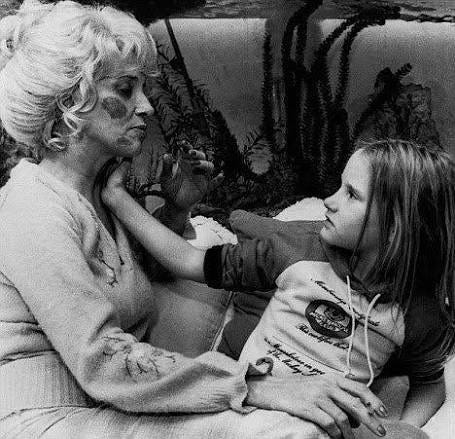
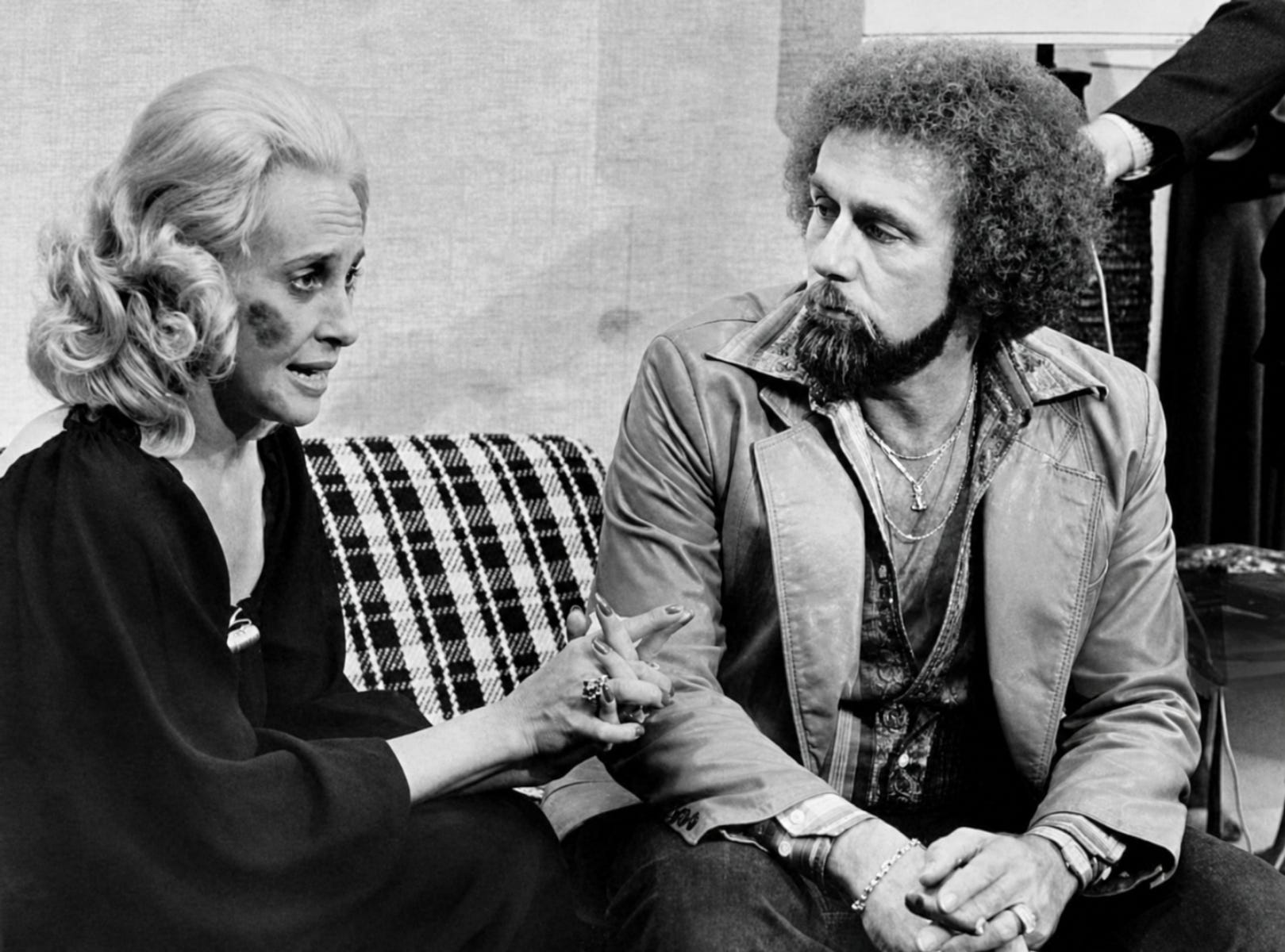
Two days later, the TBI agent visited her at her estate. He walked into the living room and stopped. Tammy was giving national television interviews to Walter Cronkite and major news outlets. Her face had completely changed. Now she had an enormous, unmistakably dark-purple black eye and a secondary bruise along her lower jaw.
Over the next ten days, the TBI and forensic investigators noticed something even stranger: the bruises shifted. Different photographs showed them in different locations, different sizes, depending on how her makeup artist had painted them that morning.
The TBI concluded what Nashville was already whispering: the entire kidnapping was a hoax.
The evidence was overwhelming:
She left her car unlocked with her purse, credit cards, and purchases sitting on the seat.
The kidnapper didn’t take anything. Not the forty dollars in cash, not any of her thirty credit cards. Nothing.
There was a pattern of escalating fakery. Before the kidnapping, she’d reported fires, graffiti on her walls (reading “PIG” and “WHORE”), and security wires being cut in her basement. Security guards and police had long suspected Tammy was behind these incidents herself—generating attention and sympathy.
When the CMA Awards were held three days later, Tammy’s name was conspicuously absent. The Country Music Association, desperate to move the genre toward a clean, mainstream pop audience, had deliberately frozen her out. They couldn’t be dragged into her increasingly erratic, tabloid-ready melodrama.
The Brutal Truth: The Law of First Lady Acres
If the kidnapping was fake, the obvious question was: why would the most famous woman in country music tie pantyhose around her own neck, drive eighty miles into a field, and lie to the TBI?
Decades later, her children revealed the answer.
In her 2000 memoir, Tammy’s daughter Jackie Daly (backed by her sister Georgette Jones) laid bare the secret behind the “happily ever after” facade of First Lady Acres. The marriage was a war zone.
Just three months after their wedding, George Richey got drunk and high on pills and beat Tammy in their bedroom. She had a real black eye. A bruised jaw. Real injuries from real fists.
Tammy was trapped. Her entire public identity was built on “Stand By Your Man.” She had spent years publicly telling women to forgive their husbands’ worst transgressions. If the public, the press, or the record label found out her “savior” husband was actively beating her, her career was over. Working-class housewives—her core audience—would have seen through her as a complete hypocrite.
So Tammy and Richey engineered a cover-up. While he stayed in Nashville establishing an alibi, Tammy drove south, parked her car in a muddy field, tied pantyhose around her neck, and walked to Junette Young’s house to sell the abduction story. The theatrical bruises she applied with makeup in the days that followed were designed to hide the very real marks from Richey’s fists.
It was a double tragedy: Tammy Wynette tortured herself and committed a federal crime to protect the man who was beating her.
The Maggots Step In: The Ultimate Camp Subversion
By 1980, the public had stopped believing her. On television appearances, she contradicted her own timeline, claiming the kidnapper had tapped her phones and delivered monologues that she’d previously sworn never happened. She was falling apart publicly, and her record sales reflected it.
That’s when the San Francisco punk scene decided to finish the job.
The Maggots didn’t care about the tragedy of Virginia Wynette Pugh. They saw Tammy Wynette as pure campy Americana—a caricature of artificial domesticity begging to be mocked. When they put that People magazine photo of her fake-bruised, weeping face on the cover of their record sleeve, they pulled off something clever: they took country music’s most sacred image of tragic female martyrdom and dragged it straight through the mud of the underground.
They made her calculated bid for sympathy into a punk-rock joke.
To the punks, Tammy’s bruises were high-camp accessories—as artificial as her hair, as hollow as her doormat anthems, as performative as her flawless eyeliner. The whole thing was a perfect storm: a country star’s tabloid chaos colliding with punk rock’s desire to destroy the myths of American wholesomeness.
The Maggots’ record remains a cult classic, a weird historical signpost from the moment punk rock started dismantling Nashville’s clean corporate myths. It’s funny. It’s savage. It’s also, if you know what was really happening, completely unbearable to listen to.
The Country Music Book of the Dead Listening Lab
To understand how Music Row’s slick machinery collided with Tammy’s real pain, listen to these three:
“Womanhood” (Tammy Wynette, 1978): The title track of the album she was promoting when she faked the kidnapping. Written by Bobby Braddock, it’s a weird, beautiful baroque masterpiece. Listen to how her voice slips into a smoky alto as she begs God for permission to perform “womanhood”—a song caught at the exact boundary between her performative femininity and whatever she actually wanted.
“(Let’s Get, Let’s Get) Tammy Wynette” (The Maggots, 1980): Two minutes of San Francisco chaos. High-velocity guitars stripping away the solemn reverence of Nashville, treating the First Lady’s tabloid drama as pure, disposable pop art.
“Apartment #9” (Tammy Wynette, 1966): Her first single, produced by Billy Sherrill. Before the wigs, the fake kidnappings, and the abusive marriages, this is Tammy’s voice at its most raw—the blueprint of domestic loneliness, keening and uncompromised.
ABOUT THE AUTHOR:
My name is Zachariah Malachi. I’m a full-time, self-employed honky tonk musician in Nashville, Tennessee. This Substack Publication was created for the purpose of sharpening my mind on more Nashville and Country Music history to share with the honky tonk patrons downtown during my shows—but I wanted more folks to benefit from the research, so it’s my gift to the country music fans of the world AND the people who WANT to be. Subscribe and come along for the ride.
I was listening to Willie's Roadhouse a while back and someone on there, maybe Dallas Wayne, told a story about Billy Sherrill listening to the first playback of "Apartment Number 9". Sherrill later said that the moment he heard her sing the first two lines, over Pete Drake's exquisite pedal-steel intro, that he knew she was going to be a star. I believe that might be the most beautiful intro in country music!
Great article about a sad, tragic Nashville story!