


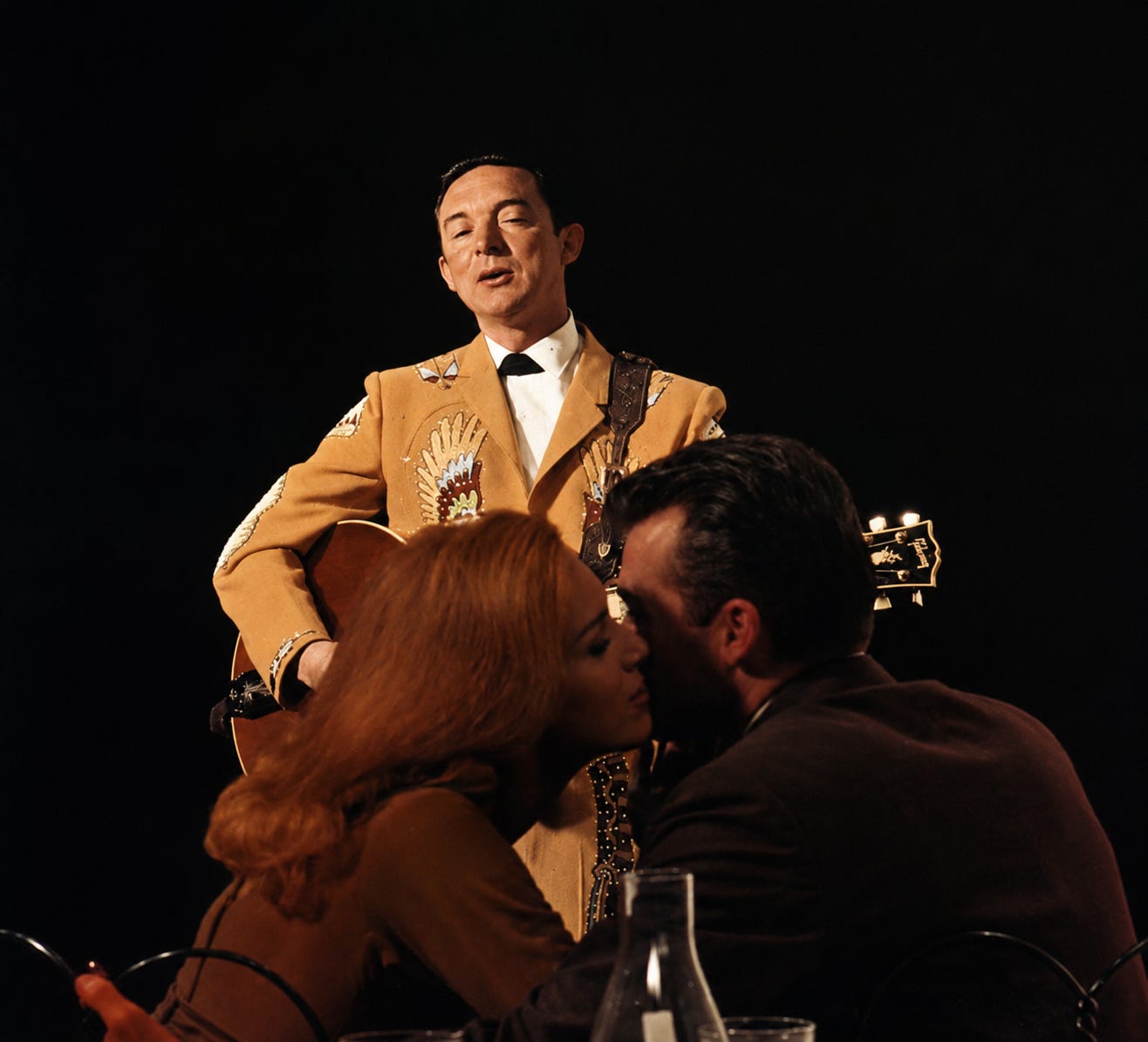
Shots have been fired. I will say it without a speck of doubt: Night Life is the best country album ever made.
The usual theory is that a person’s taste in music traces back to a memory — some song tangled up with a place, a person, a particular car ride. I’ve got plenty of those. The Beatles’ 1 will always have a soft spot in me because my dad bought that CD when I was a kid, and it lived in the player for what felt like every drive we ever took. That’s the formula, and it’s a real one.
Night Life doesn’t fit it. I don’t have a memory attached to it. No road trip, no person, no specific afternoon I can think of. I believe it’s the best one, plainly, the way you’d state a fact about the size of a room. Go ahead and run your own list back — what you love, and what’s sitting behind it in the memory bank. Sometimes it’s nothing. Sometimes the record is the thing, no backstory required.
The title track alone is reason enough. It doesn’t sound like any other country song from its era, or really any era — it’s the “Free Bird” of steel guitar songs, the one every player has to have an opinion about, the one that rewires what the instrument is allowed to do. If you ever run into someone else who holds this same opinion about Night Life, you’ve found a person with some true top-shelf hillbilly class.
There is a moment, somewhere in the early sixties, when honky tonk stopped being just a sound and started being an admission. Ray Price had already built his name on the shuffle — that rolling 4/4 walk, fiddle and steel trading lines over a beat made for sliding across a beer-speckled dancefloor with someone you probably shouldn’t be embracing. The Cherokee Cowboys were the proving ground. By 1962, Jimmy Day’s chair on steel guitar had passed to Mr. Buddy Emmons, who, within months of joining, was running the band’s arrangements. Price’s name on a record meant a certain kind of confidence — a band that could swing harder than the genre ever had swung before.
Then came Night Life.
The song existed before Price ever got a hold of it, and it had already lived a rough life by the time he did. Willie Nelson wrote it in 1958, the lyrics arriving in two spots on a thirty-mile drive between his home in Pasadena, Texas, and the Esquire Ballroom in Houston, where he was singing for whatever the house band would give him. Broke after the birth of his son, Nelson sold the song — along with “Family Bible” — to guitar teacher Paul Buskirk for $150. Pappy Daily, who ran Nelson’s label at the time, rejected it outright; he didn’t think it sounded like country music. So it went out in 1960 on RCA under a different title, “Nite Life,” credited not to Willie Nelson but to “Paul Buskirk and His Little Men featuring Hugh Nelson” — a dodge to get around the contract Nelson no longer controlled. The songwriting credit itself was shared three ways, between Nelson, Buskirk, and Walt Breeland.
Price bought the song in 1960, on Buskirk’s urging, and sat on it for a while. By the time he recorded it — early 1963, with Buddy Emmons on steel — Nelson’s reputation in Nashville had changed entirely. He’d already written hits for Patsy Cline and Faron Young, and his phone didn’t stop ringing. But the song he’d written five years earlier, on a thirty-mile drive nobody was paying attention to, was still the one that needed Ray Price’s voice to find where it needed to be. Price’s liner notes credited it only to “a boy down Texas way” — a strange, almost evasive way to introduce a song that would become his signature.
Night Life, the album, wasn’t cut in a single session — it’s more of a patchwork of recordings made across more than two years, stitched into something that plays like a unified mood even though it wasn’t built as one. That astounds me. “The Twenty-Fourth Hour” dates back to a January 1961 session, “Pride” to January 1962 — both likely cut with Jimmy Day still on steel. The title track and most of the rest came out of three days in February 1963, with Emmons now in the chair, his bluesy, jazz-inflected intro on “Night Life” becoming one of the most studied steel guitar passages in the instrument’s history. Some guitarists still argue over the exact voicing of those opening chords. One track, “Are You Sure,” even carries a co-writing credit from Emmons himself, alongside Nelson.
What unifies the record isn’t the personnel — it’s the tempo and the subject. Slow it down from the classic Price shuffle, and the honky tonk’s usual subject matter — drinking, loneliness, the hours between midnight and last call — stops sounding rowdy and starts sounding tired. There’s a difference, and the record knows it. Don Law and Frank Jones produced, working inside the Nashville Sound machinery that was reshaping country records across the board in those years — strings, smoother edges, horns where steel used to carry the lead. Night Life lets some of that in without losing its grip on the barroom. Allmusic’s Cub Koda would later describe it three ways at once: the last gasp of true honky tonk, the first real step toward the Nashville sound of the decade ahead, or — depending how you squint — country music’s first concept album.
The album was Price’s first to chart at all, and when Billboard finally launched a dedicated country albums chart in January 1964, Night Life was sitting at number one in its second week — the first of five chart-topping albums in Price’s career, nearly a year after its original release.
Calling Night Life the greatest country album of all time is not a fact, but it’s an argument worth having, because what the record actually did was quieter than “greatest” usually implies. It didn’t reinvent the wheel or anything. It proved country music could hold its own at a tempo built for thinking instead of dancing, with arrangements built around an atmosphere instead of just accompaniment, without losing the thing that made it country in the first place — the unbearable specificity of a bad night, told straight. Think of it as a strong standing concept album in country music history. Country music’s “In The Wee Small Hours”.
Every countrypolitan record that came after, every whiskey-soaked late evening ballad with string accompaniment and every honky tonk singer who ever slowed down for a purpose — they’re all working in a room Night Life walked in first. Whether or not you believe that it’s the best country album ever produced, we should agree that it might be the most necessary one. Necessary records don’t always get remembered as the best. The splash they leave may be the Genesis of some new sonic trends.
ABOUT THE AUTHOR:
My name is Zachariah Malachi. I’m a full-time, self-employed honky tonk musician in Nashville, Tennessee. This Substack Publication was created for the purpose of sharpening my mind on more Nashville and Country Music history to share with the honky tonk patrons downtown during my shows - but I wanted more folks to benefit from the research so - it’s my gift to the country music fans of the world AND the people who WANT to be. Subscribe and come along for the ride.
Thank you for highlighting what might be called "classic country music" -- from the 1950s and 1960s -- while it was not too 1940s hillbilly-bluegrass, but not yet 1970s "Islands in the Stream" Kenny Rogers-Dolly Parton. And much less "Bro Country" or whatever it is that American country music is, today. I'm pulling up Ray Price on youtube now.
This was a good thrift store find, autographed copy of Night Life.