


The two Farons
If you bought Faron Young records, you knew “The Singing Sheriff,” and he was about as clean an act as Nashville ever sold. Dairy farm outside Shreveport, the Louisiana Hayride, then eighty-nine songs on the Billboard country chart and five number ones, “Goin’ Steady,” “Live Fast, Love Hard, Die Young,” and “Hello Walls” among them. A rich baritone, every word crisp, and a stage manner people compared to Sinatra: loose, quick, grinning.
But.. if you rode the bus with him, you knew somebody else.
Johnny Russell, who sat next to him at the Opry for years, said it the simplest: “When he was drinking, he could give you the shirt off his back or cuss you out. You just never knew.” Billy Walker went further. Young “had two personalities. His good side showed up when he wasn’t drinking, and his bad side showed up when he was. He shelled out a lot of money to help people... Faron was a real philanthropist—when he wasn’t drinking. When he was drinking, he was meaner than a little snake.” Even Eddie Kilroy, who produced him, talked about the drunk Faron like a stranger who occasionally borrowed the body. “When Faron was drinking, he really wasn’t Faron—he was somebody I didn’t know. But when he wasn’t drinking, he was this incredible human being who made you forget he ever drank.”
He was five foot seven and it ate at him his whole life. Sober, he was generous, funny, and loyal to his band to a fault. With liquor in him the short man took over. George Logan drove the bus across three different decades and said the pattern never changed: Faron would find the biggest man in the room and go pick a fight with him, and since Faron was a lot stronger than he looked, it usually was a fight.
The Country Deputies, stuck on that bus overnight between one-nighters, named the drunk version of their boss. They called him “The Beast from the Back of the Bus.” Somebody put a sticker on the stateroom door that just said “The Beast.” Steel player Cal Sharp remembered the band sitting up front after a show trying to unwind, “thinking he was safely passed out in the back, and suddenly he would appear on a search and annoy mission.”
Life on the bus
The Deputies wore their reputation as the hardest-drinking band on the circuit like a badge. Other headliners warned their pickers to stay away from them. One singer fired his entire band for hanging out with Faron’s.
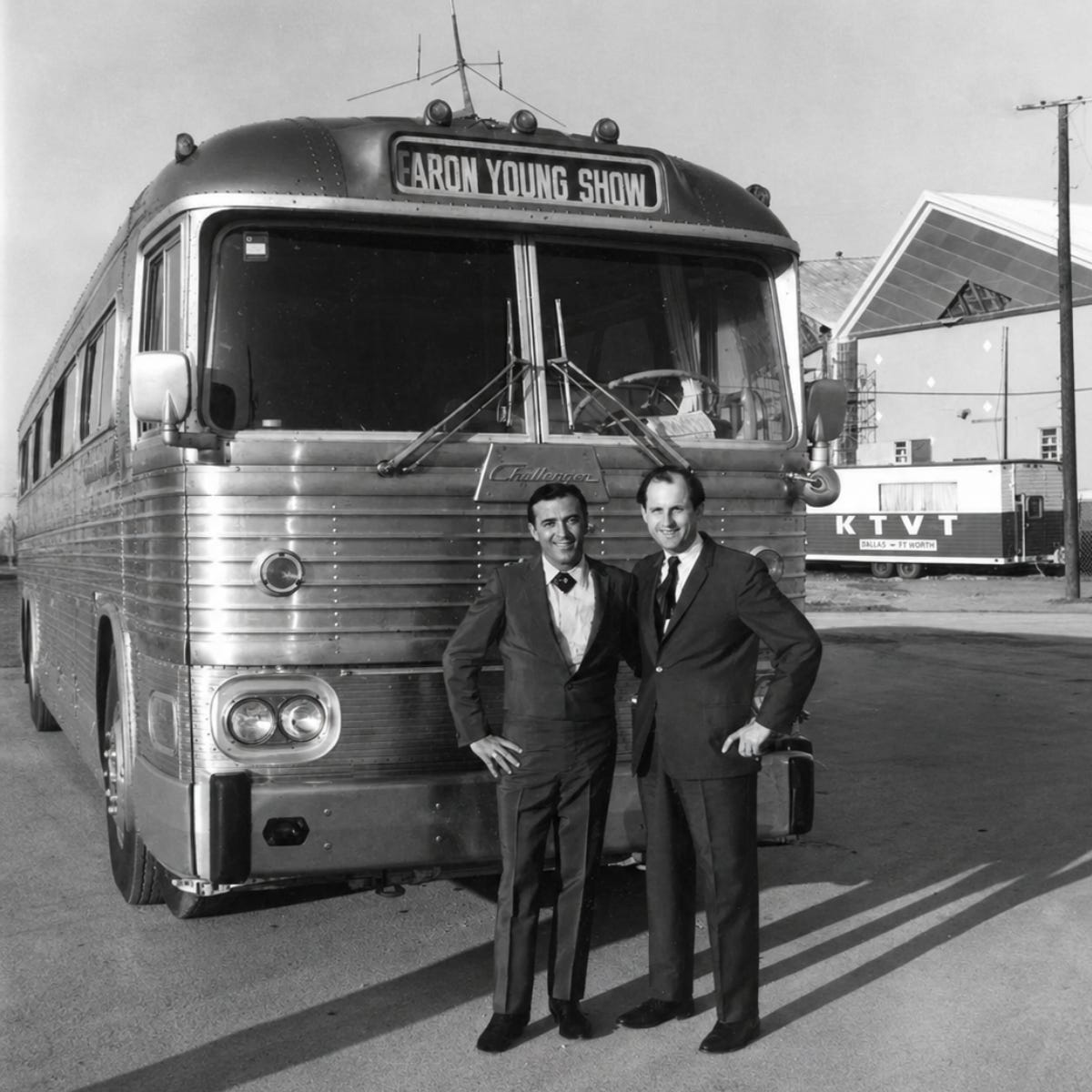
Billy Deaton booked the dates, and the dates did not care how you felt. A package might open in Texas, run clear up to Vancouver, cross Canada to Toronto, and come home through New York. Five hundred miles between shows was ordinary. You covered it on “those old yeller pills” and coffee, and the band would hole up in motel rooms picking for days at a time without anybody ever turning down a bed.
Faron’s stateroom took up the back of the bus, so when a sideman wanted out from under all of it he went to the shotgun seat, a little pull-out in the stairwell by the front door. Down in that well you could get away from the noise, or keep the driver company so he did not nod off at three in the morning.
Roni Stoneman was on that bus a lot in the seventies. Faron liked what a banjo did to his show, and he liked her. He called her “Olive Oyl,” rode her about her bird legs, and ran a clean bus, or at least he said he did. In practice, after a night of cards and beer, the trash can was a mountain of cans, sandwich halves, and cigarette butts.
One night everybody else was out cold and Stoneman slipped down into the stairwell to ride shotgun. The stateroom door opened. Faron saw the trash and lit into the empty bus about it. He had no idea she was down there. He grabbed the whole can and dumped it straight into the stairwell. Flat beer, sandwich halves, wet scraps, ashtray and all.
She sat under it for a second. Then she stood up.
Faron’s jaw dropped. “What the hell! I didn’t know you were down there!” And then he was laughing, hollering for the band to come look. “Look at ‘er. Look at Olive Oyl,” he said, and then: “Look at old bird legs herself!! Hot damn. I just . . . I’m sorry.” Stoneman said it was the only time in her life she heard Faron Young apologize to anybody for anything.
The prank that chipped a tooth
The two men who held that band together were Darrell McCall, who fronted the show and played bass, and Jerry Wayne “Cootie” Hunley on drums. Faron gave Hunley the nickname. Hunley gave Faron twenty-five years, more road time than any other musician who ever worked for him. McCall looked at Faron as something between a father and a big brother.
The band’s best weapon against The Beast started as a prank between those two.
McCall was driving one night, pipe in his teeth, when Hunley decided to get him. The aisle on that bus was so narrow that Hunley had to lie flat on his back and drag himself toward the driver’s seat an inch at a time. “Those aisles are small, and my ass is just a little bit bigger than those aisles. So it took me a long time to crawl on my back, to the front.”
McCall felt something at his boots. He looked down, and there was Cootie Hunley’s face looking up at him out of the dark floor of a moving bus. McCall bit straight through the pipe stem and chipped a front tooth.
Sock puppet therapy
McCall and Hunley noticed something in that chipped tooth. A sudden, stupid surprise can knock a man clean out of whatever mood he is in. They had a man on the bus who badly needed knocking out of his moods.
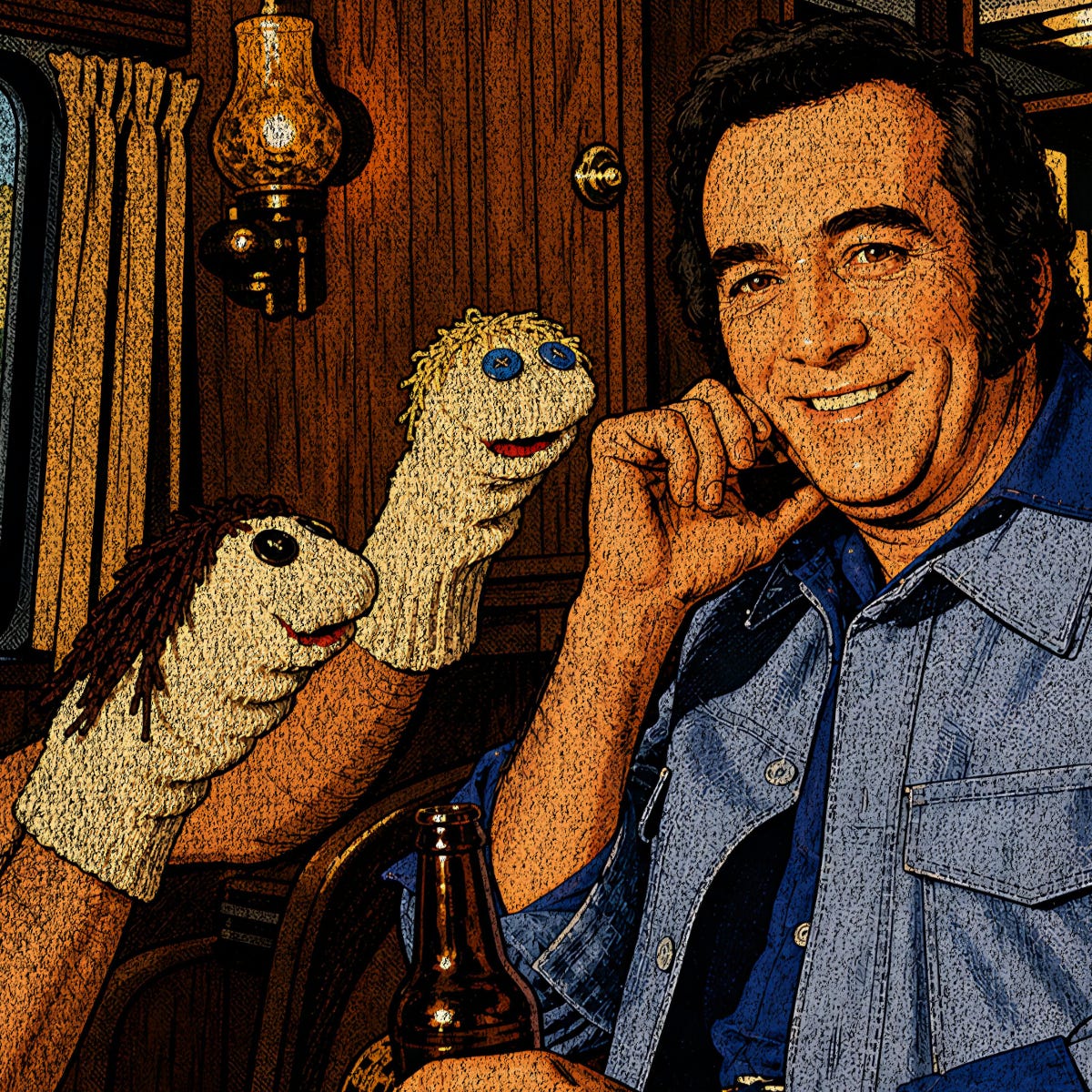
So when Faron came stomping up from the back looking for somebody to yell at, they ran what they called “Sock Puppet Therapy.”
McCall drew two big eyes on a plain white sock with a marker. The minute Faron started up the aisle, McCall dropped down into the front stairwell out of sight. Hunley got a flashlight, stood at the top of the steps, and pointed the beam straight down into the well while McCall stuck the sock up into the light.
And then McCall just talked. Voices, dumb jokes, whatever came into his head down there in the dark. “Everything was straight off the top of the head,” he said.
Faron could be as drunk and as mean as he got, and he would still reach the front of the bus, find a sock with marker eyes jabbering at him out of a stairwell under a flashlight, and stop cold. He would lean over the well and laugh until he could not breathe. McCall said he would be “just dying laughing. He didn’t want it to quit.” Nothing else on that bus could do it.
The singer behind all of it
Why did anybody stay? Because of what happened when he walked out under the lights.
He was fast and funny on stage, and crowds went home in love with him. The liquor never got to the voice. Earl Stiltner, another of his drivers, said Faron could be well into a bottle backstage, go out, and sing two flawless hours, and nobody in the house would ever know.
Stu Basore took the steel chair in 1990 and admitted he had been nervous about going back out on the road. Then he watched Faron work. “The Sheriff is who he is,” he said. “He’d get on the stage, and I’d set there and get cold chills, because—goddamn—he sang.”
Faron Young drank to cover something that hurt, and the drinking made a terror out of him. Sober, there were few better men in Nashville. The sidemen knew both of them. And for a good many years, what stood between the Sheriff and the Beast was a white sock with marker eyes, held up in a flashlight beam by a bass player crouched in a stairwell.
ABOUT THE AUTHOR
My name is Zachariah Malachi. I’m a full-time, self-employed honky tonk musician in Nashville, Tennessee. This Substack Publication was created for the purpose of sharpening my mind on more Nashville and Country Music history to share with the honky tonk patrons downtown during my shows—but I wanted more folks to benefit from the research, so it’s my gift to the country music fans of the world AND the people who WANT to be. Subscribe and come along for the ride.
John Barleycorn proved to be a stronger man again for ol' Faron. Great writing, Zachariah!
Another wonderful essay!! Love it