


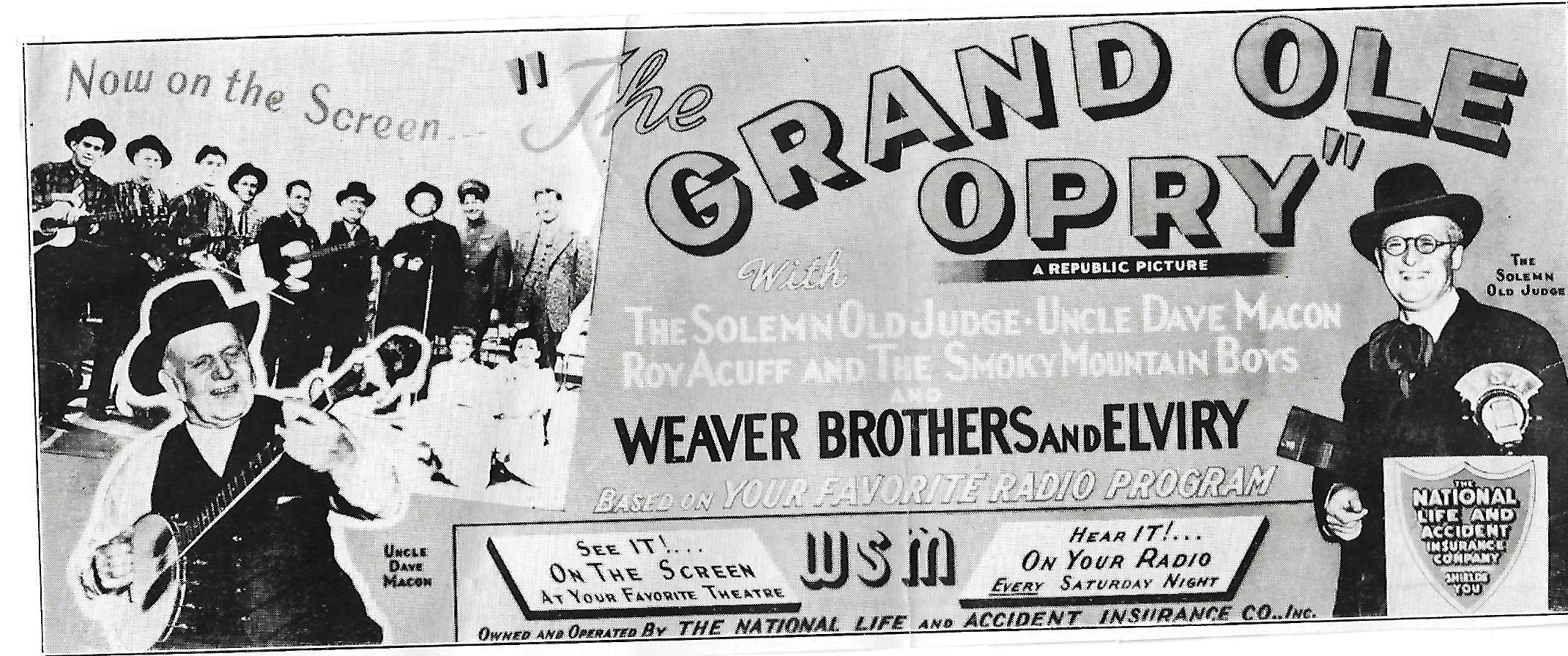
On June 25, 1940, Republic Pictures released Grand Ole Opry, directed by Frank McDonald. It’s a low-budget comedy built around the vaudeville antics of the Weaver Brothers and Elviry, but to be honest, the real story of that film isn’t in the plot at all.
It’s in what happened when Hollywood executives traveled to Nashville looking for one thing and found themselves in the presence of something they couldn’t manufacture: the architectural bones of what country music actually was.
The plot itself is flimsy and designed to be. Mayor Abner Weaver of a small town in the Ozarks gets tangled up with a corrupt political boss named William C. Scully. There’s a farm bill. There’s murder at the top—a governor dead in a duck hunt. And there’s the music playing underneath the whole mess, broadcasting over a radio channel, disrupting candidate speeches, turning the election toward an honest man who wants to help farmers instead of lining his own pockets.
It is, in other words, a test. Can music do what politicians and lawmen cannot? The film’s answer, across seventy minutes, is yes.
The Gravity of the 1940 Lineup
Here is what Republic spent money on: Roy Acuff and his Smoky Mountain Boys. Uncle Dave Macon and his son Dorris Macon, a guitar accompanist and a man who had carried that banjo through the minstrel circuits before the Opry even existed. And George Dewey Hay himself—”The Solemn Old Judge,” the man who had founded the Grand Ole Opry on WSM Radio in 1925 and watched it grow from a Saturday night local broadcast into something that had made the NBC network.
George Hay appears in the film as Judge George Hay. Same name. Same authority. The filmmakers understood the assignment: Hay was not just a personality. He was the institutional weight that held the whole thing together.
Roy Acuff by 1940 was not yet the “King of Country Music”—he would earn that title in the years ahead—but he was close. He was Roy Acuff in his sharpest form: a voice that could cut through static, a sense of melodrama that was genuine rather than performed. The film gives him moments to sing, to showcase that voice in its pure state, and those moments are the closest the picture gets to stopping time.
Uncle Dave Macon is the archival miracle of the film. He was born in 1870, which means he was seventy years old when he walked in front of the camera. His stage dress—plug hat, tail coat, white chin whiskers—was barely exaggerated from his own daily wear. He had earned his nickname “The Dixie Dewdrop” not through marketing but through decades of actual performance on the vaudeville circuit, in tent shows, at homecomings and hoedowns across the South. The only film appearance of his entire life is in Grand Ole Opry, recorded in 1940. He sang “Take Me Back to My Smokey Mountain Home” with Dorris, and that recording—that brief moment of celluloid—is now one of the most valuable documents of what he sounded like, what he moved like, what his particular brand of music-hall sincerity looked like when translated to the Hollywood frame.
To be honest, you cannot separate Uncle Dave Macon from what the Opry actually was at its root: minstrel tradition, medicine show energy, a man who played the banjo as if he were wrestling conversation out of it.
The Geography of the Invented Space
The film was not shot at the Grand Ole Opry, nor was it shot in Nashville. Republic Pictures built a version of the country dreamscape on studio backlots—somewhere in the Hollywood ecosystem, somewhere that could be dressed and lit and controlled. The setting is the Ozarks, a fictional town called Hopeville, and the entire physical world is as constructed as any other studio production.
And yet.
The credit card on the film reads “Grand Ole Opry used courtesy of Radio Station WSM, Nashville, Tennessee.” WSM permitted them to use the name, the reputation, the institutional permission. In exchange, Republic sent a troupe of its own vaudeville comics (the Weavers, Elviry, supporting players) and filmed it all in Hollywood while the real Opry kept broadcasting on Saturday nights in Nashville.
What matters is not the location. What matters is that in 1940, a studio felt that country music was valuable enough to pursue, important enough to center an entire film around, even if that film was a vehicle for performers whose primary skill was pratfalls and comic timing. The Weaver Brothers get top billing and the slapstick. Roy Acuff, Uncle Dave Macon, and George Hay get the dignity. And the message underneath is clear: we know which way the wind is blowing. We know what the audience came to see.
The Seismic Shift We’re Still Living In
To sit with the 1940 Grand Ole Opry film now is to watch a hinge moment. You are watching the institution recognize itself as having value. You are watching a studio court a music form by sending executive talent scouts across the country. You are watching the Opry perform as the Opry, not as some exoticized novelty.
Roy Acuff’s 1940 performance in that film—concentrated, without apology, carried forward in his voice—is closer to the Roy Acuff of 1950, 1960, 1970 than to anything before. Uncle Dave Macon at seventy, recorded once on film, gave the world the only visual document of that tradition as it actually moved through a human body.
And George D. Hay, presiding over the courtroom trial that anchors the film’s plot, is performing what he had been practicing for fifteen years: the role of the judge of taste, the arbiter of legitimacy, the voice that says yes, this matters.
The irony, of course, is that the film itself is a period piece now. Seventy-five years later, we watch it not for the Weaver Brothers’ comedy but for the six or seven minutes of Roy Acuff and Uncle Dave Macon in their prime, recorded once, preserved in celluloid. We watch it for the institutional self-confidence: a major studio, in wartime America, deciding that country music was worth investing in.
That decision rippled forward. The Opry survived. Roy Acuff became what he promised to become. Uncle Dave Macon left behind the only film footage the world will ever have of him. And George Hay, standing in that fictional courtroom as Judge George Hay, gets to preside over the idea that the music matters more than the politics, that the honest voice can be amplified across radio waves and into the homes of farmers who need to hear it.
That’s what you’re actually watching. Not the plot. Not the Weavers. That.
ABOUT THE AUTHOR:
My name is Zachariah Malachi. I’m a full-time, self-employed honky tonk musician in Nashville, Tennessee. This Substack Publication was created for the purpose of sharpening my mind on more Nashville and Country Music history to share with the honky tonk patrons downtown during my shows - but I wanted more folks to benefit from the research so - it’s my gift to the country music fans of the world AND the people who WANT to be. Subscribe and come along for the ride.
Wonderful!!