


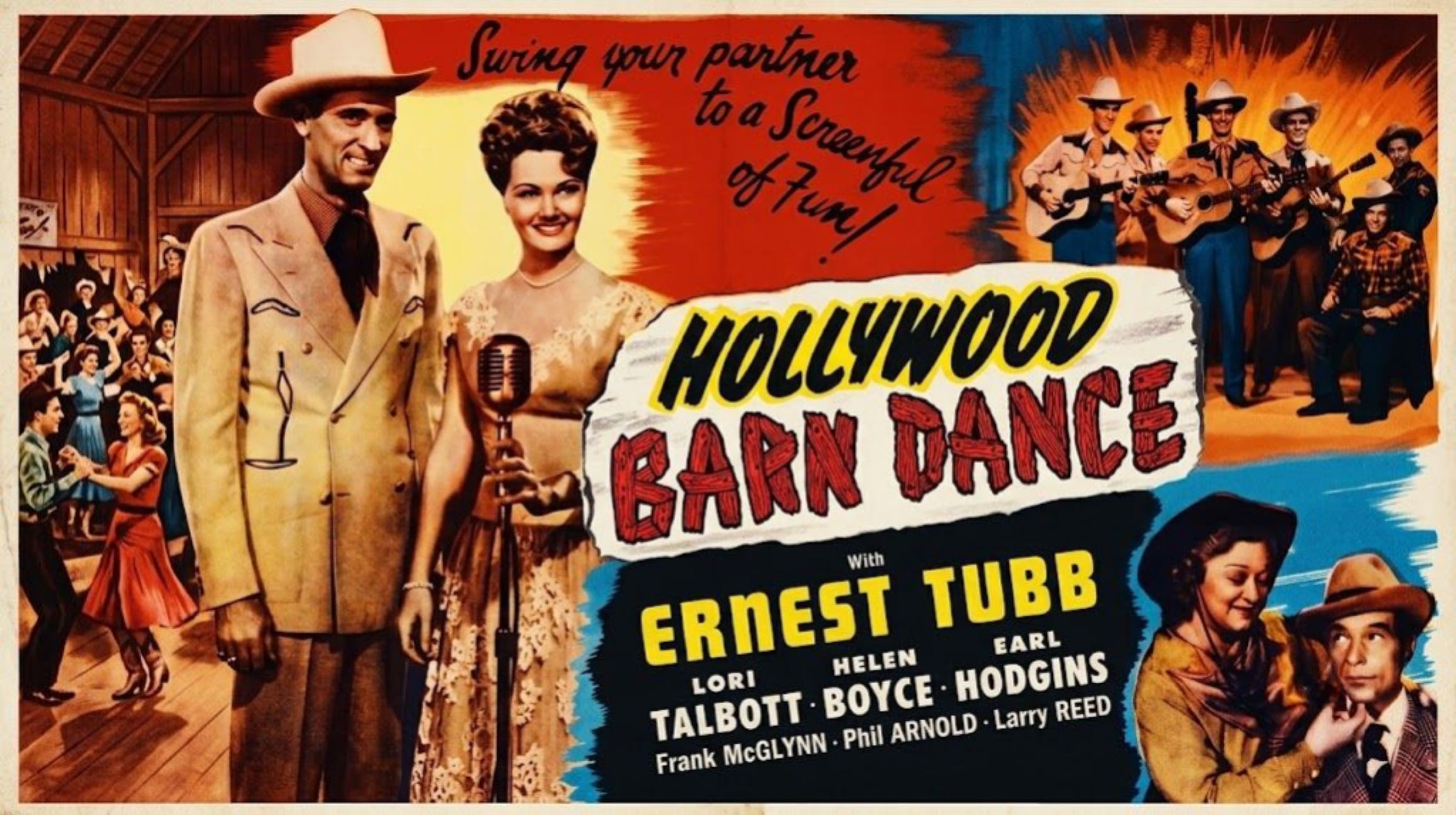
On November 21, 1947, Jack Schwarz Productions released Hollywood Barn Dance, directed by Bernard B. Ray. It’s a poverty-row picture built around what was left of a CBS radio broadcast, a thin plot about a church that burned down, and a mandate from the studio to get eighteen songs on screen. It’s a low-budget musical dressed up as a second feature—the kind of picture you’d see while waiting for the movie you actually paid to see.
But to be honest, the real story of that film isn’t in what was planned at all.
It’s in what happened when a studio acquired the title of a radio show, shot that title into a Hollywood soundstage, and discovered they had captured something that radio could only hint at: Ernest Tubb in his prime, recorded once on celluloid, performing as himself with the Texas Troubadours backing him like they’d been rehearsing for this moment their entire lives.
The plot is serviceable and asks you to care about it for exactly as long as it takes to get to the next song. Ernest Tubb and his band have burned down their church—accidentally, during rehearsal—and they need two thousand dollars to rebuild it. They hit the road. They get tangled with a fast-talking manager named Cartwright who loses all their money in a poker game. The manager sends them to his sister-in-law’s house. A woman joins the band. Eventually, they audition for the Hollywood Barn Dance radio show itself, the broadcast that gives the picture its name and its permission to exist.
It is, in other words, a love letter disguised as a plot. And what the letter is actually saying is this: we know what you are. We know what you sound like. We know you matter.
The Architecture of Ernest Tubb in 1947
Here is what matters about the 1947 Hollywood Barn Dance: it is the only starring film Ernest Tubb ever made. And Bernard B. Ray, a poverty-row director whose career was already beginning its descent—he would direct only four more pictures in the twelve years before his death in 1964—was shrewd enough to know that the less Tubb had to act, the better the picture would be.
And so Tubb, credited in the film as playing “Ernie,” is essentially playing Ernest Tubb. He wears his own authenticity like a working suit. He doesn’t perform. He exists.
By 1947, Ernest Tubb was already established as the architect of what would become the Nashville Sound. He’d recorded “Walking the Floor Over You” in 1941—a song that would define him across the next sixty years. He’d served, and he’d survived. The war was over. The servicemen were home. And here, on a Hollywood soundstage dressed to look like nothing particular, Tubb was permitted to sing eighteen songs in a row, backed by the Texas Troubadours, without the filter of radio distortion or the compression of a single three-minute 78.
The camera watches him. The camera watches his hands. The camera captures what Tubb understood about the guitar: that it was an extension of the voice, that the instrument and the man were not separate things.
To be honest, this is the visual document of what Ernest Tubb actually was in the moment before he became a legend. Not yet King—that title wouldn’t settle on him until later—but already something unmistakable. A man who could carry the entire weight of a tradition on his shoulders without bending.
The film permits him to do this. Eighteen times.
Jack Guthrie, the Shorts, and the Constellation
But Ernest Tubb is not alone in that picture, and that is where the real architecture becomes visible.
Jack Guthrie appears in Hollywood Barn Dance as himself—or as close to himself as the format would allow. Guthrie was Woody’s cousin, a fact that would be forgotten almost immediately after this film, buried under decades of folk music historiography that preferred Woody to everyone, including the people who were actually related to him. But in 1947, Jack Guthrie was a performing musician in his own right, a honky tonk singer with authentic credentials and the kind of voice that didn’t require a studio to sound good—it just required a microphone and a song to prove it.
And Jimmy and Leon Short, known as “The Short Brothers,” appear in the film as performers—two musicians whose names barely register in country music history now, seventy-seven years later, but who were skilled enough, competent enough, authentic enough that a low-budget studio was willing to commit their faces and their music to celluloid.
This is not a lineup designed to impress Hollywood. This is a lineup designed to impress people who actually knew what country music sounded like. The studio was courting not the critics or the industry. They were courting the audience. And the audience for country music in 1947 was not sitting in the orchestra section of a theater. They were sitting in the balcony. They were watching between shifts. They knew the difference between authentic and performed.
The Texas Troubadours—backing Tubb through every song, through every moment—are the connective tissue. They are the reason a church-burning plot and a manager-embezzlement subplot don’t collapse under their own weight. They are the reason you watch the film not for the narrative but for the six or seven minutes between each song, when the camera lingers on an instrumental passage and you realize that these men have been playing this music together since before the war, since before radio was a serious business, since before anyone thought country music was worth thirty-five millimeters of film.
The Poverty Row Architecture
Bernard B. Ray directed Hollywood Barn Dance on what is now called a “Poverty Row” budget—cheap sets, cheap stock shots, the kind of production design that was already looking shabby while the film was being made. Ray had been a bigger name a decade earlier, a writer and producer in the Gower Gulch ecosystem of Hollywood’s Western film community. But by 1947, he was directing pictures that were built to fill time, to occupy the lower half of a double feature, to generate revenue from places that didn’t have access to first-run productions.
And yet.
The studio purchased the rights to the Hollywood Barn Dance radio program. The radio show had aired on CBS from 1943 to 1947, originally hosted by Cottonseed Clark. It was a replacement broadcast—Gene Autry’s Melody Ranch had gone off the air while Autry was serving in the Army Air Force during the war. When Autry returned, the Hollywood Barn Dance radio show was phased out, its name purchased and converted into a motion picture because someone in the studio understood that there was residual goodwill attached to that name. And that goodwill was worth something.
But here’s the real architecture: the studio bought the name of the radio program. They did not buy its cast. No member of the 1947 radio cast appears in the film. Instead, the studio brought in Ernest Tubb—a man whose reputation was built in the South and in Texas, a man whose radio presence had been forged on WSM’s Grand Ole Opry broadcasts and on Decca recordings, a man whose authenticity could not be manufactured because it had been earned through years of performing in dance halls and honky tonks where the audience was unforgiving.
The equation is stark: the studio understood that the audience didn’t care about the radio program’s cast. The audience cared about country music. And in 1947, country music meant Ernest Tubb.
What You’re Actually Watching
To sit with Hollywood Barn Dance now is to watch a studio system in transition. You are watching a major production house make a picture designed for the second half of a double feature, on a budget that was already constricted, and fill it with musicians who were regarded as regional talent rather than national stars. You are watching a director whose career was winding down direct eighteen musical numbers with the precision and care of someone who understood that the music was the only thing that mattered.
Roy Acuff, in the 1940 Grand Ole Opry film, was permitted to be Roy Acuff. He was given moments. He was honored.
Ernest Tubb, in the 1947 Hollywood Barn Dance, is given the entire film. The plot is a scaffolding. The songs are the structure. The Texas Troubadours are not accompaniment—they are partners.
The irony is not gentle. This cheap, hastily-assembled picture—a film designed to fill time in second-run theaters, in small towns, in places where they didn’t have access to the major releases—turned out to be the only starring film Ernest Tubb ever made. And because of that accident of production, because of that poverty-row budget and that winding-down director and that one studio’s decision to buy a radio program’s name and fill it with the best country musicians they could afford, we have a visual record of Ernest Tubb that is more complete, more genuine, more unguarded than anything that would follow.
The camera watches him play. The camera watches him sing. The camera captures the sound that would define the next fifty years of country music in Nashville—not the pop-inflected, orchestra-laden sound of what would come later, but the lean, true sound of a guitar and a voice and a band that had been playing together through the Depression and the war and into an uncertain peace.
That’s what you’re actually watching. Not the plot. Not the burned church or the lost money or the happy ending. That.
You’re watching the moment before the legend. You’re watching a man who was already essential, already true, already exactly what he would remain for the rest of his life. And you’re watching him get that recorded. That preserved. That permanent.
ABOUT THE AUTHOR:
My name is Zachariah Malachi. I’m a full-time, self-employed honky tonk musician in Nashville, Tennessee. This Substack Publication was created for the purpose of sharpening my mind on more Nashville and Country Music history to share with the honky tonk patrons downtown during my shows—but I wanted more folks to benefit from the research, so it’s my gift to the country music fans of the world AND the people who WANT to be. Subscribe and come along for the ride.