


There’s a sonic identity in music that doesn’t belong to any instrument, not really. It belongs to something breaking. A circuit at its limit. Electricity turned on itself. It’s the sound of the beautiful mistake — and it was born in a Nashville recording studio during a soft, piano-led country ballad about heartbreak.
Nobody planned for it. Nobody asked for it. One man absolutely hated it when he heard it. But a lot of people loved it.
Which is why it changed everything.
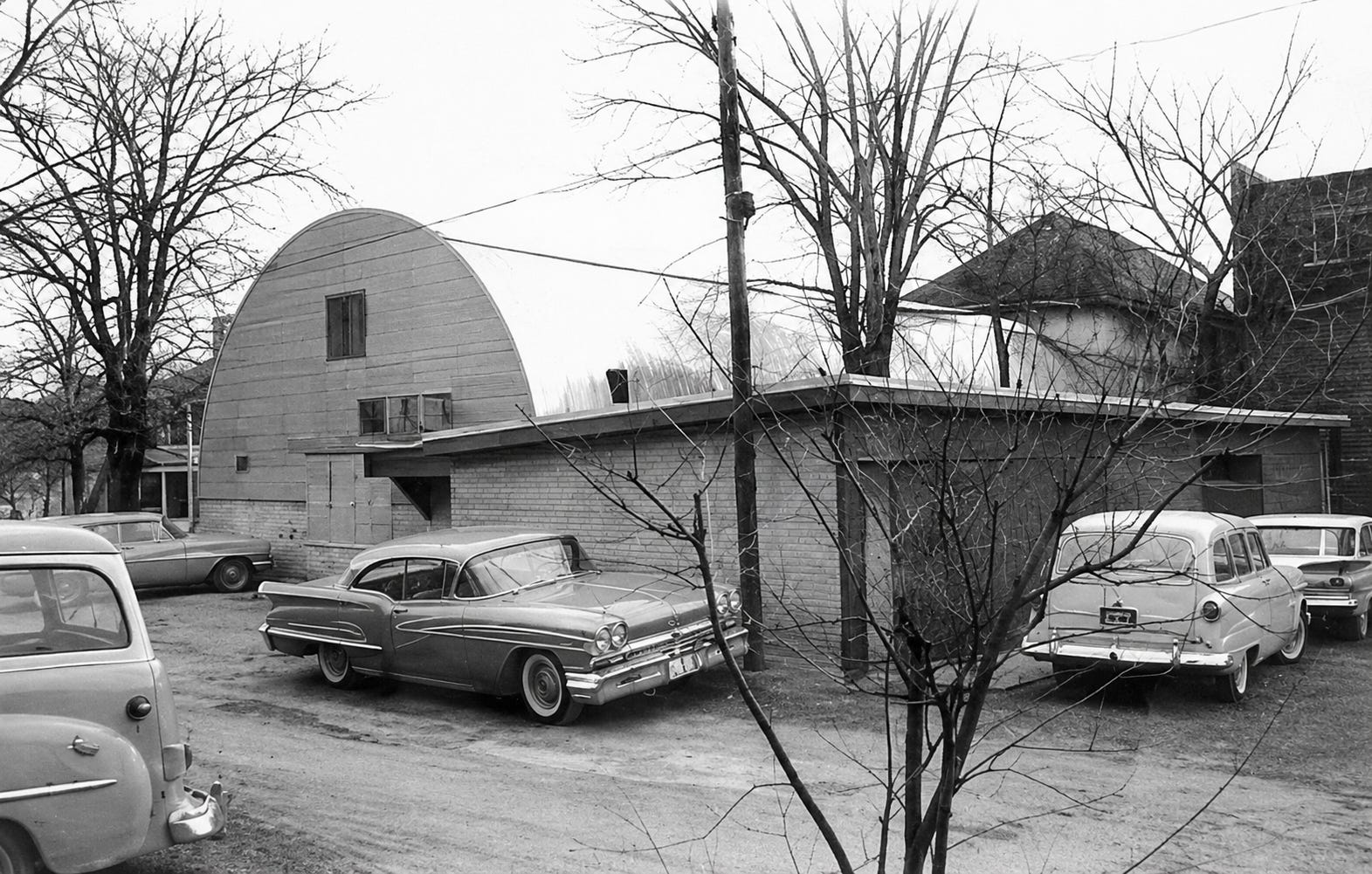
Bradley Studio B, 1960. The Quonset Hut.
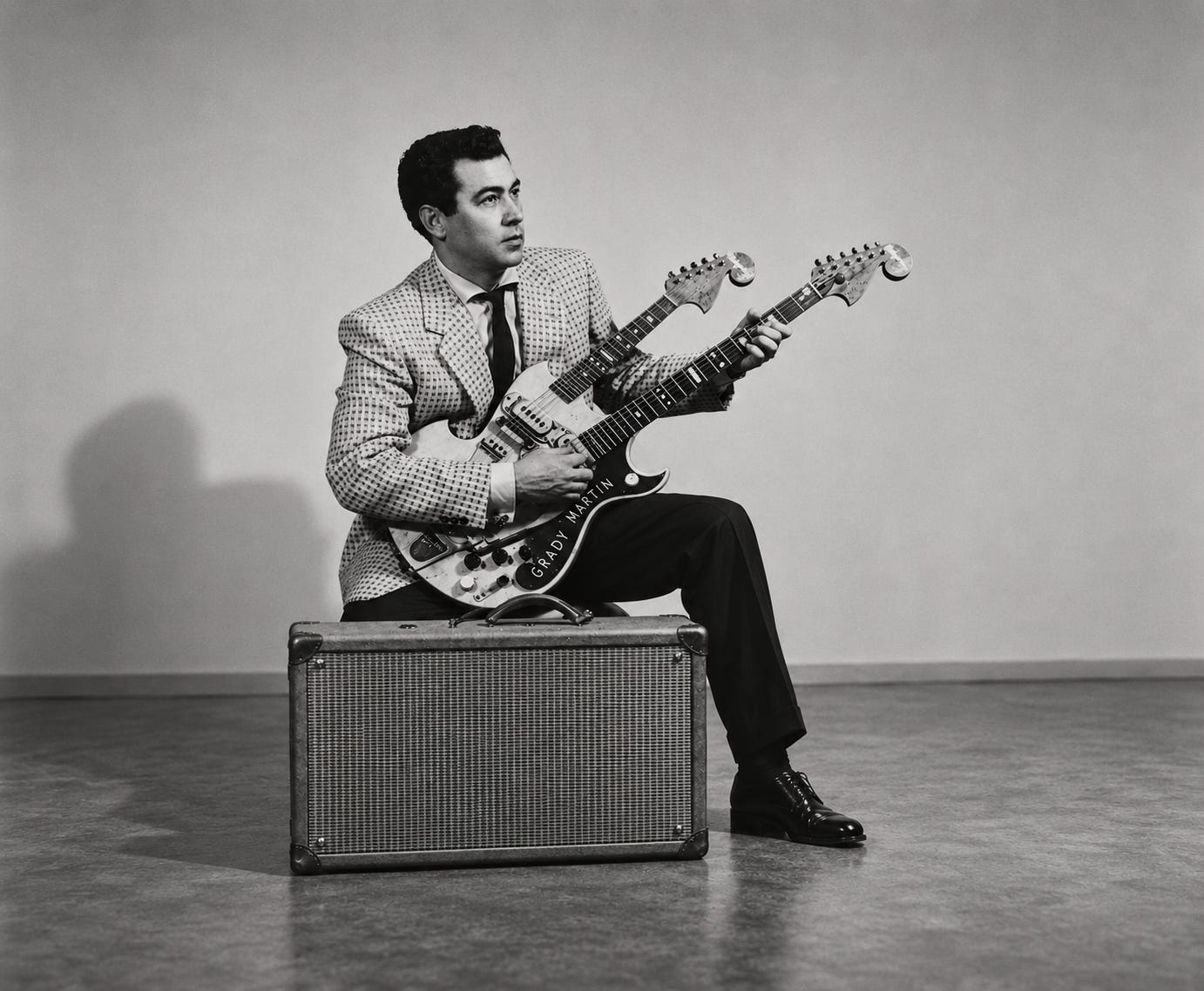
Grady Martin was arguably one of the top session guitarists in Nashville — maybe in the world at that particular moment. His hands are on more classic recordings than most people have names for. He played on Marty Robbins’ “El Paso.” He was the secret weapon on Loretta Lynn’s “Coal Miner’s Daughter.” If you loved country music in the 1950s and early ‘60s, you loved Grady Martin whether you knew you did or not. He was everywhere and invisible, the way the best session men always are.
On the day in question, he was playing six-string bass — a Danelectro, strapped low and run through the console. The song was Marty Robbins’ “Don’t Worry.” A heartbreak song. Simple. Clean. The kind of record that made country radio feel like a back porch conversation.
Then something went wrong.
The Quonset Hut studio had recently received a new custom-built console outfitted with Langevin 116 tube amplifiers. The Langevin company had moved to California and farmed out a batch of output transformers to another manufacturer. At least 35 of these transformers ended up in the console at Bradley Studios — and they started to go bad. One of them, on the channel Grady Martin was plugged into, developed what engineers suspected was an open primary winding. With roughly 250 volts DC running through that winding, a tiny arc developed — and that arc caused a peculiar, unprecedented sound.
Martin’s six-string bass, in the bridge section of “Don’t Worry,” sounded like it had been dragged through a hornet’s nest. Ragged, buzzing, furious. Like a saxophone played by something with teeth.
Grady Martin did not like it.
What the engineer heard
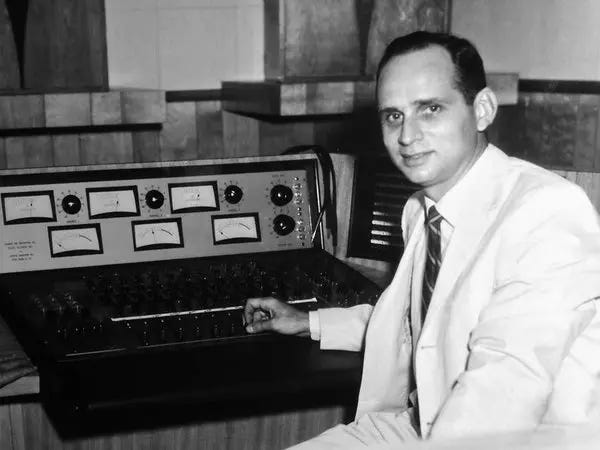
Glenn Snoddy was behind the glass. He heard it too. The distorted sound initially troubled him, and he requested a redo. Standard procedure. You fix the problem and you keep going.
But Marty Robbins, producer Don Law, and the other musicians in the room stopped him. Wait. Something about what they’d just heard — that broken, snarling intrusion in the middle of an otherwise gentle country ballad — was not nothing. It was something no one had ever heard on a record before. Something that shouldn’t work but did.
They kept it.
“Don’t Worry” was released in February 1961. It reached number one on the country chart and stayed there for ten weeks. It crossed over to the pop chart and peaked at number three on the Hot 100. For most country songs of that era, that’s that. A hit song. Sweet.
Except for what happened at the 1:25 mark.
A noise that cannot be unheard.
Once “Don’t Worry” was on the radio, the questions started coming. What is that sound? How do we get it?
Snoddy tried to duplicate it in the studio and couldn’t. The transformer was the transformer — a defect, a fluke, not a reliable piece of equipment anyone could bottle and sell. But the demand was real. Musicians heard that sound and wanted it. Needed it. Something about it reached into the chest and pulled.
Grady Martin continued using the same malfunctioning preamplifier and recorded an instrumental called “The Fuzz” in 1961 under his own name, leaning directly into the accident. That track reached the ears of The Ventures, who came looking for a way to reproduce it.
Snoddy understood what they wanted. He just had to figure out how to build it.
From Tube to Transistor
The broken transformer was a tube circuit misbehaving. Snoddy’s challenge was to make that misbehavior intentional — controllable — and available to anyone who wanted it on any stage or in any studio.
He teamed up with fellow WSM radio engineer Revis Virgil Hobbs and built a standalone device entirely based around three 1N270 germanium transistors — designed to intentionally recreate the fuzzy effect. The result was a pedal that let you go from a clean to a distorted sound simply by pressing a button with your foot.
The fuzz box.
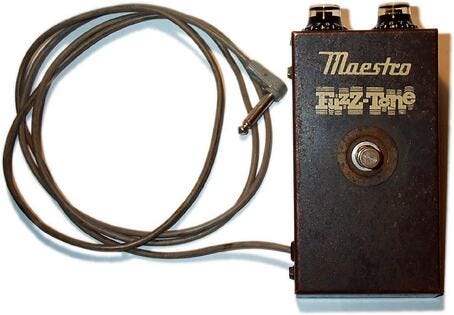
They sold the circuit to Gibson, who introduced it in 1962 as the Maestro FZ-1 Fuzz-Tone — the first commercially available fuzz pedal. It was powered by two 1.5-volt batteries, and it was originally marketed as a way to make your guitar sound like a brass instrument.
A brass instrument. That’s how they sold it. That instinct was correct — there’s something horn-like about that clipped, saturated buzz — but nobody could have predicted what the thing was actually going to become.
The Pedal That Waited
For its first few years, the Maestro sat on the shelf. Gibson reportedly sold a grand total of three units over the course of two years. The company nearly let the whole experiment die.
Then 1965 happened.
Keith Richards picked up his Maestro FZ-1 and played the opening riff of “(I Can’t Get No) Satisfaction.” Gibson sold 40,000 pedals in the wake of that song’s success.
One riff. One number. And the entire history of rock guitar changed shape overnight.
What happened next is what you already know, or think you know. The Fuzz Face. The Tone Bender. Jimi Hendrix running one into a wall of Marshalls and rewriting what the electric guitar was capable of. The Big Muff Pi arriving in the late ‘60s and eventually becoming the sound of a generation of alternative and grunge records. Every overdriven amp, every blown speaker treated as a feature, every piece of “distortion” in the signal chain across sixty years of popular music — all of it traces a bloodline back to a single bad transformer in a Nashville ballad session.
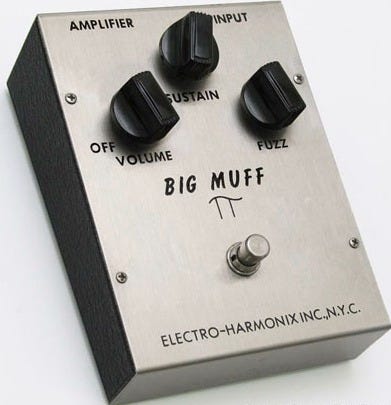
What They Were Actually Making
Here’s what I keep thinking back to..
“Don’t Worry” is a country song. A country song — Nashville, 1960, steel guitar and piano and a silk-throated Marty Robbins telling a woman everything is going to be fine. It is about as far from rock and roll mythology as a record can get. And yet it is the ground zero of one of the defining sonic signatures of rock and roll.
The fuzz tone came out of the most professional, controlled, polished recording environment in country music — the Quonset Hut, Bradley Studios, Nashville — because a transformer failed at the wrong moment.
Or the right moment. Depending on how you see it.
Grady Martin hated the sound so much. Glenn Snoddy was annoyed by it. The engineer asked for a redo. And the greatest sonic accident in popular music history almost got fixed before anyone could hear it.
But this was also a time when music makers were more risky in their choices — which is what ended up making them pioneers down the line.
That’s the thing about accidents that become genius. They are almost always one decision away from the trash can. Robbins said keep it. Don Law agreed. Snoddy stepped back from the board.
And the rest of us got the sound of distortion.
Metalheads, thank Country music. Yeah, I’m talking to you.
The Maestro FZ-1 Fuzz-Tone was introduced by Gibson in 1962. Glenn Snoddy died in 2018 at the age of 96. Grady Martin passed in 2001. His hands are on hundreds of Nashville recordings — but the one that lit the fuse was a broken bass channel on a heartbreak song that almost got re-recorded clean.
You can hear it at 1:25. Don’t skip to it. Listen to the song in it’s entirety.
ABOUT THE AUTHOR:
My name is Zachariah Malachi. I’m a full-time, self-employed honky tonk musician in Nashville, Tennessee. This Substack Publication was created for the purpose of sharpening my mind on more Nashville and Country Music history to share with the honky tonk patrons downtown during my shows - but I wanted more folks to benefit from the research so - it’s my gift to the country music fans of the world AND the people who WANT to be. Subscribe and come along for the ride.
had no idea what to listen for at the beginning of your article. Just went to Apple Music and started playing "Don't Worry," and then as I was reading about this weird fuzz, it hit on the song, and... well, that was pretty cool. Thank you for this!
Great. I live in Nashville now. Great history