


My family’s roots in Tennessee go back to when Tennessee was still North Carolina. One of my ancestors helped draw the actual border between the two states — the line that made Tennessee Tennessee. I grew up knowing that, and taking real pride in it.
I also grew up in Metro Detroit.
Not instead of Tennessee — alongside it. My school semesters were in Michigan. My summers and the geography of my blood were somewhere else entirely. The reason my family was in Detroit is the same reason hundreds of thousands of Southern families ended up in Detroit: the automobile industry pulled them north the way a strong current pulls everything in the river. My grandfather worked the assembly line at Cadillac Motors. He was one of the men Ford’s industrial expansion had made necessary, one of the Southern migrants who arrived in the city with a set of skills that translated directly into factory work and stayed because the wages were real and the farm back home couldn’t match them.
I grew up obsessed with cars because of him. I went on field trips to the Henry Ford Museum in Dearborn. I visited the Henry Ford mansion. I ended up on the Dean’s List at Henry Ford College — which, to be honest, is not the accomplishment it sounds like, but it happened. My first car was a dark 1997 Ford Mustang GT Convertible, which was beautiful in every season except Michigan winter, when the tire situation became a recurring crisis I was not emotionally or financially prepared for. I didn’t even get my license until I was eighteen. I lived walking distance from my high school, had older friends with cars, and couldn’t see the point of rushing into a license only to then immediately need a job to pay for gas. So I waited.
I tell you all of this because the story I’m about to tell you is, in a way that I didn’t fully understand until I started writing this piece, my family’s story. Henry Ford built the machine that brought my grandfather to Detroit. And then, simultaneously, he spent a fortune trying to preserve the very culture my grandfather carried north in his chest and never fully left behind.
The irony of that has been sitting with me for a while now.
Dearborn, Michigan - 1925
The smoke rising from the River Rouge plant in Dearborn, Michigan, in 1925 was the color of a wet slate shingle. It hung over the Detroit River like a curtain, a monument to the efficiency Ford had spent thirty years perfecting. He had taken horse-and-buggy America, melted it down in his blast furnaces, and rebuilt it from steel and rubber and the standardized repetitive motion of the assembly line. He had produced an automobile cheap enough for the common laborer to own, and in doing so had reshaped the American landscape more completely than almost anything before or since.
And he hated what he saw happening to the country he had modernized.
Ford looked at the 1920s and saw a moral sewer. He saw a generation of young people who had cut their hair, shortened their skirts, and abandoned the family parlor to drink bathtub gin in the backseat of his own Model Ts. He heard jazz drifting out of basement speakeasies and it made his stomach turn in a way that was not casual disgust but something closer to genuine alarm — the alarm of a man who believed that the music a civilization dances to is the music it becomes. To Ford, jazz was not an art form. It was a toxin being administered to Anglo-Saxon youth by a syndicate he had decided to name in public.
His response was not a lawsuit or a lobbying campaign. It was a fiddle.
The Newspaper and the Conspiracy
Ford was a man of contradictions so extreme that it takes a moment to hold them all in the same frame. He was the pioneer of modern industrial capitalism and also a man who spent millions collecting pieces of a pre-industrial past he never stopped mourning — buying up historic schoolhouses, general stores, old buildings, relocating them to his Greenfield Village museum in Dearborn, trying to freeze time inside a compound in Michigan while his factories did more to accelerate time than almost anything else in human history. He had grown up on a hardscrabble farm and become the richest man in America and never fully reconciled those two facts. The farm was what he trusted. The wealth was what he had.
The music of the twenties was a daily insult to the version of America he was trying to preserve in amber. In the pages of his personal newspaper, the Dearborn Independent — which he distributed through Ford dealerships and required his employees to read — Ford published front-page attacks on jazz as a product of Jewish cultural engineering, a deliberate campaign to corrupt the moral fiber of the nation’s youth. He stood behind that sentiment for a long time. Jazz was a soul-ruining evil, the paper warned. It was a music of rebellion against the rock-ribbed social restraints of the church. It was un-American, and it was intentional, and it had to be countered.
Ford’s counter wasn’t legislation. It was dance.
His theory was that if you gave Americans the right music to move to — clean, traditional, rooted in the rural past — the moral chaos of the Jazz Age would simply fail to find purchase. In 1925 he hired Benjamin Lovett, a professional dancing master from New England, and brought him to Dearborn on a permanent salary to design a standardized curriculum of old-time square dances, reels, and contras. Ford didn’t suggest this curriculum to his employees. He mandated it. High-ranking executives and their wives were required to attend formal square dances in his private ballroom on a weekly basis. Show up in the wrong attire, refuse to learn the Grand Square, fail to demonstrate sufficient enthusiasm for the Virginia Reel — and your corporate future at Ford Motor Company got quietly, systematically shorter.
To take the movement national, he needed something more than a dancing master and a ballroom. He needed a symbol. He needed a face for the thing he was building — something that could compete in the public imagination with the slick-haired jazz bandleaders of New York and Chicago. He went looking for the finest old-time fiddler in America.
The Tennessee Fiddler and the Silk Canopy Bed
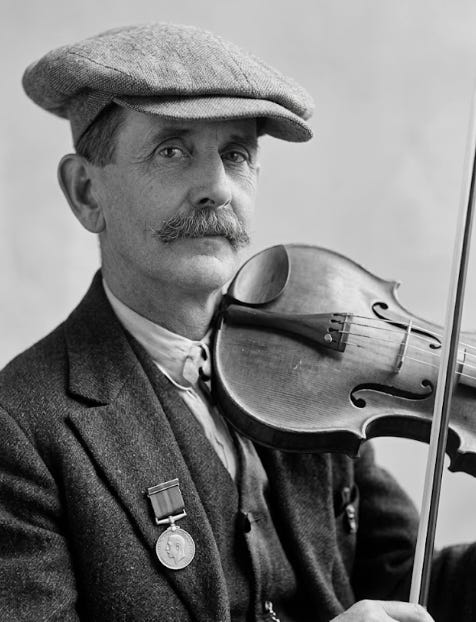
In early 1926, Ford sponsored a series of regional old-time fiddle contests across the country, offering prize money and the possibility of a personal audience with the billionaire himself. The national press was already half-amused and half-fascinated by the spectacle of Ford Motor Company promoting square dancing, and when a dirt-poor tenant farmer from Readyville, Tennessee, named John L. Stephens — known locally as Uncle Bunt — won the regional contest in his area, playing “Sallie Gooden” on a battered fiddle with a raw double-stop style that sounded like it had been handed down from somewhere before living memory, the newspapers got what they had been waiting for.
Henry Ford summoned him to Dearborn.
For two weeks, Uncle Bunt Stephens was the personal houseguest of the richest man in the world. The papers ran daily features about it, most of them patronizing in a way that tells you more about the journalists writing them than about Stephens himself — the mountain man in the lavish European-style parlors, the tenant farmer in the silk canopy beds, the old fiddler playing “Turkey in the Straw” and “Old Hen Cackled” for an audience of corporate executives who watched him like he was a museum piece. Stephens, by every account, was completely unfazed. He kept his worn work shoes on in the parlor. He tuned his fiddle the same way he tuned it at home. He played what he played and didn’t perform bewilderment at the surroundings for the benefit of anybody watching.
Ford was ecstatic. He saw Stephens as proof of everything he believed — a man of unsophisticated decency, untouched by the corrupting forces of commerce and urban life, the living embodiment of the rural American soul that Ford was spending millions to memorialize and defend. He gave Stephens a tailored suit, a new Lincoln automobile, and a pocket full of cash. Stephens thanked him, took the gifts, and drove back to Tennessee. Within a week of his return he was spotted sitting on a woodpile in his old overalls, playing his fiddle for local farmhands. The Lincoln was in the yard. The suit, presumably, was somewhere inside. What Stephens had been before Dearborn is what Stephens still was, which may be the most interesting thing about the entire episode.
The Machine That Ate the Village
Here is the part of the story that Ford never fully reckoned with, and that makes the whole project read, in retrospect, like a very expensive form of self-sabotage.
The single greatest destroyer of the rural isolation Ford was trying to preserve was his own car.
Before the Model T, the traditional music of the Southern hills and valleys had evolved slowly and quietly inside a geography that protected it — poor roads, limited infrastructure, almost no mass media. The isolation was the condition. It was what allowed regional styles to develop their own particular character without being immediately flattened by commercial influence from outside. Ford’s assembly line ended that condition more decisively than anything else in American history. It put cheap, reliable transportation in the hands of people who had never been fully mobile before. And then it put those same people to work in factories that needed bodies, and it paid wages the farm back home couldn’t match.
My grandfather was one of those people. He came north from Tennessee and went to work on the Cadillac line because that’s where the work was. He carried the South with him the way all of them did — in his music, in his cooking, in the accent that never fully left — and he built a life in Michigan that was genuinely his, not a lesser version of the Tennessee life he’d left. That story repeated itself hundreds of thousands of times across Detroit and Chicago and Cincinnati and every other industrial city that needed the labor the South had to offer.
And once those migrants arrived in the cities, they didn’t spend their Saturday nights in Ford’s approved ballrooms learning the contras that Benjamin Lovett had codified. They went to the honky-tonks. They went to the rowdy smoke-filled beer joints where the acoustic string music of their childhoods was being electrified to cut through the crowd noise, amplified and commercialized and pushed through 50,000-watt clear-channel radio stations between advertisements for hair tonic and patent laxatives. The music followed the people into the cities and the cities changed the music and the music that came back out the other side was not what Ford had been trying to protect. It was something new. Something that carried the Tennessee blood and the Detroit noise in the same body.
The yeoman farmers and millhands Ford had championed as the moral backbone of the nation had taken his roads and his wages and built their own culture with them — raw, electrified, commercially oriented, not especially interested in Henry Ford’s opinion of it. While Ford sat in Dearborn romanticizing the simple joy of the pre-industrial past, the actual working class he was romanticizing was doing something more complicated and more alive than nostalgia.
What the Fiddle Contest Proved
Ford spent somewhere between five hundred thousand and a million dollars on his old-time fiddle revival campaign over the course of the 1920s, depending on which accounting you trust. The square dancing curriculum got codified and distributed to schools (Yeah, you can thank Henry Ford for that). Lovett’s manual was printed and circulated. The fiddle contests continued. And some portion of what Ford financed found its way into genuine documentation of traditional music that would have otherwise been lost — that’s real, and it’s 100% worth saying.
But the culture war he was fighting was already lost before he started fighting it. Not because jazz was stronger than old-time fiddle music, or because moral decay was inevitable, or because the young people of the 1920s were worse than the young people who came before them. It was lost because the thing Ford was trying to preserve — rural isolation, the closed geography of traditional music, the conditions under which the old songs stayed old — had already been dismantled by the Model T. He was trying to build a dam downstream from his own factory.
Uncle Bunt Stephens took the Lincoln and went home and sat on the woodpile in his overalls and played for the farmhands. That image has stayed with me since I first read about it. Because Stephens wasn’t making a statement. He wasn’t performing humility or rejecting modernity on principle. He was just a man who knew what he was, and a suit and a Lincoln didn’t change it.
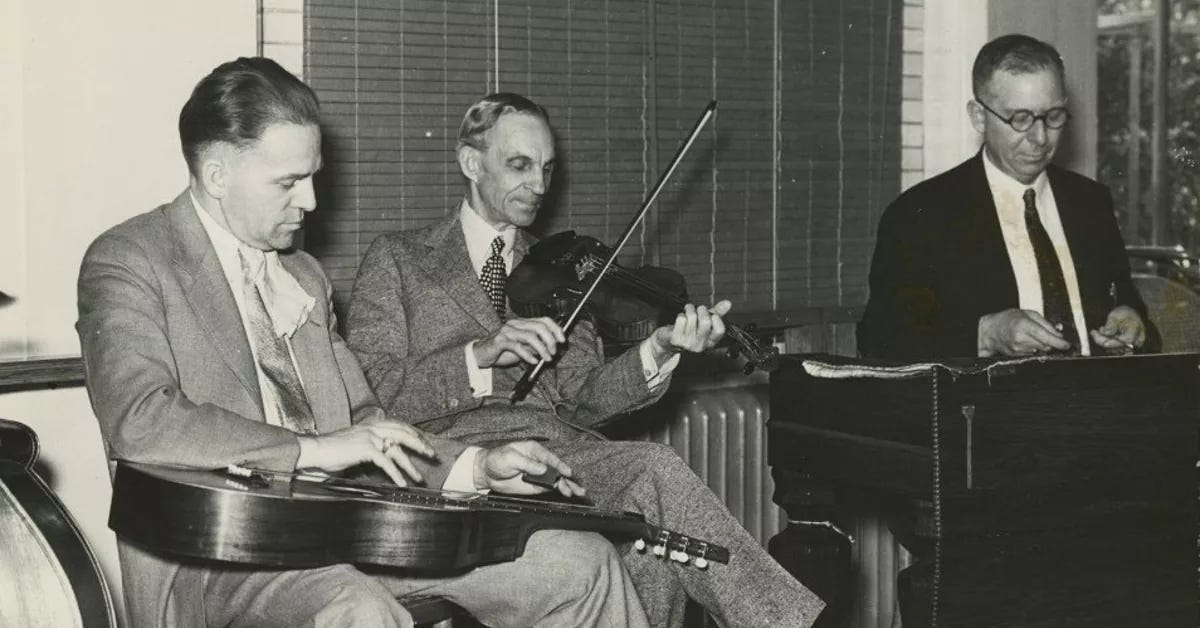
And Ford? On his seventieth birthday in 1933, he celebrated by picking up a fiddle himself and playing with his old-time dance orchestra. The richest man in America, surrounded by the machinery of modernity he had built, sawing away on a fiddle at his own birthday party. Whether that reads as sweet or sad probably depends on how generous you’re feeling toward a man who spent a decade running antisemitic screeds in his personal newspaper. But it does tell you something about how deep the obsession ran — this wasn’t a pose for the press or a philanthropic project he could hand off to an administrator. He meant it. He genuinely believed the fiddle could hold the line against everything his own factories had set in motion.
I grew up walking distance from my high school and didn’t see a point in rushing to get my license. I had older friends with cars. I had Tennessee in my blood and a Detroit address and both of those things were true at the same time, without one canceling the other out. My grandfather went to work on the Cadillac line and never stopped being who he was. Ford spent a fortune trying to manufacture that quality in a culture he’d already transformed beyond recovery.
Stephens just lived it. So did my grandfather. So did a lot of people whose names didn’t end up in the newspaper.
The money came and went.. and the fiddle stayed.
ABOUT THE AUTHOR:

My name is Zachariah Malachi. I’m a full-time, self-employed honky tonk musician in Nashville, Tennessee. This Substack Publication was created for the purpose of sharpening my mind on more Nashville and Country Music history to share with the honky tonk patrons downtown during my shows - but I wanted more folks to benefit from the research so - it’s my gift to the country music fans of the world AND the people who WANT to be. Subscribe and come along for the ride.
Americans have been on the move since the beginning. Move away from the coast, move west for more land, more gold, more destiny! "On the road" is not just a book title; it's the ethos that Americans carry with them and always have. Our romance with motion was sent a love letter from Henry Ford. Ford's Model T and the factories that made them and their automotive siblings simply gave them another destination and the means to get there easier and faster than ever before.
All ways, all ways learn something new. Cars and music are still in my blood at 73.