


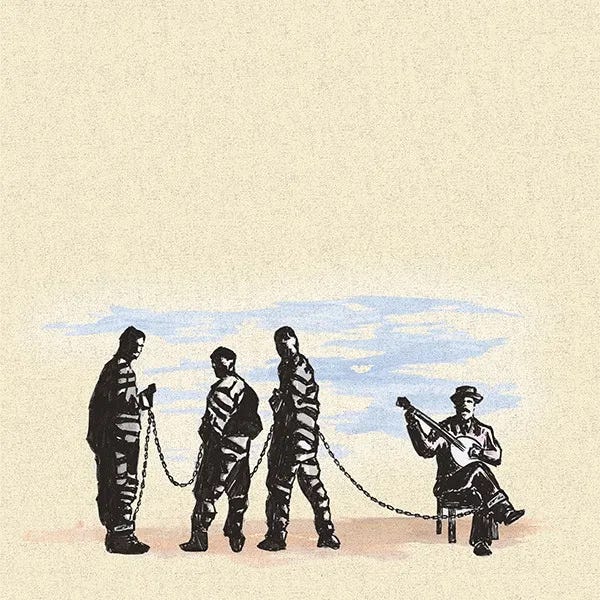
If you want to understand the true history of country music—the actual history, not the cleaned-up version in museum brochures—you have to start by unlearning the fairy tale. The story gets told like this: big-city record executives wandered down to the backwoods, stumbled into some pristine folk paradise, and gently coaxed out timeless songs preserved in mountain isolation. That’s a lie. The songs that built country music weren’t born out of peaceful mountain singing. They came from industrial wreckage, physical suffering, and the desperation of people trying to survive in a world that didn’t give a damn about them.
No song proves this better than “Man of Constant Sorrow.” Most people know it from the O Brother, Where Art Thou? soundtrack—the eight-million-copy monster hit that went global in 2000. But that’s the ending. The real story belongs to a blind street singer named Dick Burnett, a man who turned that song into his only tool for staying alive. His life is the case study for how tragedy, violence, and the ancient art of surviving on street corners created the foundation of modern country music.
The Night That Changed Everything: 1907
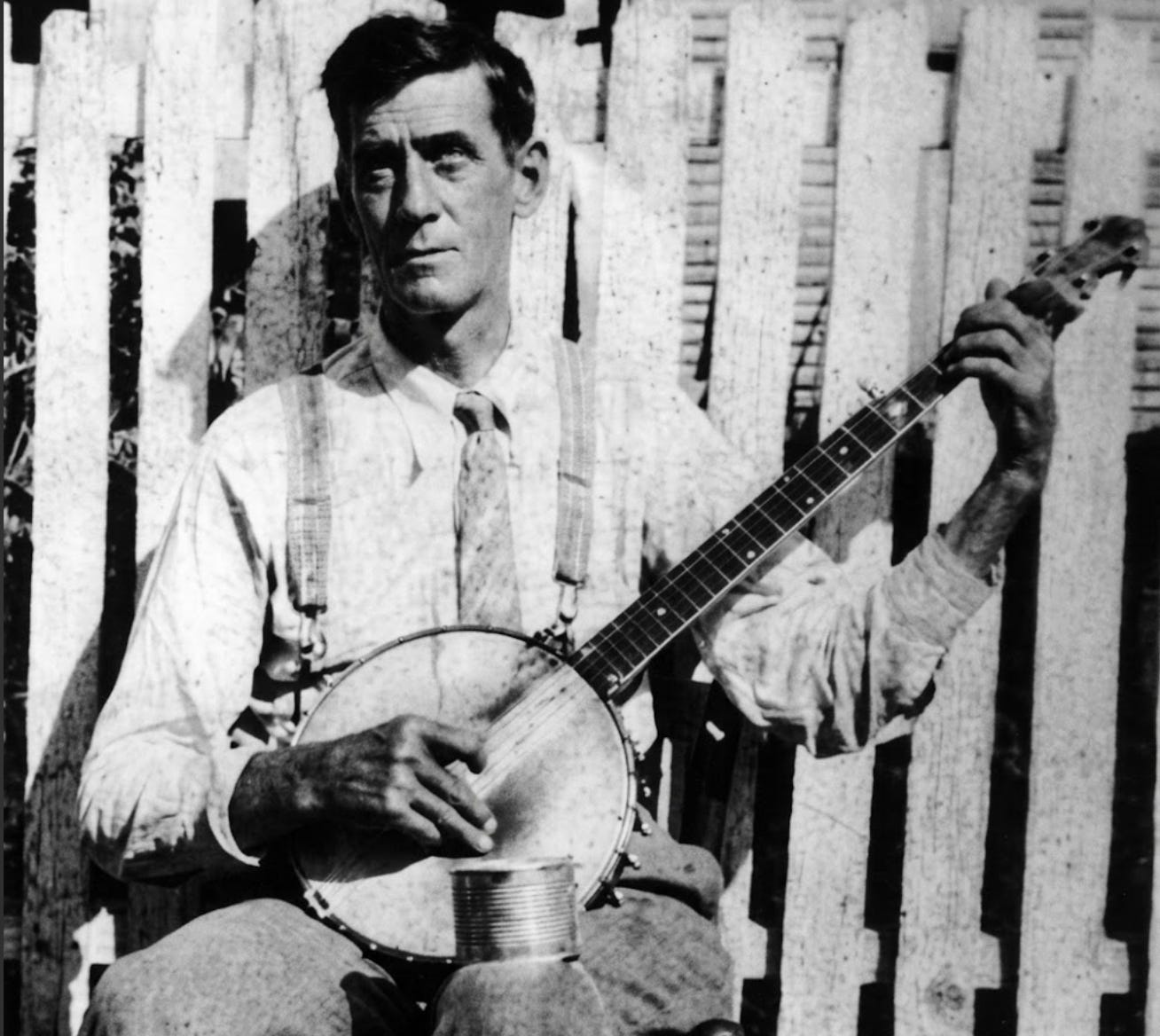
Dick Burnett’s story doesn’t start with songwriting—it starts with a gun going off in the dark. He grew up poor in Kentucky hill country, raised by people who owned almost nothing. By age twelve, both his parents were dead. No social safety net. No family money. Just a kid trying to find work in an economy built on coal mining, subsistence farming, and blood feuds.
When he was twenty-four, Burnett was shot in the face during a robbery. The gun went off close enough to blind him completely.
In 1907 Appalachia, that was a death sentence with no trial. There were no disability benefits. No rehabilitation programs. No one to help. A blind working-class man with no family had exactly three options: the poorhouse, the street, or the graveyard.
Burnett refused the poorhouse. Like thousands of blind men going back centuries, he picked up a banjo and became a street singer. It was the only work left.
How Blind Men Stayed Alive
For years, Burnett walked the dusty roads of Kentucky, Tennessee, and across the Upper South with a five-string banjo, playing for whatever change people dropped into his cup. This wasn’t a romantic pursuit. It was brutal. A blind man traveling alone through coal camps and timber towns gets robbed. Gets sick. Freezes. Burnett’s entire existence depended on his ability to stop a crowd and hold their attention. He played county fairs, revivals, political rallies, train stations—anywhere working people gathered, even public hangings.
To make extra money, he worked an old trade that goes back centuries: the broadside ballad. He’d print his song lyrics on cheap postcard-sized sheets called “song ballets,” sing the story out loud on street corners, then sell the printed pages for a nickel or dime each.
This was journalism before newspapers could reach rural people. It was tabloid entertainment at its most immediate. When a train wrecked, when a miner got killed, when a murder happened in the next county, ballad-makers would dash off verses, print them, and sell them to people hungry for news and the emotional catharsis of a shared song.
A Desperate Song on a Postcard
Around 1913, while walking through Monticello, Kentucky, Burnett put together a small broadside pamphlet of his songs. One of them was a raw, agonizing lament called “Farewell Song”.
He didn’t write it to be a hit. He wrote it from the center of his own broken life—mixing traditional folk verses with the actual reality of being blind, orphaned, and alone:
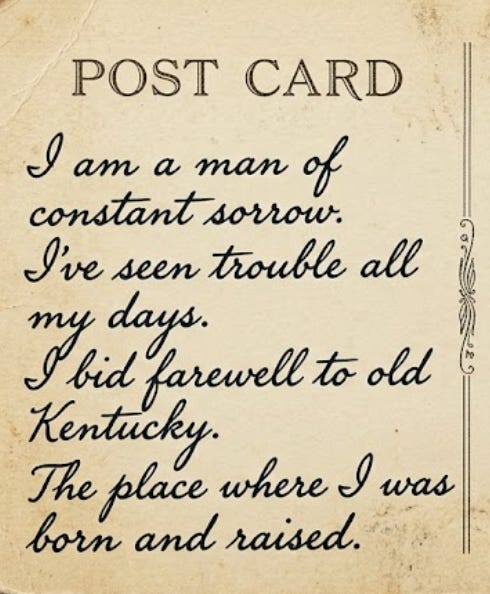
Those lines hit hard because they were true. And they were true for everyone listening.
In the early 1900s, the South was tearing itself apart economically. Families were getting pushed off farms by debt and crop failure. Thousands migrated to textile mills, coal mines, and northern factories—leaving behind everything they knew. The people who heard Burnett sing “Farewell Song” on courthouse steps weren’t listening to a museum piece. They were hearing their own lives back to them—the backbreaking work, the lack of medical care, the spiritual weight of just trying to survive.
From Street Corners to Recording Studios
In 1914, Burnett partnered with Leonard Rutherford, a talented fiddler from Kentucky. For years they traveled as Burnett and Rutherford, a sharp string band. Rutherford’s weeping fiddle was the perfect match for Burnett’s clawhammer banjo and stark vocals.
By the early 1920s, the record business was in crisis. Urban pop sales were tanking because of radio. Record executives—Victor, Columbia, OKeh—realized they needed new markets or they’d go under. They turned to rural America, launching entire record series for what they sneeringly called “hillbilly” music.
In the late 1920s, Burnett and Rutherford moved from the coal-oil circuit into recording studios, cutting 78 RPM shellac discs. The record labels wanted original, copyrighted songs now, not the traditional tunes they’d been playing.
Burnett never recorded “Farewell Song” himself, but his postcard broadsides had already done the work. The song had entered the folk tradition, traveling mouth-to-mouth across the mountains. In 1929, a singer named Emry Arthur walked into a studio and cut the first commercial recording, calling it by the title it’s still known by: “Man of Constant Sorrow”.
Greenwich Village Gets It
For decades, “Man of Constant Sorrow” stayed regional—a bluegrass standard kept alive on back porches and early radio by acts like the Stanley Brothers. The song’s life wasn’t over yet, though.
In November 1961, a twenty-year-old folk singer from the Midwest showed up in New York City, broke and hunting for work in Greenwich Village coffeehouses. He signed to Columbia Records. His name was Bob Dylan.
When Dylan recorded his first album, he went straight for the deep-cut Southern mountain ballads he’d learned from traditional players. “Man of Constant Sorrow” was on that album. The sleeve notes called it a “traditional Southern mountain folk song... probably never sung quite in this fashion before.”
Dylan’s version was something different. He didn’t treat the song like a museum piece. He got inside the desperation and existential weight of it—his raw voice and harmonica made it sound like it came from someone living in a nuclear-age, cold-war world. Thirty years after a blind Kentucky street singer wrote the words to keep from starving, the song had become an anthem of the 1960s counterculture.
Waylon’s folk-country transition at RCA
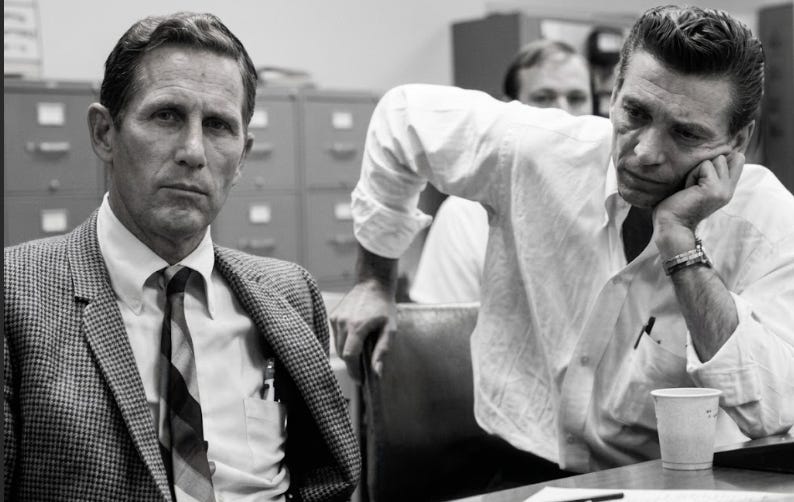
While Bob Dylan was electrifying the folk revival in New York, a young, leathery-voiced singer from Littlefield, Texas, was struggling to find his footing in Nashville. Waylon Jennings had spent his youth picking cotton under a burning West Texas sun, escaping his poverty by listening to Bill Monroe’s high-lonesome wails and Hank Williams Sr.’s hard-hitting honky-tonk on the family radio.
Then came February 3, 1959. The plane crash that killed Buddy Holly. Waylon’s mentor. The trauma never left him—he carried it like a stone in his chest for the rest of his life. (Please refer back to The Country Music Book of the Dead Buddy Holly/Waylon Jennings article for some deep insight on that tragedy if you haven’t read it, yet). After that, he spent years playing rough clubs throughout the Southwest before RCA Records finally paid attention and signed him.
It was March 1965 when Chet Atkins, the powerful head of RCA’s country division, brought Waylon into the studio for his first sessions. Chet had a plan: he was going to remake Waylon into a “folk-country” performer, capitalizing on the college folk market boom. He wanted Waylon’s masculine baritone paired with songs like “Man of Constant Sorrow” and “Scarlet Ribbons”—crossover material.
But here’s the interesting part: Chet actually loosened his grip on those sessions. He let Waylon bring his Phoenix road band, the Waylors—Paul Foster on bass, Jerry Gropp on guitar, Richie Albright on drums—right into the studio. And he did something almost unheard of: he gave Waylon creative freedom. Five of Waylon’s own songs made it onto the tracklist, including “That’s the Chance I’ll Have to Take.”
On the surface, it looked progressive. In reality, it was a compromise neither man was comfortable with.
When Waylon sang “I’m a Man of Constant Sorrow,” he was still reaching for the safer places in his voice—cautious, clean enunciation. Chet and the engineers buried him under layers of heavily echoed background vocals, trying to recreate the smooth, easy-listening Nashville Sound that Jim Reeves had perfected. It was the corporate formula, applied with technical precision. It was wrong for Waylon.. and everyone eventually saw that.
When RCA released the album in March 1966—titled Folk-Country—the commercial success Chet was banking on did not materialize. The record didn’t connect. It didn’t sell.
But it mattered anyway. That album was a bridge. It showed Waylon’s restless need to bring his own road-hardened band into the studio, to fight for his own sound against the corporate machinery. It showed the first seeds of rebellion—the artistic independence that would explode ten years later when he stopped asking permission and started making records on his own terms. The Outlaw movement didn’t come out of nowhere. It came out of recordings like this, where a musician was forced to choose between what the label wanted and what his gut was telling him to do. Classic story.
Ralph Stanley and The Clinch Mountain Lonesome
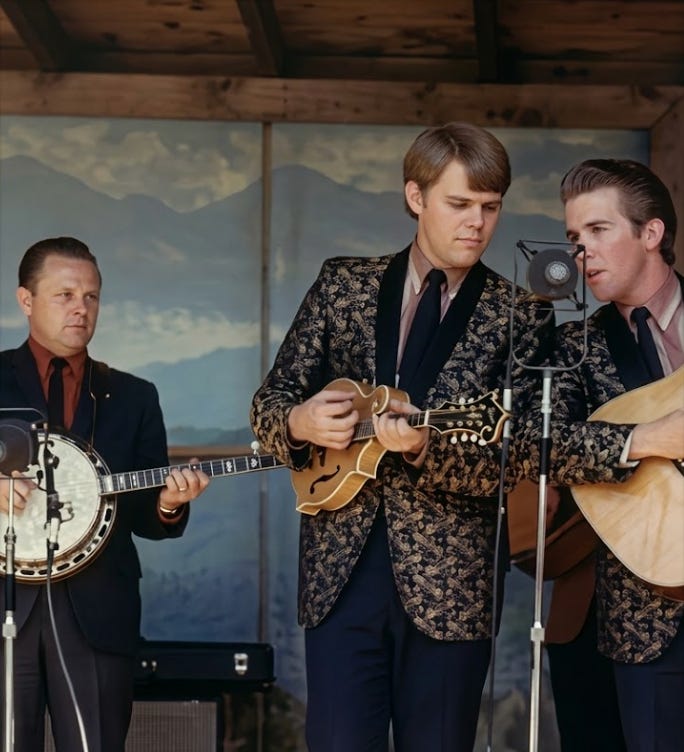
While Bob Dylan introduced the song to the northern folk revival, the definitive keepers of the song’s sacred flame were Ralph and Carter Stanley. The Stanley Brothers possessed the most impeccable, traditional roots in all of string music. They grew up in a run-down, two-room log cabin in a hollow along Big Spraddle Creek in McClure, Virginia, before moving onto Smith Ridge in the Clinch Mountains of Dickenson County.
Their father, Lee Stanley, was a sawmill operator and a Sunday church singer who possessed an “old-time lonesome voice, down to earth like he dug it right out of one of these mountains.” He frequently sang “Man of Constant Sorrow” around the house, cementing the song in his sons’ minds during their early childhood. Their mother, Lucy Smith Stanley, played the banjo in the traditional, brushing “claw-hammer” style. She famously traded a pig for a five-dollar banjo from her sister Rosie so that young Ralph could sit under an apple tree and practice the rolls.
The Stanley Brothers took their father’s slow, modal mountain lament and turned it into a hard-driving, fast-tempo bluegrass standard with a three-finger banjo roll and high-lonesome, pinched-throat vocal harmonies. When they moved to Columbia Records, their recordings of “Constant Sorrow” and other lonesome standards established the “Stanley sound”. Bill Monroe was initially furious, accusing them of stealing his signature bluegrass style, and he refused to speak to or make eye contact with either brother for fourteen years.
But tragedy permanently altered the Clinch Mountain trajectory. On December 1, 1966, Carter Stanley died of liver cancer at the early age of forty-one. Despite their long, bitter feud, Bill Monroe was devastated. Monroe interrupted a Deep South tour, flew north, and drove a car up to the top of the Virginia mountain home place where Carter was being laid to rest. Over the coffin, Monroe sang an a cappella rendition of “Swing Low, Sweet Chariot,” touched the wood with his fingertips, and whispered, “We’ll meet again”—later admitting to a friend that getting through the song without breaking down was the hardest thing he ever had to do.
Ralph Stanley took over the band, forcing himself to overcome his deep natural shyness. His keening tenor voice, delivered in the classic, backcountry pinched-throat style, became an incredible vessel of pure, ancestral grief. He self-consciously stripped down the Clinch Mountain sound, playing his banjo in the claw-hammer style of his mother and insisting that what he sang was “old-time mountain music—not bluegrass.”
In 1970, Ralph Stanley discovered two fifteen-year-old eastern Kentucky prodigies who would help him carry the lonesome torch: Ricky Skaggs of Brushy Creek and Keith Whitley of Sandy Hook. The teenagers had bonded over their mutual adoration of the Stanley Brothers, capably reproducing Carter and Ralph’s vocal blend in Whitley’s garage and high school talent shows.
Stanley first encountered them on a spring evening at a beer joint in Fort Gay, West Virginia. Car trouble had delayed Stanley and the Clinch Mountain Boys, so the teenagers unpacked their instruments and gave the rowdy crowd a note-for-note replication of the Stanley Brothers’ greatest hits. When Ralph finally walked into the bar, he sat down, dropped his head with sheer emotion as he listened to these children sing his brother’s parts, and immediately invited them to join the band.
In February 1971, while the boys were supposed to be in school, Stanley took them to a basement studio in Clinton, Maryland, to record the landmark Rebel album “Cry from the Cross.” To stay awake during grueling, three-hundred-mile overnight jumps on the bus, Skaggs and Whitley would sit with Ralph at 3:00 a.m., singing a cappella Baptist hymns like “That Old Village Church”.
This incredible generational collaboration was captured on film by director Albert Ihde at Carlton Haney’s 1971 Labor Day weekend festival in Reidsville, North Carolina, for his documentary “Bluegrass Country Soul.” Clad in a crimson shirt and a black cowboy hat, sixteen-year-old Ricky Skaggs picked a flurry of notes on the mandolin as the band launched into “Man of Constant Sorrow”.
The performance was a master class in collaborative vocal trust: Keith Whitley sang lead on the first verse, Roy Lee Centers sang lead on the second, Ralph sang tenor on the chorus, and Ricky Skaggs sang tenor on the second verse. From the crowd, a thirteen-year-old Marty Stuart watched, spellbound by the sight of these young teenagers standing alongside Ralph Stanley, singing a song that had traveled directly out of the nineteenth-century hills.
(Please watch the following video when you have time - it’s incredible footage)
Hollywood Success and What It Really Means
The irony got thick at the turn of the millennium. In 2000, Joel and Ethan Coen made O Brother, Where Art Thou?—a Depression-era satire of Homer’s Odyssey where a fictional string band called the Soggy Bottom Boys scores a hit with “Man of Constant Sorrow”.
George Clooney stood at the microphone on screen, but the real voice was Dan Tyminski, a session guitarist and singer from Alison Krauss & Union Station. Dan now is doing a lot as a solo artist. I heavily recommend his work.
Anywho, the response was massive. In an era of computerized pop production, the raw acoustic reality of the song exploded globally. The soundtrack sold eight million copies. Won five Grammys, including Album of the Year. Started a whole new wave of interest in bluegrass and old-time mountain music - which eventually led to another music movement we will be talking about later on at some point.
But underneath all that—the spotlights, the awards, the royalty checks—the song remained exactly what Dick Burnett built it to be in 1913: a record of hard, unvarnished truth. “Man of Constant Sorrow” wasn’t designed by a marketing team or dreamed up in a corporate boardroom. It was paid for with blood, blindness, and a lifetime of walking lonely highways across Appalachia and the rest of the American South.
Dick Burnett died in 1963, quietly, and never saw his song become what it is. But every time those opening banjo notes hit, every time someone sings those lines about constant sorrow, that blind Kentucky street singer is still there on the corner—proving that in country music, the tragedy is always real, and in the end, that’s the only thing that lasts.
ABOUT THE AUTHOR
My name is Zachariah Malachi. I’m a full-time, self-employed honky tonk musician in Nashville, Tennessee. This Substack Publication was created for the purpose of sharpening my mind on more Nashville and Country Music history to share with the honky tonk patrons downtown during my shows—but I wanted more folks to benefit from the research, so it’s my gift to the country music fans of the world AND the people who WANT to be. Subscribe and come along for the ride.
What a great story Zach! I had no idea there were so many covers to that great tune.