


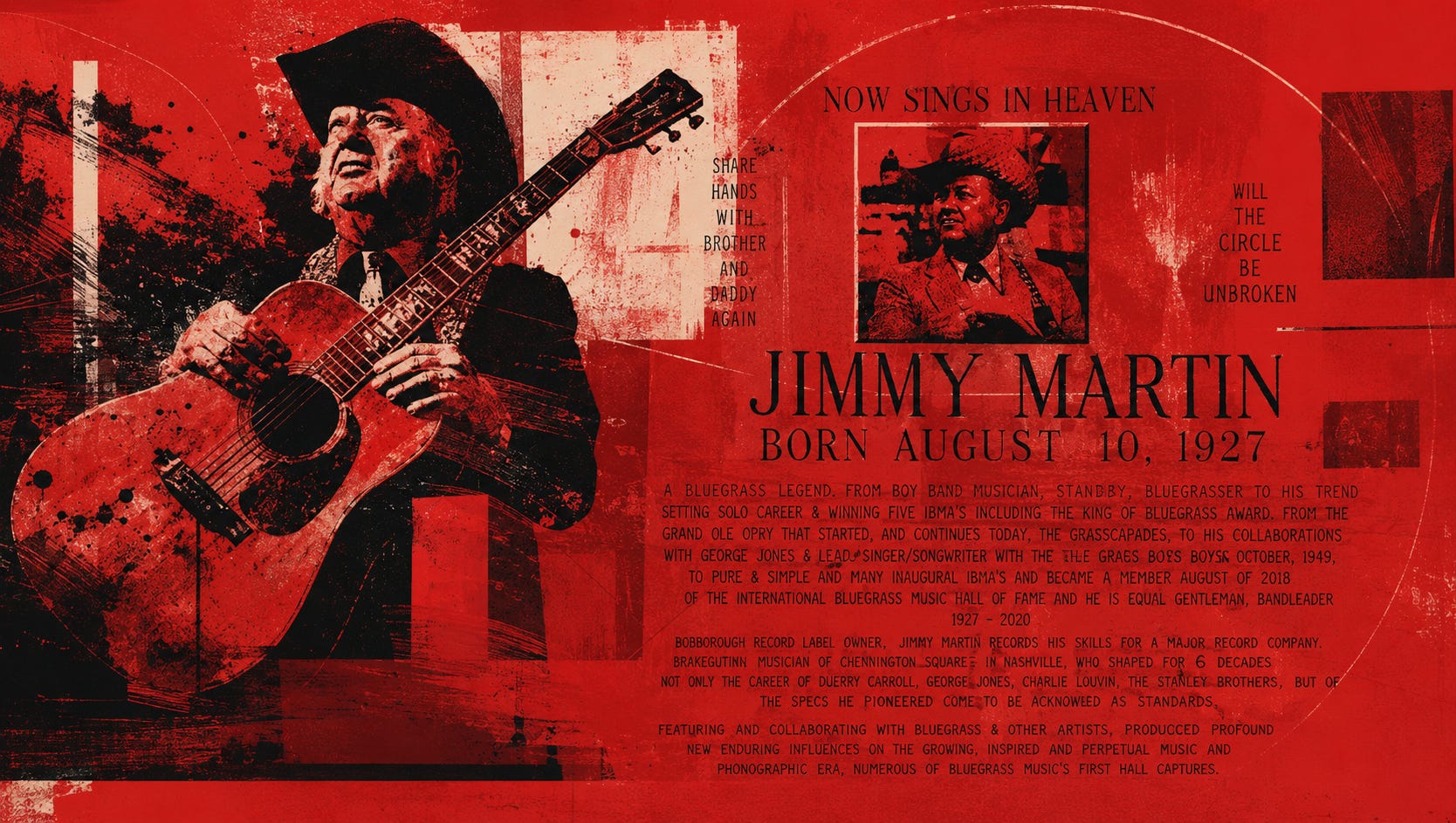
There’s a certain kind of heartbreak in country music that doesn’t show up in lyric form — it shows up when an artist loves an institution more than life and the institution doesn’t love him back. Jimmy Martin spent forty years in a friends-with-benefits relationship with the Grand Ole Opry that never fully bloomed into making him a member.
He called himself the King of Bluegrass, and by the time he died in 2005, most anyone would have quietly agreed that he’d earned it. The voice was the proof — that high, raw, almost wounded sound he and Hank Williams worked out together back when Jimmy was riding shotgun with Bill Monroe’s Blue Grass Boys. It wasn’t a pretty voice. It was a voice that sounded like it had been through something, and that’s exactly why it cut through everyone else’ noise.
A more personal note before we dig in
I grew up around bluegrass, even though it was never really my music — not at first. It was the soundtrack to every family reunion, the sound that meant the whole family was together in one holler, one porch, one room. And for whatever reason, as a kid, I drew this line in my head between Tennessee and bluegrass. My family’s been in Tennessee for centuries — that’s deep pride for me — and Tennessee, to little-kid me, meant country music. Nashville. That was ours. Bluegrass felt like it belonged to Kentucky, somehow. I couldn’t tell you why my brain sorted it that way, but it did.
I love all of it now, obviously. And when I think back on those reunions, what I reach for is Bill Monroe, Del McCoury... and Jimmy Martin.
Jimmy Martin is a name I didn’t really get acquainted with until I was older and had gone fully down the rabbit hole of music history. And once I did, I realized how much I loved not just his music but him — the persona, the whole package. He’s sort of a Jerry Lee Lewis figure in bluegrass, if that lands the way I think it does. The talent’s undeniable, the ego is part of the show, and the chaos isn’t separate from the artistry — it’s woven right into it. You don’t get the voice without the man, and the man was a lot.
So with that in mind — here’s his story.
How he got there
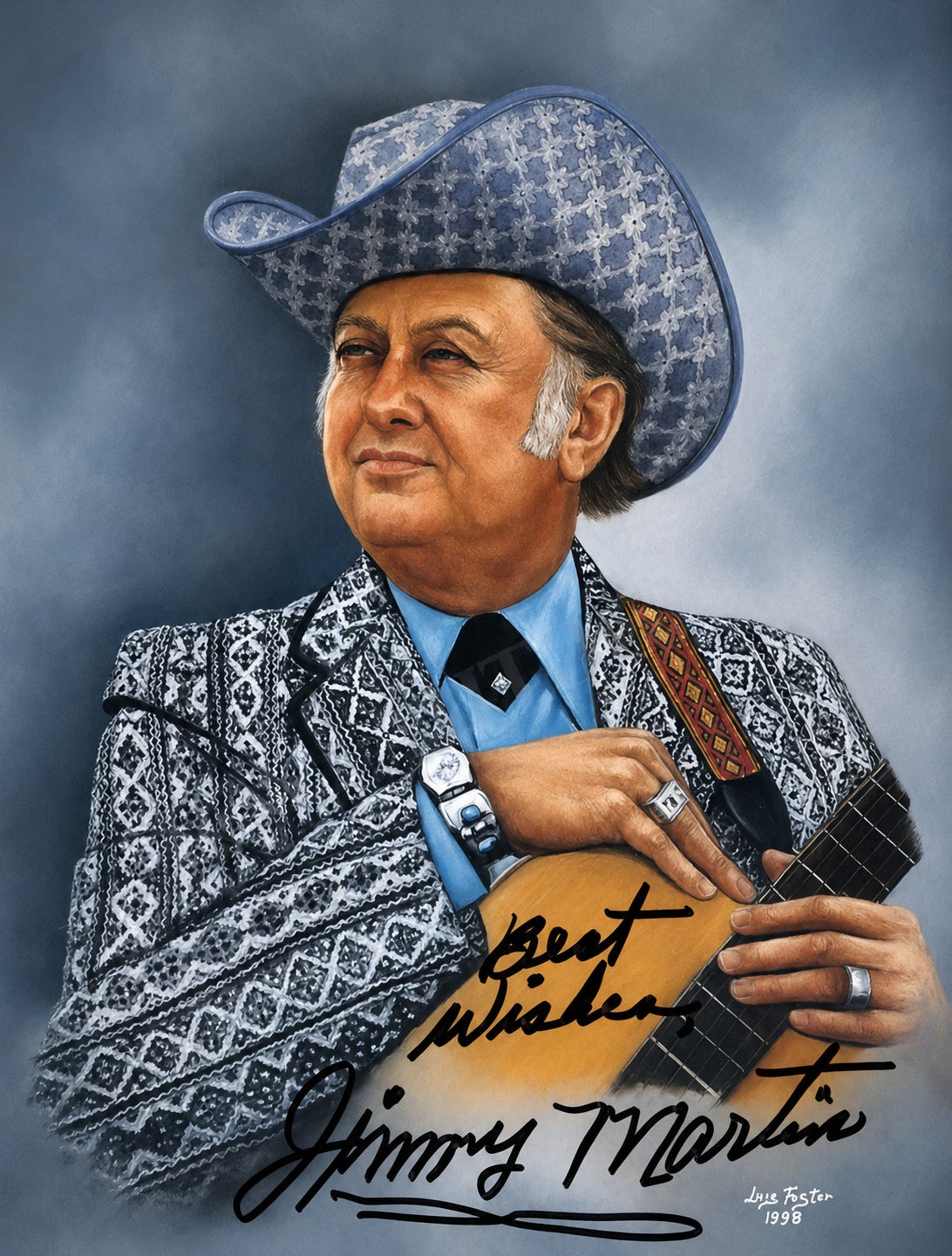
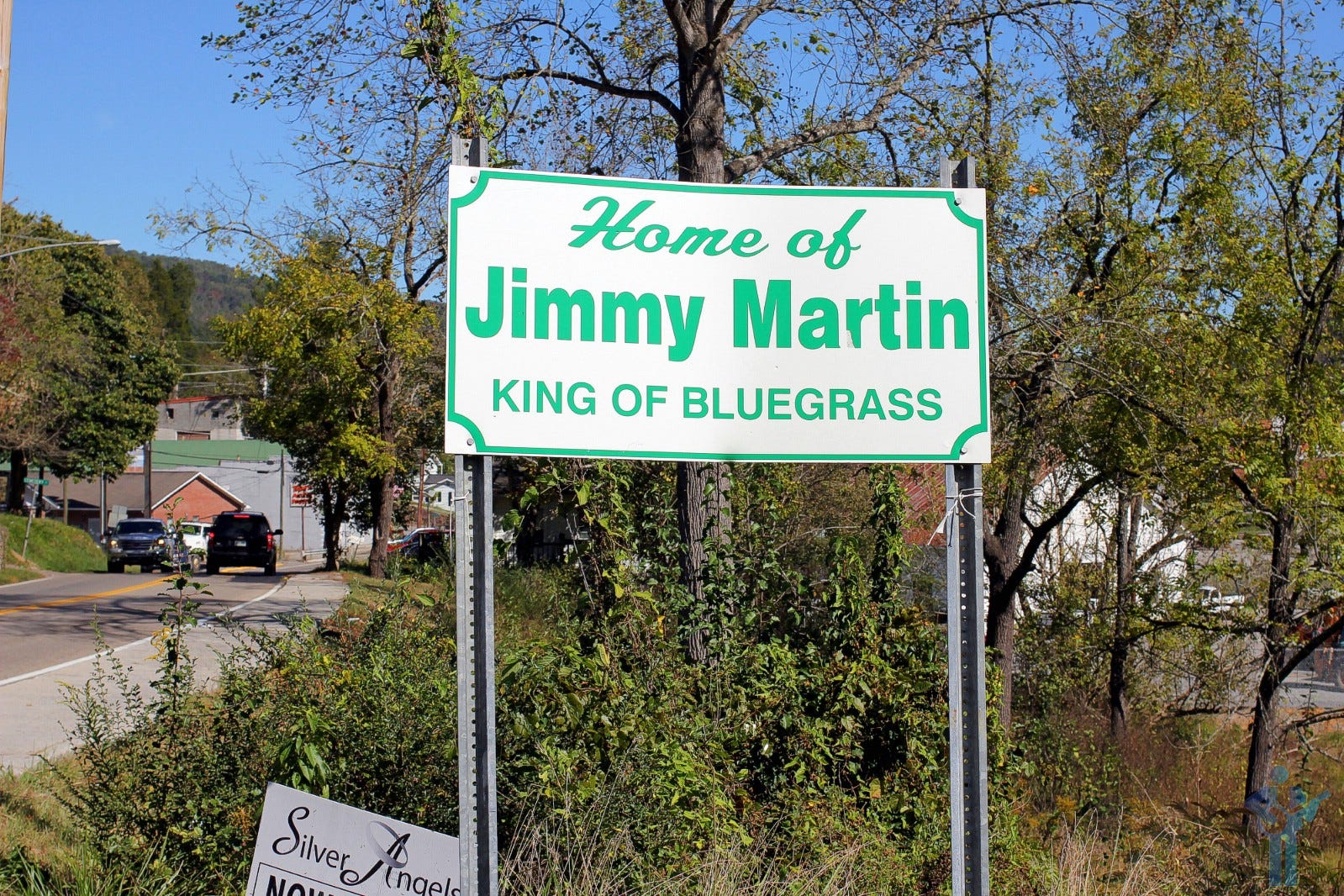
Jimmy Martin came up out of Sneedville, Tennessee — Cumberland Gap country, the kind of east Tennessee hill ground that produced half the voices that built this music. His father died when Jimmy was four. He grew up singing gospel with his mother and stepfather, picked up the guitar as a teenager, and by the time Mac Wiseman left Bill Monroe’s band, Jimmy had heard about it and gotten on a bus to Nashville with nothing but nerve and a head full of Monroe’s catalog.
The story goes that he talked his way backstage at the Opry, cornered Monroe, and started singing Monroe’s own songs back to him — every harmony part, note for note. Monroe hired him on the spot. And for a few years, it worked the way those things sometimes do when two strong voices lock together: “Uncle Pen,” “Letter From My Darling,” “On My Way Back to the Old Home” — recordings that are still considered foundational, still get pulled out as the high-water mark of that era of the Blue Grass Boys.
But it didn’t last, because it never does with two men who both think they’re the lead.
The Break
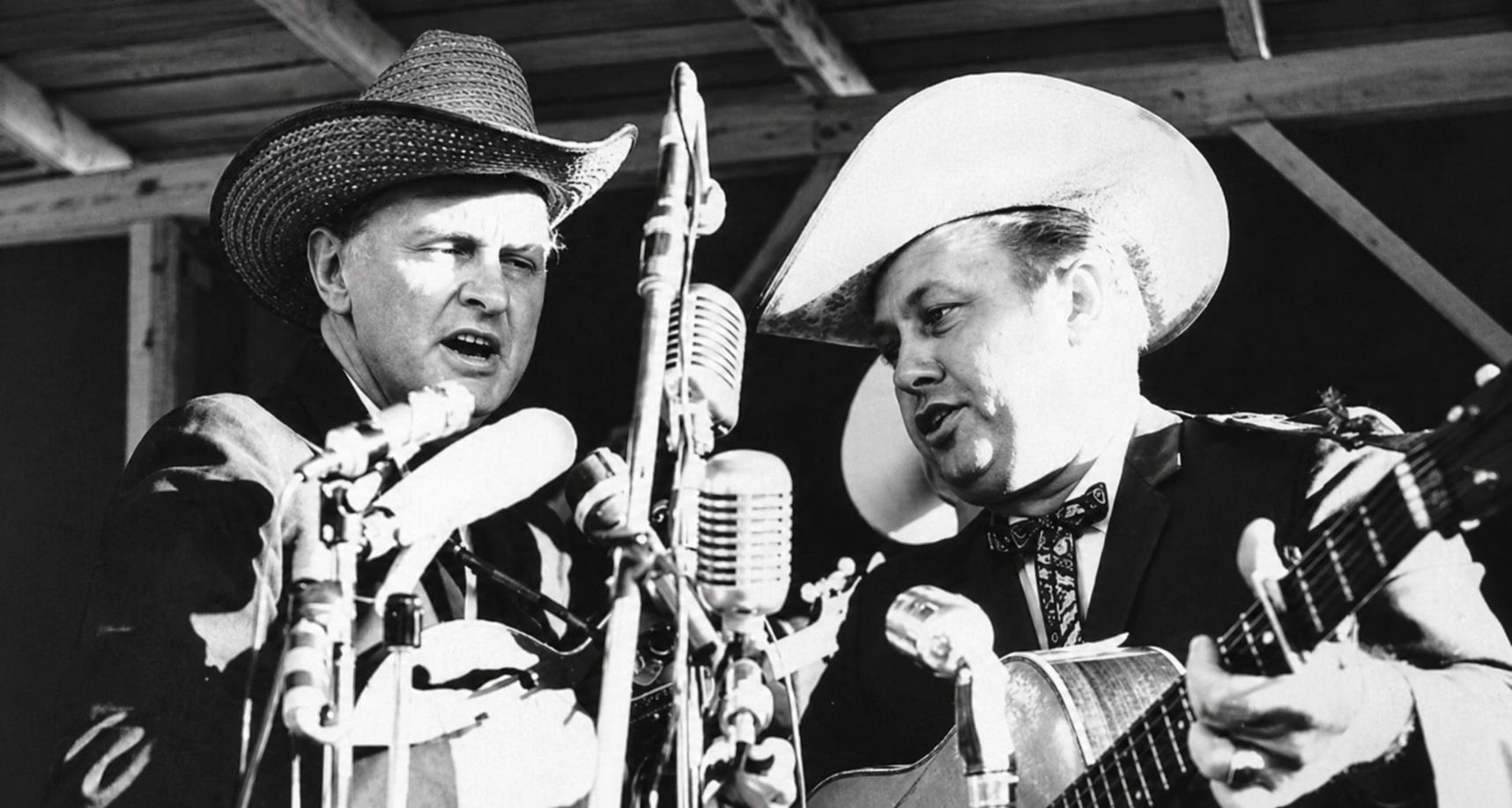
Jimmy left Monroe in 1954 and formed his own band, the Sunny Mountain Boys, and from there he built something genuinely his own — a sound that took Monroe’s high lonesome foundation and pushed it toward something smoother, punchier, more emotionally direct, with country instrumentation bleeding into the edges. His bands were stacked: the Osborne Brothers came through, J.D. Crowe, Paul Williams — musicians who’d go on to shape bluegrass for the next generation, all of them passing through Jimmy’s band first. A bluegrass rite of passage.
By any honest measure, he was doing exactly what Monroe had done a generation before him — taking the music somewhere new and making it pay. And for a while, it did pay. Jimmy Martin out-booked and out-earned Monroe through long stretches of the ‘60s, which is its own kind of country music irony: the student outworking the teacher, and the teacher never forgiving him for it.
The Door
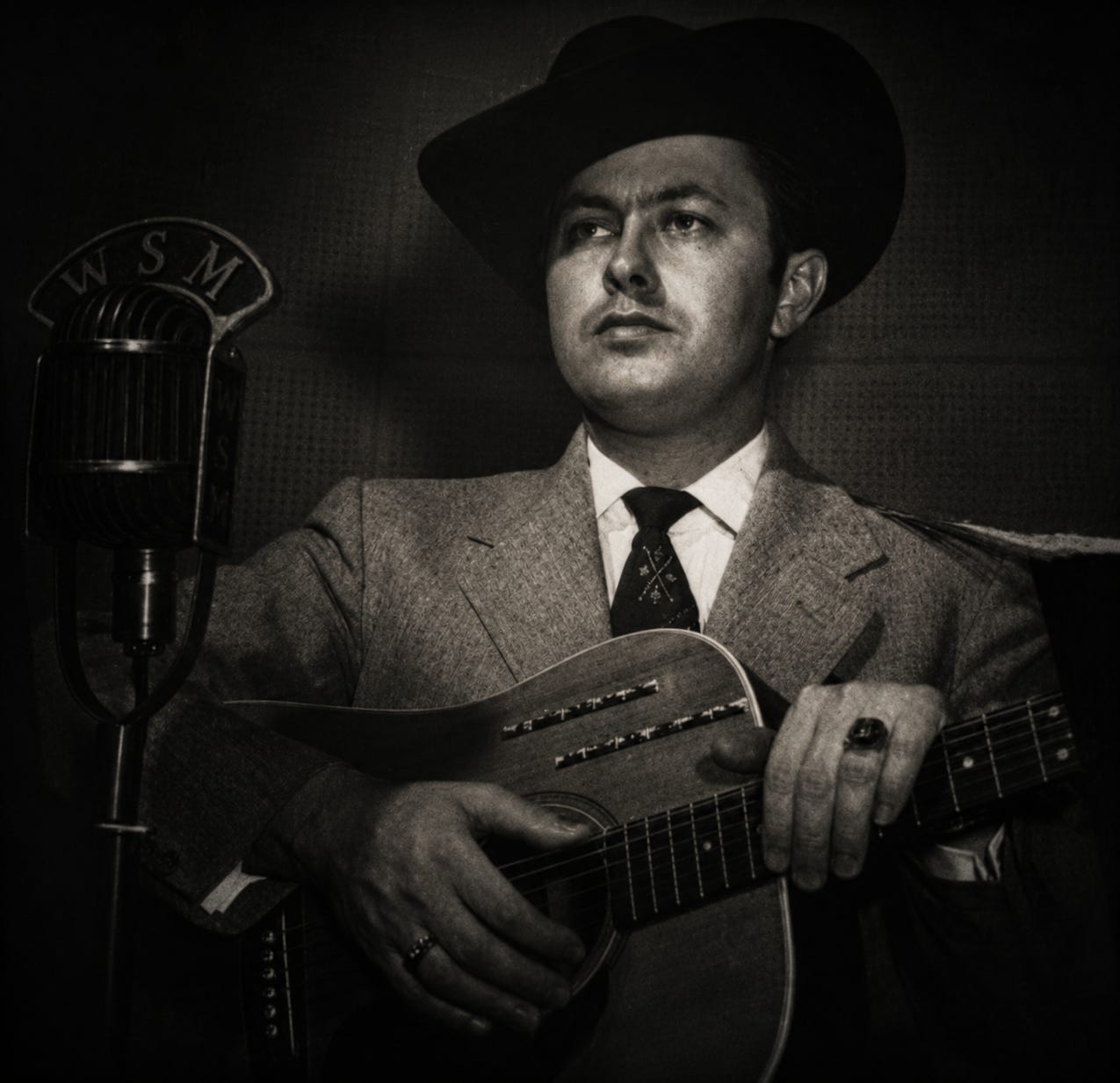
Here’s where the story turns dark, and where it stops being just a music biography.
Jimmy Martin wanted into the Grand Ole Opry more than he wanted almost anything else in his life. He played it constantly — as a guest, always as a guest, for decades — and he never stopped angling for membership. By most accounts, the membership question came down to Bill Monroe. Whatever happened between them — and there are several versions involving stolen sidemen, a poker game over a Martin D-28 that ended with Hank Snow paying to have Jimmy’s name inlaid on the fingerboard, even a tangle with Monroe’s own daughter that Monroe forbade and that kept happening anyway — whatever the real mixture of grudges was, Monroe worked the Opry’s management for years to keep Jimmy out. And it worked.
Jimmy Martin never got his membership. He died in 2005, at 77, having spent decades of his career standing on that stage as a guest, watching other men — some of them men he’d trained, men whose harmonies he’d built — get inducted while he never did.
It curdled in him. People who knew him talk about a meanness that came out late in life, late at night, with a drink in him — a real venom aimed at Opry stars who’d gotten what he never did. It’s not a flattering part of the story. But it’s not hard to understand, either. Imagine spending forty years being told you’re not quite good enough for a room you helped build the sound of.
Now, what’s left?
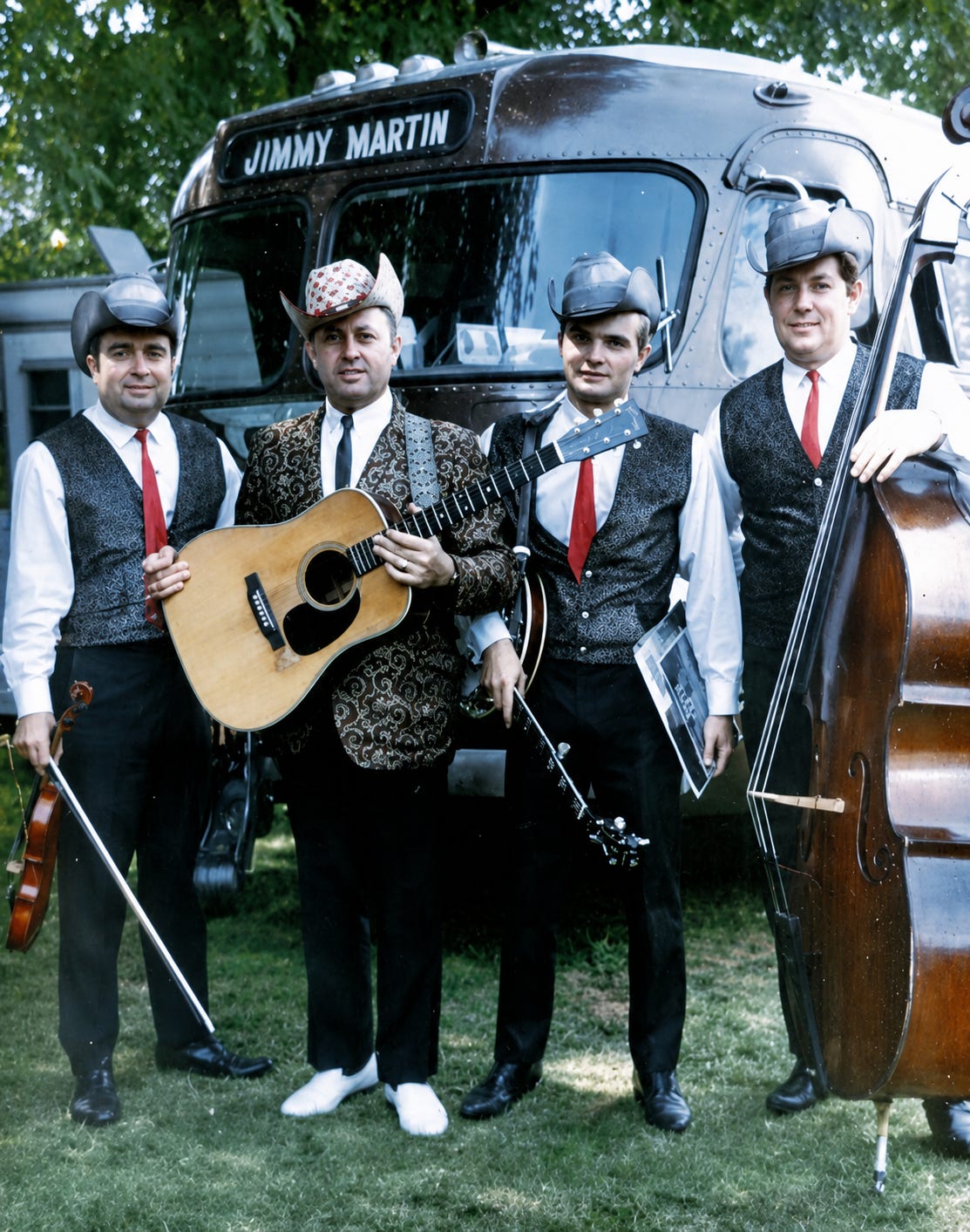
What’s left is the voice. That’s the thing that survives all of it — the feud, the bitterness, the snub. Put on those early Monroe sides from the early ‘50s, or the Sunny Mountain Boys records from a decade later, and you can hear exactly why people called him a king, self-appointed or not. There’s an ache in it that no amount of institutional approval could have given him and no amount of institutional rejection could take away.
Some people on the bluegrass message boards still argue about whether he deserved the Opry, whether the title was earned or just bluster from “one of country music’s most colorful characters.” But underneath all of that is a simpler thing, and it’s the thing that makes Jimmy Martin’s story feel less like ancient bluegrass trivia and more like something close to the bone for anyone who’s ever made something true and watched the gatekeepers decide it wasn’t quite right enough.
He was the King of Bluegrass. He just never got the room to say so out loud.
MESSAGE FROM THE AUTHOR:
My name is Zachariah Malachi. I’m a full-time, self-employed honky tonk musician in Nashville, Tennessee. This Substack Publication was created for the purpose of sharpening my mind on more Nashville and Country Music history to share with the honky tonk patrons downtown during my shows - but I wanted more folks to benefit from the research so - it’s my gift to the country music fans of the world AND the people who WANT to be. Subscribe and come along for the ride.
I didn't know about Jimmy. Thanks, another road to follow.
As an aside, I'm a British Deadhead who they kifnapped late 1966. Lobg story.
Jerry was a fine banjo player. He wss part of Old In And The Way who had such as Pete Rowan and master fiddler Vassar Clements - who got toj play with the Stones in the glory glory Exile time.
So. Jerry's band supported Bill Monroe one night. Jerry was too shy to go say hello.
Both core delineators of fine American music. A Hillbilly and a free-thinking in betwixt Beat and Hippy.
Heady times. My love old time American music dates back to my hippy days. It's cool. Music talks to us all and directly to our hearts.
"Let their be songs to fill the air
I was always a big Jimmy Martin fan, and I couldn’t believe he kept playing the Opry all those years while continuing to be snubbed. I wish he’d finally told the Opry where they could stick their membership, which considering the low-level artists they inducted was not worthy of someone of his stature and talent. Jimmy Martin deserved the Opry, but the Opry did not deserve Jimmy Martin.