


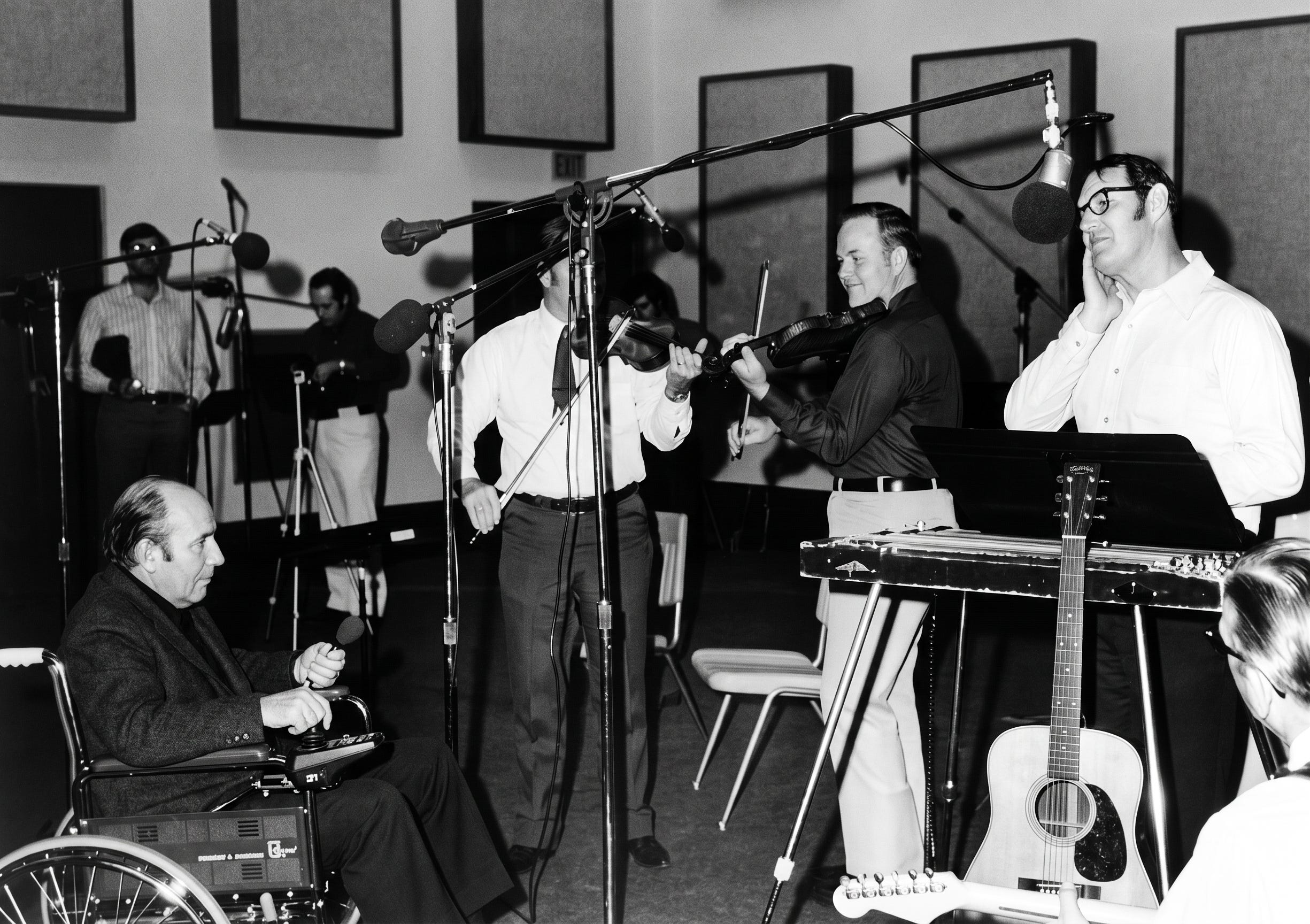
Ray Benson of Asleep at the Wheel was there that day. He kept a photograph from the session on his office wall — Bob Wills in a wheelchair, surrounded by men who loved him. Years later, he would look at it and say: “That’s a man who’s about to have a stroke.”
Nobody in that room knew that yet. That’s what makes it all the more unbearable.
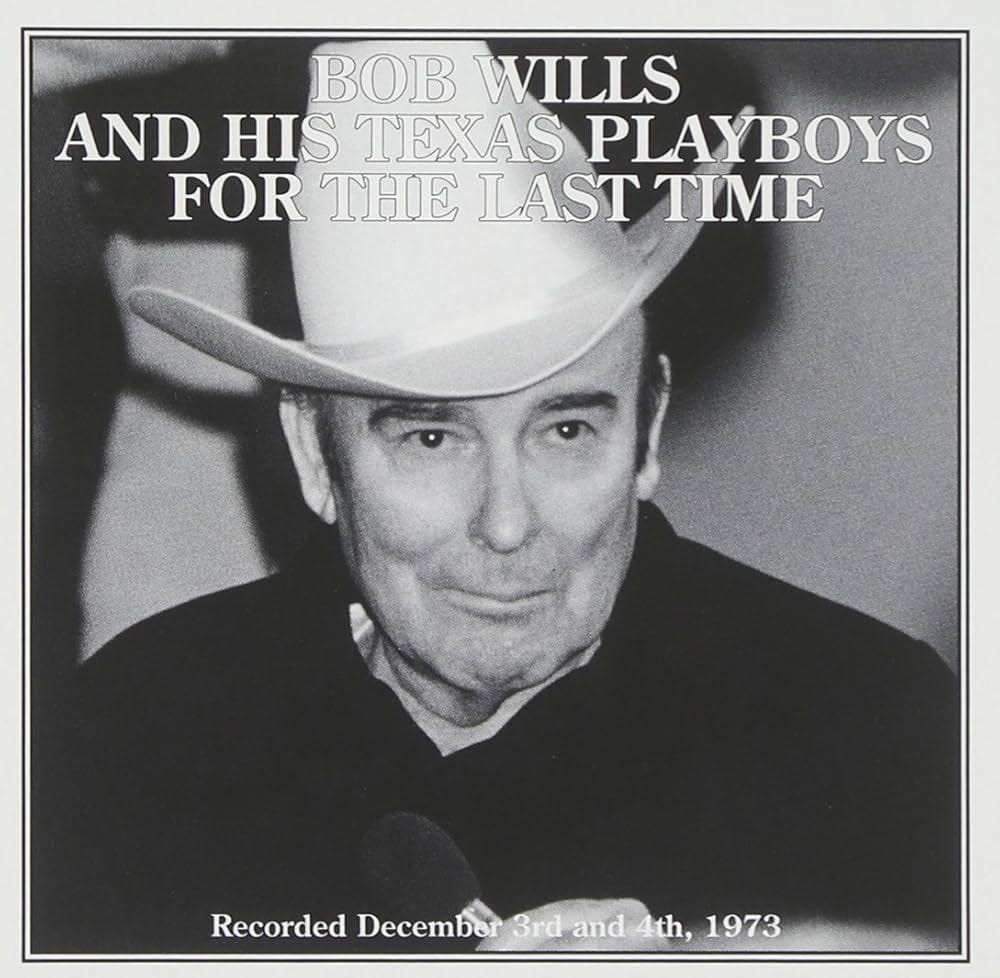
Let me tell you who Bob Wills was, because if you don’t already know, that’s its own kind of scandal.
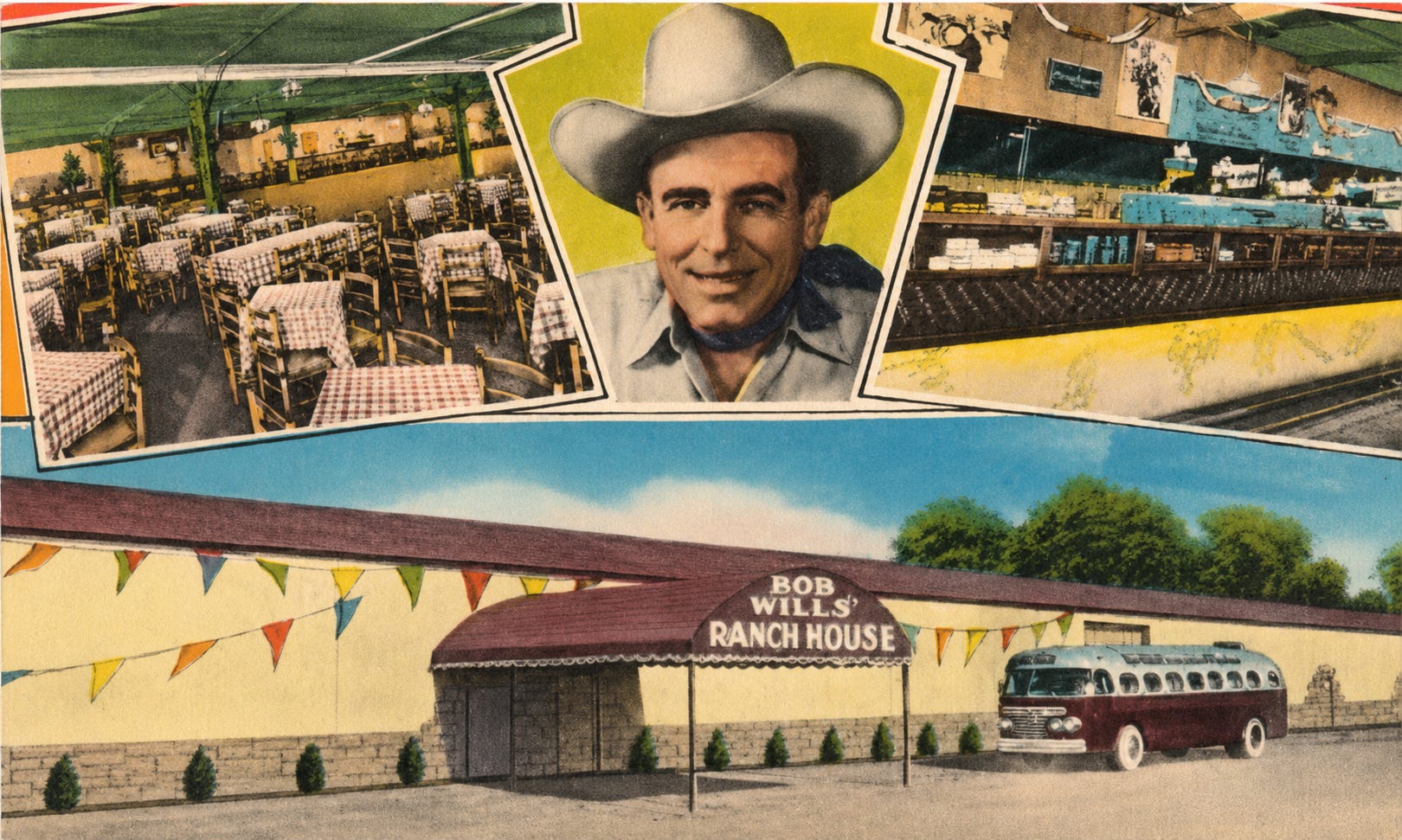
He was a bandleader, a fiddler, a singer, and a songwriter whose Texas Playboys popularized western swing music in the 1930s and ‘40s. That sentence, accurate as it is, does not touch what he actually put together. Western swing was not a genre that already existed and waited for someone to play it. Bob Wills invented an entire language. He blended Texas frontier fiddle tunes, string band and hillbilly music, early jazz, big band swing, blues, and Mexican mariachi music into a swinging dance music that filled ballrooms across the Southwest and California for twenty years running. He put drums in a country band at a time when no one else would dare. He put horns in there, too. He put jazz soloists next to fiddle players and told them all to swing hard and mean it.
He built the template that Merle Haggard learned from. That Buck Owens learned from. That every California country player learned from. Well, a lot of us learned from it down the line. But, originally - he did it out of a radio station in Tulsa, Oklahoma, broadcasting live dances from Cain’s Ballroom to the entire Southwest, building a following that filled halls six nights a week for a decade straight.
Then the 1950s happened and the world just moved on.
After two heart attacks in 1965, he dissolved the Texas Playboys to perform solo with house bands. While he did well in Las Vegas and made records for the Kapp label, he was largely a forgotten character. The Country Music Hall of Fame inducted him in 1968 — the old honor that comes when an institution finally gets around to recognizing someone they should have been talking about for thirty years. The day after the ceremonies in Austin honoring him for his contributions to Texas music, Wills had the first in a series of crippling strokes. That is the kind of timing that makes you wonder what God finds funny.
A 1969 stroke left his right side paralyzed, ending his active career. He could no longer play his fiddle. He could no longer perform. The man who had filled the Aragon Ballroom in Hollywood, who had played to crowds of ten thousand in California during the war years, who had written “San Antonio Rose” and “Faded Love” and “Take Me Back to Tulsa” — he was in a Fort Worth nursing home, largely immobile, his right side just about completely gone.
He also sold his Dallas dance hall during earlier financial troubles. The buyer was a then-unknown businessman named Jack Ruby. Even his real estate had a dark footnote.
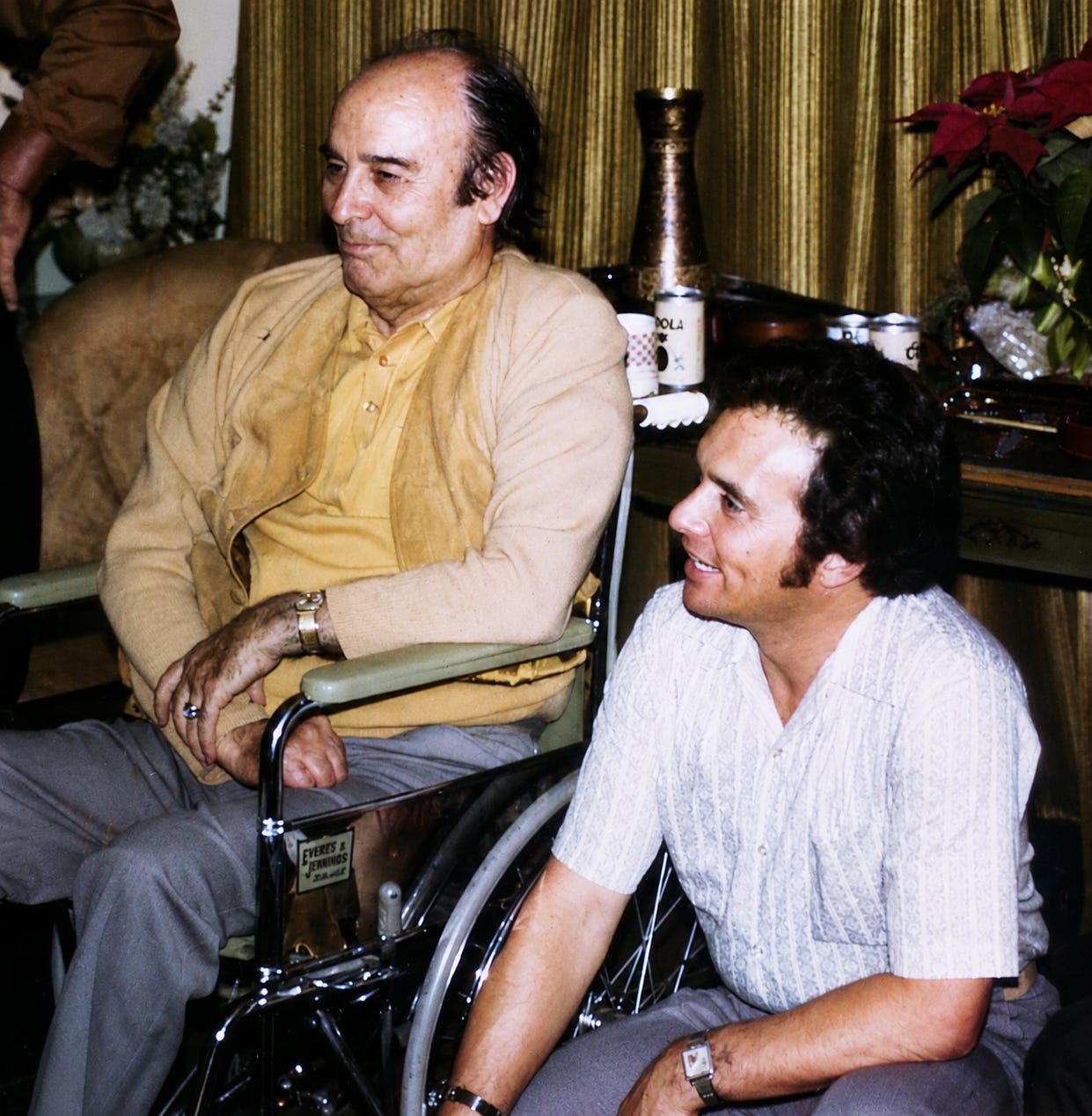
Here is where Merle Haggard comes in.
Merle Haggard worshipped Bob Wills the way some men worship God — with his whole chest, without reservation, no holding back. He had grown up in Bakersfield hearing the Texas Playboys on the radio, had seen them live, had understood at a molecular level that this was where the real came from. In 1970, while Bob Wills sat paralyzed in Fort Worth, Merle recorded an entire tribute album — A Tribute to the Best Damn Fiddle Player in the World — and the title was not hyperbole. It was a statement of theological fact. That album sparked a western swing revival and inspired a generation of younger players. Merle handed the torch back to the man who’d first lit it, and the fire caught.
By 1973, Wills had recovered enough to travel occasionally. After a Bob Wills Day celebration that spring in Turkey, Texas — his boyhood home — he appeared stronger than he had in years. He told his wife Betty there were three things he wanted to do before the year was out: play at a dance, go to Nashville to receive an award ASCAP wished to give him, and have one more recording session with his Texas Playboys.
When Haggard heard about the session being planned, he went to Wills’s motel room in Nashville in mid-October and asked if he could be included. Betty Wills put it simply: “Merle wanted to be a Texas Playboy for a day.”
The session was scheduled for December 3 and 4, 1973, at Sumet-Burnet Studios in Dallas, Texas. The night before, they gathered at Bob’s Fort Worth home — a jam session, a meal, a homecoming. For Jody Nix, the youngest musician in the room at twenty-one, the whole thing was already overwhelming. “We went to Bob Wills’ home for a jam session, a meal, a get-together, a rehearsal, a homecoming of Bob Wills and his Texas Playboys in preparation of an album which was to make musical history,” Nix said. “And I was part of it.”
The personnel assembled for December 3rd reads like a roll call of the devoted. Johnny Gimble on fiddle, mandolin, and harmony vocals. Keith Coleman on fiddle and harmony vocals. Leon McAuliffe on steel guitar and vocals. Eldon Shamblin on guitar. Leon Rausch on bass and vocals. Al Stricklin on piano. Smokey Dacus on drums. Hoyle Nix on fiddle and vocals. Jody Nix on drums and vocals. Tommy Allsup producing. Some of these men had not recorded together since the 1930s. Some of them had been playing Wills’s music for forty years. They came from wherever they were and they came without hesitation.
Merle Haggard had a show in Chicago the night before. He played Chicago, got back on his bus, and drove through the night to Dallas just to be in that room. He arrived for day two. There are things a man does that tell you everything about who he is.. and/or who Bob Wills is to him.
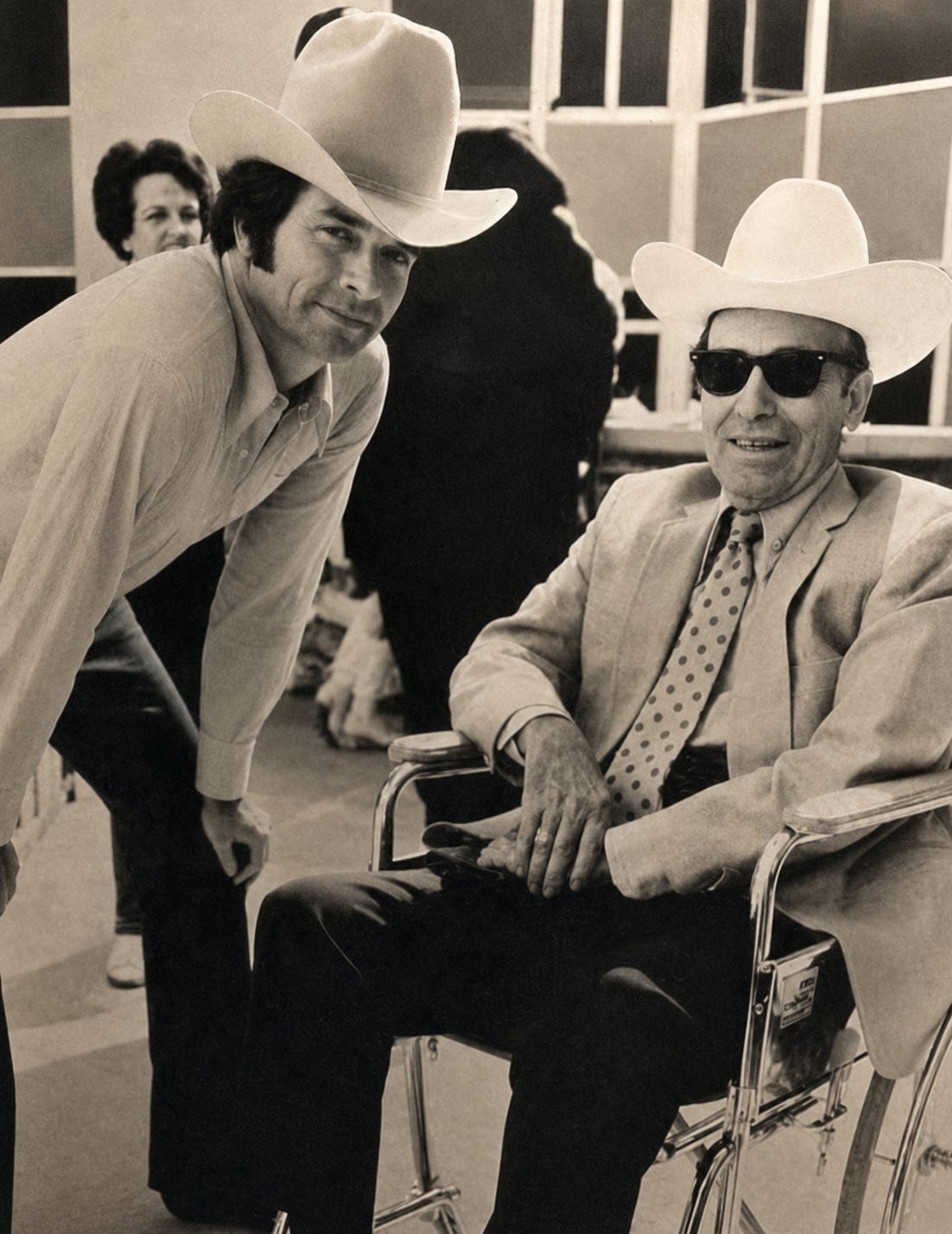
Day one, December 3:
Wills was in high spirits, calling on his musicians when it came time for their solos, chiming in with his trademark “Ahhhh haaaa!” Even in the wheelchair, brought into the studio by Betty, he was alert and present and commanding. He had personally chosen the songs — “Faded Love,” “San Antonio Rose,” “Milk Cow Blues,” the standards his hands had carried for forty years. The room arranged itself in a semicircle around him the way rooms had been arranging themselves around Bob Wills since 1934.
Jody Nix stood at the vocal mic with Wills immediately to his left. “I will never forget that,” Nix said. “The vocal mic was right by him, as I stood there, he was to my immediate left, watching me the whole time. I can see those jet black eyes to this day just gleaming.”
The voice was still there. Diminished, slurred at the edges, but present — the sound of a man who built something enormous and knew it and was saying goodbye to it in a room full of people who loved him, on songs they had all played together when the world was younger and the halls were full.
That night, at his Fort Worth home, Bob Wills suffered another massive stroke.
Day two, December 4:
Merle Haggard arrived from Chicago. The man he had driven through the night to play beside was in a Fort Worth hospital, unconscious, and would never speak again.
Jody Nix recalled the change in the room: “The atmosphere changed in the studio. All the Playboys were quiet, but there was a job to do.”
And that’s exactly what they did. The old men and the honorary Playboy and the youngest drummer in the room finished the record without their king. They played “Faded Love” and “Take Me Back to Tulsa” and “San Antonio Rose” into a microphone in a Dallas studio while the man who wrote those songs lay comatose in Fort Worth. They played them as well as those songs had ever been played. Maybe better. Because they knew what they were doing and they did it anyway, which is the only definition of grace I have ever trusted.
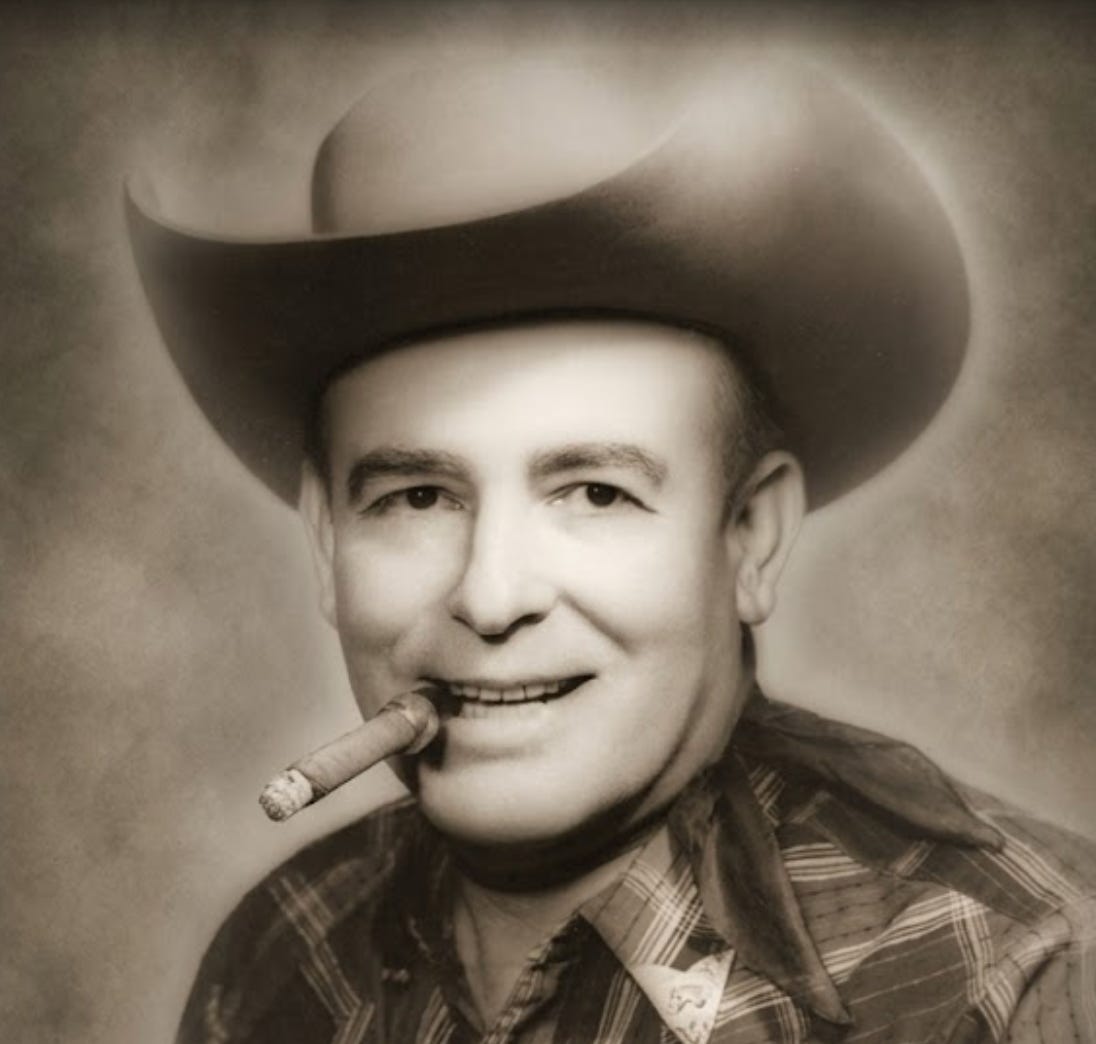
Bob Wills unfortunately never regained consciousness. He lingered seventeen months in a nursing home in Fort Worth, never speaking, never waking fully. He died on May 13, 1975, of bronchial pneumonia. He was seventy years old.
The album was released in 1974 by United Artists while he was still alive and still silent. It sold more copies than any record he had made in his entire career. It won a Grammy Award — the highest honor ever given to a western swing recording. His record sales skyrocketed as he lay dying.
He never heard the reviews. He never knew it won.
Or maybe he did. There are things we cannot verify about the interior life of a man in a Fort Worth nursing home in 1974. What we know is that the album his musicians finished without him, in a studio where the air had changed overnight, became one of the best-selling and most decorated record of his life. The Texas Playboys played their hearts out for a man who could no longer hear them, and the world finally decided to listen.
Friends—sometimes, this is sort of what the Country Music Book of the Dead is for:
The musician who built an entire American music form, watched it outlive his body, and died in a nursing home while his last record climbed the charts and won awards he would never get the chance to hold.
It’s definitely not the worst of outcomes in life, right?
So—when you think of the making of For the Last Time by Bob Wills and the Texas Playboys, I want you to think of a man in his in a wheelchair, surrounded by people who loved him, smiling. He is at the center of the semicircle the way he had always been at the center.
There is rosin on the bows.
Leon’s steel guitar is in tune.
The room is full.
He had one more Ahhh haaa left in him…
And he damn sure used it.
A MESSAGE FROM THE AUTHOR:
My name is Zachariah Malachi. I’m a full-time, self-employed honky tonk musician in Nashville, Tennessee. This Substack Publication was created for the purpose of sharpening my mind on more Nashville and Country Music history to share with the honky tonk patrons downtown during my shows - but I wanted more folks to benefit from the research so - it’s my gift to the country music fans of the world AND the people who WANT to be. Subscribe and come along for the ride.
Fantastic article, Zachariah! What I would've given to be in that studio then! 😉
I've been a Bob Wills fan for almost my entire life. I can heartily recommend Professor Charles R. Townsend's biography of Bob, "San Antonio Rose; the Life and Music of Bob Wills." There are so many great stories and details therein! And whenever you find yourself in central Texas, stop by the old Rainbow Courts in Rockdale where you can stay in the Bob Wills Cottage!
Great post and as Waylon Jennings sang “don’t matter who’s in Austin, bob wills is still the king”.