


I spend a lot of nights in many a different western duds answering to a name that isn’t on my driver’s license, so I have a stake in this one.
People who love country music make the same mistake over and over. They decide the person on stage is the person who goes home. The whole genre is sold on the promise that nothing about it is fake, so the audience takes the accent, the outfit, and the hollering as a straight report from somebody’s kitchen table. Most of the time it isn’t. The stage character is something the artist built out of other people, other jobs, and a lot of years, and it earns its keep by giving the crowd a bigger show than a normal person could deliver while keeping the normal person out of the line of fire.
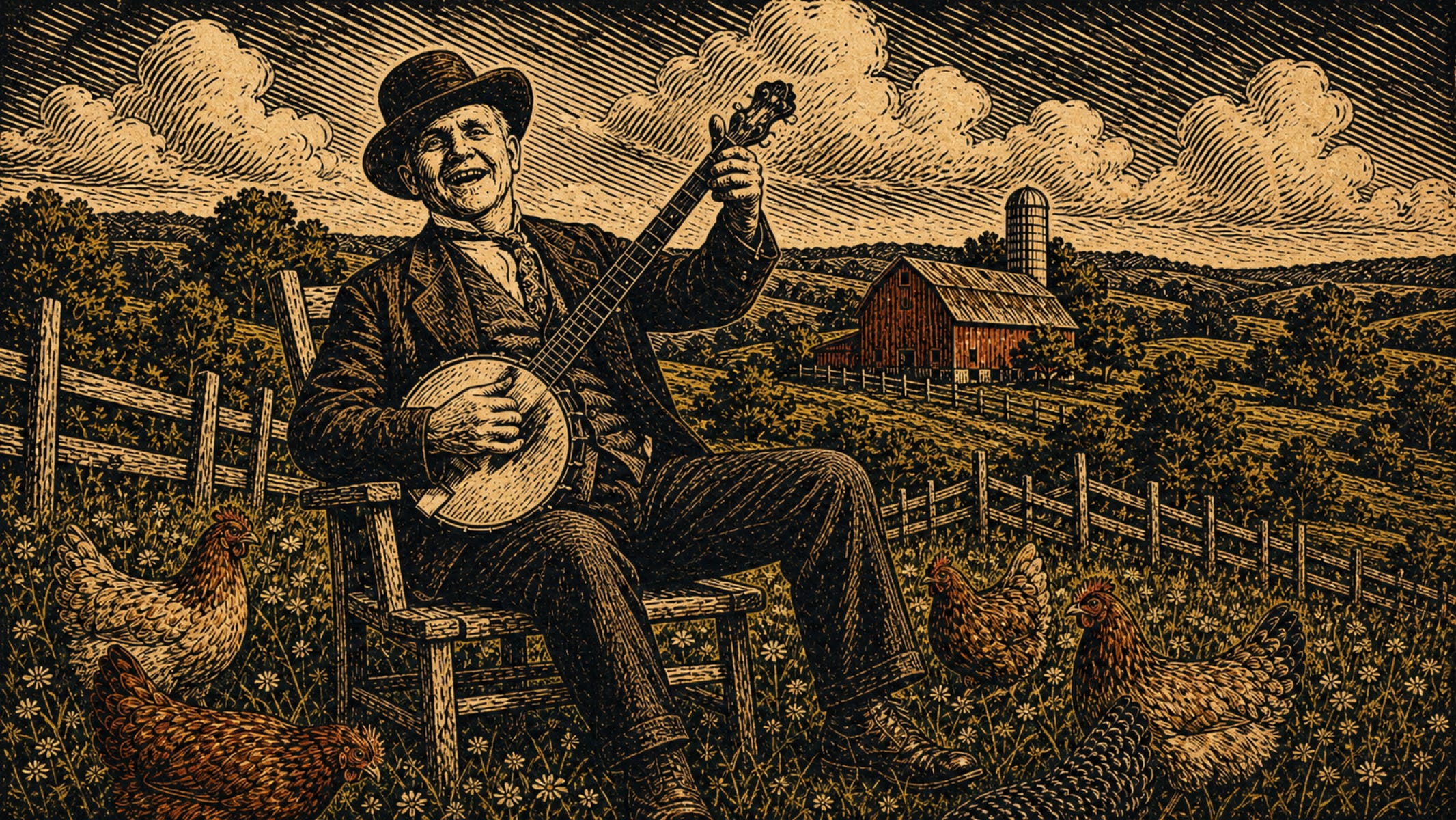
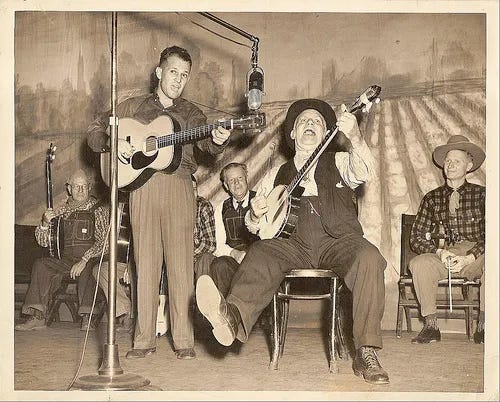
The first Opry star understood this better than anybody who came after him, and he understood it fifty years before Nashville had a publicist. David Harrison Macon was known to radio listeners as Uncle Dave, or the Dixie Dewdrop, a gold-toothed banjo picker who stomped and twirled and cackled like something that had wandered out of the cedar breaks of Cannon County. Behind the act was a farmer with a library, a freight man who counted his money to the penny, and a fellow who could give a proper speech in church. The character was his instrument. It was also his armor.
David Harrison Macon and Uncle Dave
Start with the man. He was born in 1870 to a family with money; his father had been a Confederate officer. From roughly 1900 to 1920 he ran the Macon Midway Mule and Wagon Transportation Company, hauling freight, produce, and Jack Daniel’s whiskey the twenty-odd miles between Murfreesboro and Woodbury. He had a farm at Kittrell and kept ledgers that would satisfy an auditor. He read. Everyone who knew him privately describes a settled, dignified man.
Then the trucks came. Around 1920 motor freight killed the mule line, and Macon, fifty years old, went professional as an entertainer instead of sitting down on the porch. He’d been sharpening the act for decades at picnics, dances, and church socials, and now he had nothing else to do with it.
Uncle Dave was loud wherever David Macon was quiet. He toured with three banjos and had “Uncle Dave Macon, World’s Greatest Banjo Player” stenciled on the trunk. When WSM started putting Opry acts in overalls and straw hats to look like rubes, he wouldn’t do it. He walked out looking like a country gentleman from the previous century: double-breasted waistcoat, stiff gates-ajar collar, silk tie, a heavy gold watch chain across the front, and a wide-brimmed felt hat. When he grinned, the light caught his gold teeth. I think about that outfit a lot. He was told to dress down, and he dressed up instead, and the audience loved him for it. There’s a lesson in there for anybody who’s ever been handed a costume by management.
Where the character came from
Uncle Dave didn’t just fall out of the sky.
When David was a teenager his family moved to Nashville and ran the Broadway House, a hotel that put up vaudeville actors, minstrel performers, and circus people passing through. So the kid spent his formative years watching professionals work a room: the timing, the sight gags, when to hold a beat and when to break it. In 1885, after seeing a circus banjo comedian named Joel Davidson, the fifteen-year-old talked his mother into buying him a five-string.
On top of that theater education he layered twenty years of singing to mules. Driving those wagons he picked up ballads, hymns, and blues from Black farmhands and street musicians along the road, and he sang all of it, all day, to nobody. When he finally took the act onto vaudeville stages and then onto radio in the 1920s, he ran the whole pile together. Circus clown, minstrel, street caller, country preacher, at full volume, on one man.
The grip, the pillow, and comedy as cover
On stage Uncle Dave was a physical event. He treated the radio microphone as an obstacle. He’d step away from it, kick, dance around the banjo, and the engineers had to keep hauling him back and clearing him room to jump. In the recording studios in New York and Jackson, his stomping shook the floor hard enough to jar the cutting stylus, so they slid a pillow under his feet. On the road he carried a little black satchel he called “the grip,” which held his nightcap, a checkered bib for eating pie, and a bottle of Jack Daniel’s. Most of what we know about these habits comes from Charles Wolfe’s research and the interviews he did with the people who traveled with Macon, and I’m leaning on Wolfe here.
The size of the character is what bought him his freedom. He could do “I’ll Tickle Nancy” or “Keep My Skillet Good and Greasy,” about as suggestive as you could get on a 1920s stage, and then go straight into “Rock of Ages,” and nobody in the crowd called him a hypocrite. They weren’t grading David Harrison Macon’s morals. They were watching the Dixie Dewdrop, and the Dewdrop was allowed to contain all of it.
Kirk McGee, who toured with him for years, told Wolfe: “He was a showman. He sold what he had.”
What he left behind
Macon set the pattern for how country entertainers survive being looked at. Build a character big enough to give the audience everything, and the private person gets to stay home with the ledgers.
The line runs straight from him. Louis Marshall Jones was twenty-two when he put on fake whiskers, suspenders, and fifty-year-old boots and became Grandpa Jones. Sarah Ophelia Colley, a college theater major from Centerville, hung a $1.98 price tag on a straw hat and became Minnie Pearl. Neither of them was lying to anybody, and neither was Uncle Dave. The character isn’t the con. It’s the delivery vehicle, and the audience, if you’ve done your job, knows the difference without needing it explained. Uncle Dave worked that out before there was an Opry to work it out on.
ABOUT THE AUTHOR:
My name is Zachariah Malachi. I’m a full-time, self-employed honky tonk musician in Nashville, Tennessee. This Substack Publication was created for the purpose of sharpening my mind on more Nashville and Country Music history to share with the honky tonk patrons downtown during my shows—but I wanted more folks to benefit from the research, so it’s my gift to the country music fans of the world AND the people who WANT to be. Subscribe and come along for the ride.
"There was Uncle Dave Macon, his gold tooth and plug-hat"
He's counted among the other country music legends in "The Grand Old Opry Song", recorded in 1956 by Hylo Brown and reprised by the Nitty Gritty Dirt Band on "Will The Circle Be Unbroken" in 1972.
Wonderful article!
Will you be writing anything about Uncle Dave’s fellow Grand Old Opry star DeFord Bailey?