


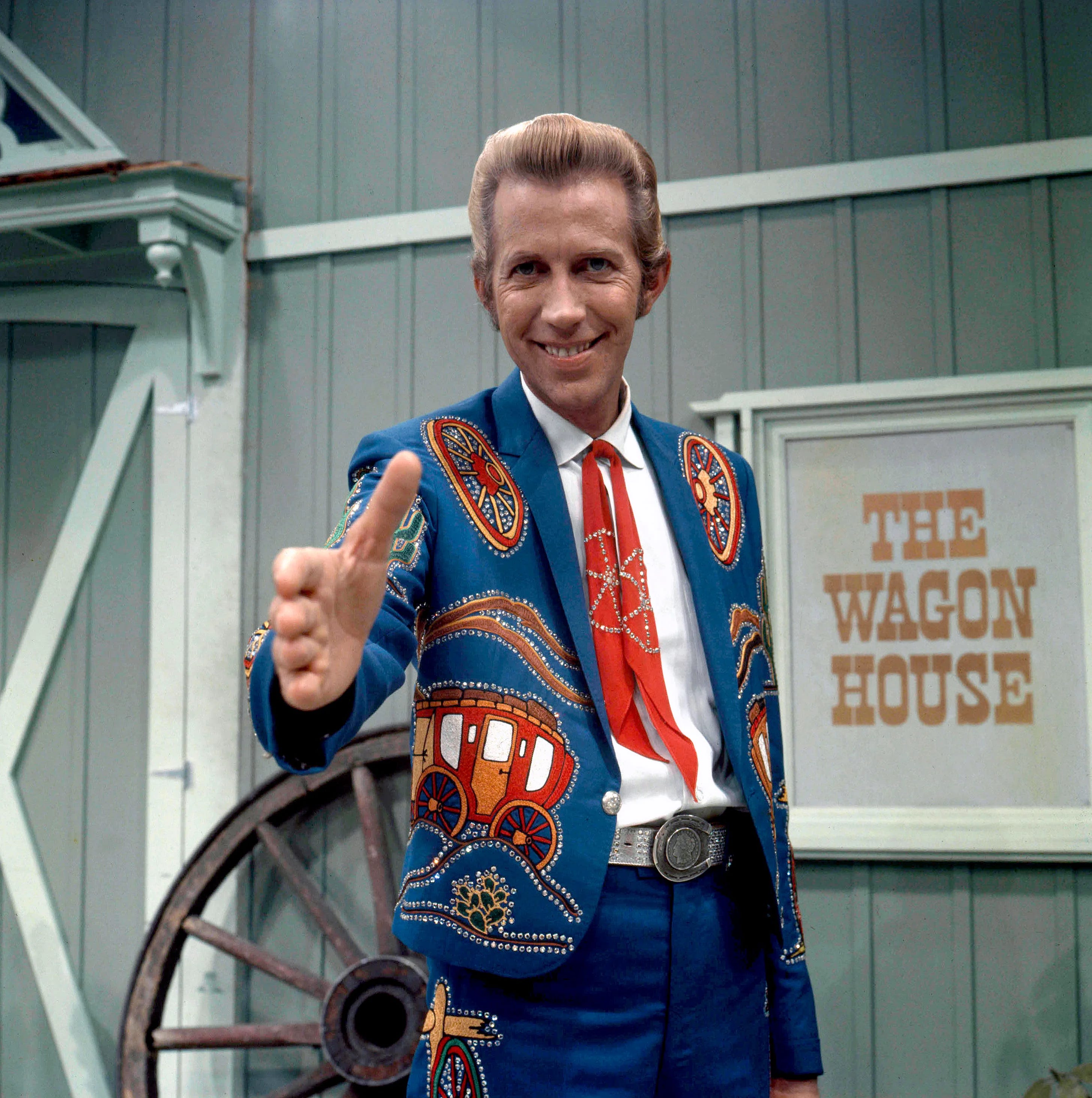
There is a moment, if you go looking for it, where you realize that the modern idea of gothic country — the dark aesthetic, the murder ballads, the death imagery wrapped in something beautiful and strange — didn’t begin with Nick Cave or Johnny Cash’s American Recordings or any carefully curated 21st century Americana artist with a taste for the macabre. It began much earlier, in a rhinestone suit, on a syndicated television show in 1960s Nashville, with a blond pompadoured man from a Missouri farm who smiled at the camera and then sang you a song about a death row inmate, a nervous breakdown, a murder covered up by a grieving son, and a drunk discovered in the gutter outside the Grand Ole Opry.
His name was Porter Wagoner. He was called Mr. Grand Ole Opry. He charted 81 singles, introduced Dolly Parton to the world, wore fifty-two custom Nudie suits worth up to $18,000 apiece, and recorded some of the most deeply, cheerfully disturbing music in the history of American popular song. His Los Angeles Times obituary noted that his music “often told dark tales of desperate people in stark terms that placed him in the gothic tradition of country music.” That’s as close as the mainstream press ever came to saying what anyone who has spent time with his catalog already knows: Porter Wagoner was gothic country. He was possibly the first. And almost nobody talks about it that way.
Let’s fix that.
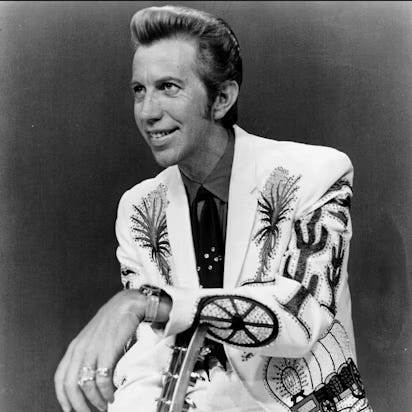
Porter Wagoner. The rhinestones were not an accident. Neither were the songs about death row.
The Contradiction That Wasn’t One
The first thing you have to understand about Porter Wagoner is that his image — blond pompadour, blinding rhinestone suits, wagon wheels and Conestoga wagons embroidered across his chest in glittering thread — was not separate from his darkness. It was inseparable from it. This is the core of what makes him genuinely gothic rather than simply gloomy.
Gothic aesthetics have always operated on a particular tension: beauty and dread in the same frame. The ornate and the morbid. The spectacular surface and the rot underneath. Victorian funeral culture gave us elaborate mourning jewelry made from the hair of the dead. Edgar Allan Poe gave us the most lavishly decorated sentences in the English language describing the most horrifying things imaginable. And Porter Wagoner gave us the most extravagant suits in country music wrapped around songs about padded cells and prison executions.
His first Nudie suit, made in 1962, was a peach-colored showpiece featuring a covered wagon made up of rhinestones and sequins and an all-over pattern of spangled cacti and wagon wheels. He would eventually own 52 of them. He walked onstage looking like the most festive possible version of a country star and then opened his mouth and described, in careful detail, the specific contours of a man’s psychological unraveling.
This is not a contradiction. This is a method. The brightness of the exterior makes the darkness of the content land harder. You’re not braced for it. You don’t see it coming. And Porter knew exactly what he was doing.
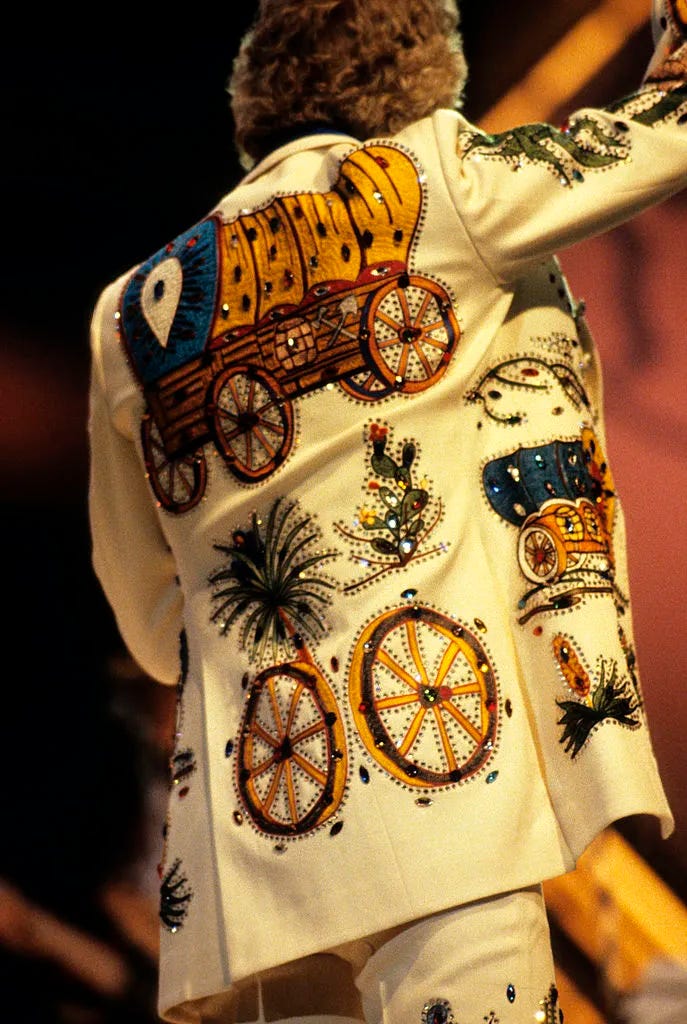
Conestoga wagons in rhinestones. Murder ballads on the B-side.
The Songs: A Guided Tour Through Porter Wagoner’s Chamber of Horrors
Let’s go song by song, because the catalog is the argument.
“Green, Green Grass of Home” (1965)
This one is a masterpiece of misdirection so clean it nearly qualifies as a magic trick. The song opens with a man returning home — the old house, the old oak tree, the old streets of his hometown, his parents waiting at the door, and Mary, “hair of gold and lips like cherries,” running toward him smiling. It is warm and nostalgic and exactly what you’d expect from a country ballad about coming home.
And then the final verse. The man wakes up. He has been dreaming. He is on death row, and he will be executed in the morning. The green, green grass of home is the churchyard where they’ll bury him.
The song is about a Death Row prisoner who is only dreaming of going home — in reality, he is to be executed the following morning. Porter took it to number four on the country chart. Tom Jones covered it and took it international. Millions of people heard what they thought was a homecoming song and got a death sentence instead. Porter delivered the whole thing in his calm, smoky baritone without breaking a sweat.
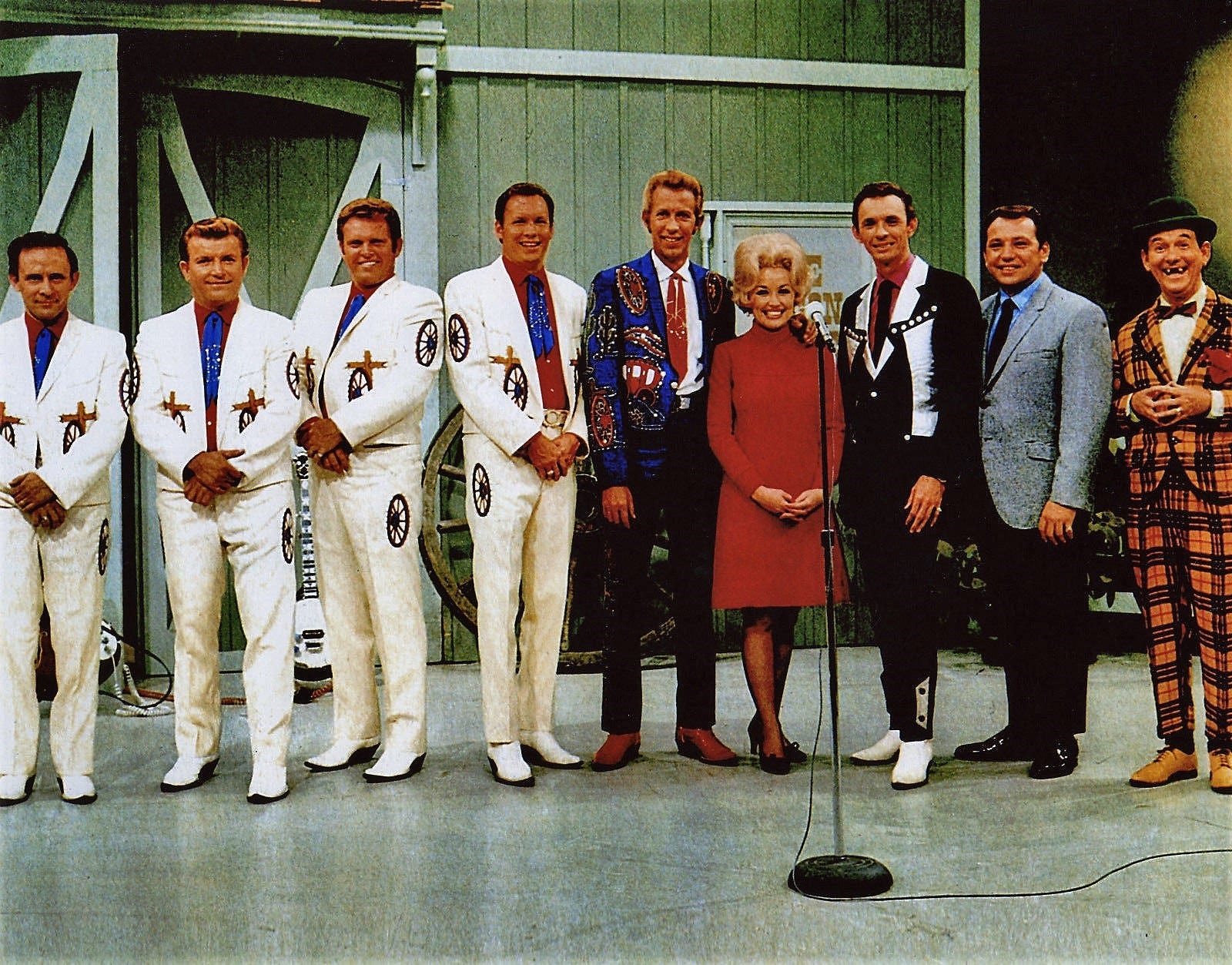
The whole crew on the Porter Wagoner show set.
“The Cold Hard Facts of Life” (1967)
A man comes home early from a business trip. He stops at a liquor store to buy wine for a surprise celebration with his wife. The clerk mentions he just sold the same bottle to a couple a little while ago. The man follows the couple’s car. It turns into his driveway.
Without directly describing the outcome, the song ends with the husband sitting in his cell on death row, asking himself, “Who taught who the cold hard facts of life?”
Porter never once describes the violence. He doesn’t have to. The song ends and you’ve seen everything. This is literary economy of the highest order — the horror implied so completely that your imagination fills in every detail. It’s the same technique Flannery O’Connor used. It’s the same technique Cormac McCarthy uses. Porter Wagoner used it on a 1967 country single and charted at number two.
“The Carroll County Accident” (1968)
The singer tells the story of a single-car accident near his hometown. Walter Browning, an upstanding member of the community and seemingly happily married man, dies; while the driver, Mary Ellen Jones, a woman not his wife but also well respected, survives to testify that she was taking him to town on an errand of mercy.
The narrator goes to see the wreck, like everyone else in the county does. And he finds something no one else noticed: behind the dash of the woman’s crumpled car, a small matchbox held together with a rubber band. Inside it — Walter Browning’s wedding ring. The ring he’d removed before getting in the car with her.
In a surprising twist, we discover the narrator is Browning’s son, and he disposes of the ring to preserve his dad’s reputation. By dark of night, he drops it in a well. He swears a sacred oath he’ll never tell. The town gives his father a marble monument. He carries the secret forever.
This song won the CMA Song of the Year in 1969. It is a story about adultery, accidental death, a cover-up, and the silence a son chooses to protect his father’s name — all delivered in under three minutes with the restraint of a master crime novelist. It is also a profound meditation on the stories small towns tell about themselves and the ones they agree never to tell.
“The Rubber Room” (1971)
And then there’s this one. If the other songs are Porter Wagoner operating as a country gothic novelist, “The Rubber Room” is him going somewhere else entirely — somewhere closer to avant-garde than anything Nashville had ever officially sanctioned.
Porter’s interpretation of a mental breakdown tops the unease chased by many of the prior decade’s proto-punks and garage rockers. The song is told from inside a padded cell, from the perspective of a man who has been driven to complete psychological disintegration. The production is disorienting, dreamlike, genuinely unsettling. It sounds nothing like country music of its era. It sounds like something that should have come out of a late-night art rock session, not from a man in rhinestones on a syndicated family television program.
It was best exemplified in his 1971 recording “The Rubber Room,” about a man who has been driven insane by an unfaithful lover. He recorded it anyway. He put it out. And it remains one of the most genuinely strange artifacts in the entire country music canon.
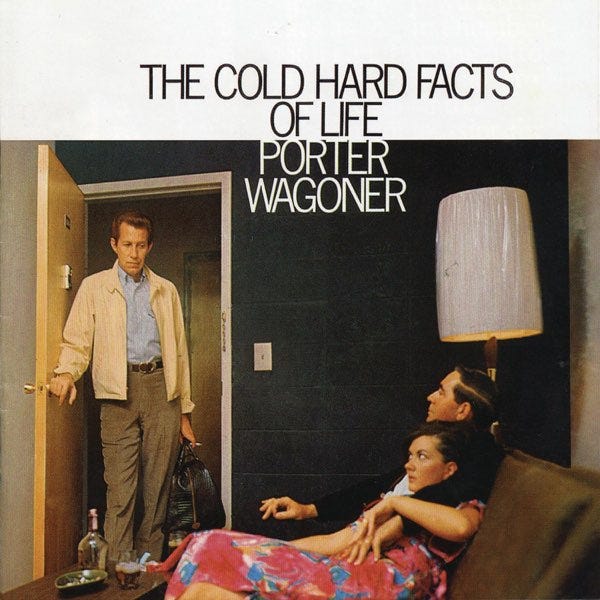
The album covers were not subtle. The songs were even less so.
Skid Row Joe: The Character Study
Porter Wagoner’s gothic sensibility wasn’t confined to individual songs. He built a whole alter ego around it: Skid Row Joe, a recurring character he returned to across multiple records and stage performances.
His 1966 LP Confessions of a Broken Man is a good example. On the cover, we see the first appearance of the character usually identified as Skid Row Joe. The title track is a gut-wrenching recitation about a man whose wife dumps him when his drinking and gambling spiral completely out of control. In the cover shot, we see a dejected Porter decked out in the filthy clothes of a hobo and slumped on the stairs of the Ryman Auditorium.
The image is jarring. The man who owned fifty-two rhinestone suits chose, for his album cover, to dress as a derelict on the steps of the house of country music. And he didn’t just show up in costume — Porter’s biographer Steve Eng reported that Wagoner conducted field research by visiting the Skid Rows of Chicago and Minneapolis, dressed in disheveled attire, the better to soak up the seedy atmosphere.
He went to skid row in disguise. He studied it. He brought it back and made it into art. This is not the behavior of a man who stumbled into dark material — this is the behavior of a method actor operating inside a country music career.
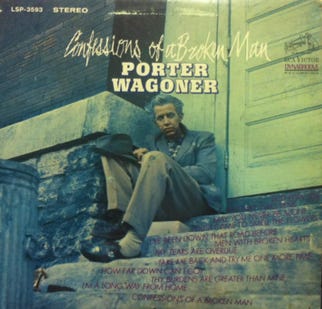
Skid Row Joe, at the steps of the Ryman. The rhinestone suits were back at the hotel.
The Entire Albums Were Concept Records of Grief
This is perhaps the thing least understood about Wagoner’s work: he didn’t just scatter dark songs through otherwise normal albums. Sometimes he would devote an entire album to grim examinations of topics like alcoholism, murder, or prison.
This was unusual in 1960s country music. The Nashville Sound era — the strings, the smooth production, the attempt to crossover to pop audiences — was actively trying to sand down the rough edges of country, to make it more palatable, more radio-friendly, less like the raw and troubling music it had come from. Porter, during this same period, was making concept albums about drunks and killers.
He was, in the truest sense, a counterweight to the commercialization of Nashville. While the industry was trying to make country music more comfortable, he was making it more honest — and honest, when it comes to the lives of rural, working-class Appalachia and the South, often means dark. His darkness wasn’t aesthetic posturing. It came from somewhere real.
Where the Darkness Came From
Porter Wagoner was born in 1927 on a farm in West Plains, Missouri, and the Great Depression wasn’t an abstraction to him — it was the actual texture of his childhood.
His older brother, Glenn — who had drawn Porter on stage to play for local barn dances and had helped him choose his first guitar — succumbed to myocarditis, an inflammation of the heart, in August of 1942. Porter was twelve years old. The next spring, debt forced the family to auction off everything — horses, cows, hogs, the family mule — and move to town. He quit school after seventh grade to help out.
He grew up in the specific American darkness of poverty and loss that has always been the actual subject matter of country music, underneath the trucks and the boots and the stadium anthems. He knew what it meant to lose everything. He knew what it meant to watch someone die too young. He knew what it meant to be a man out of options in a small town with a family to feed and no clear road forward.
When he wrote and recorded songs about those people — the drunks, the prisoners, the men who came home to find their lives already over, the sons who buried their fathers’ secrets in wells — he was writing about people he recognized. He’d grown up next to them. He might have been one of them. The rhinestone suits were partly armor, partly performance, and partly a declaration: I made it out, and I’m going to dress like it. But the songs were about the ones who hadn’t.
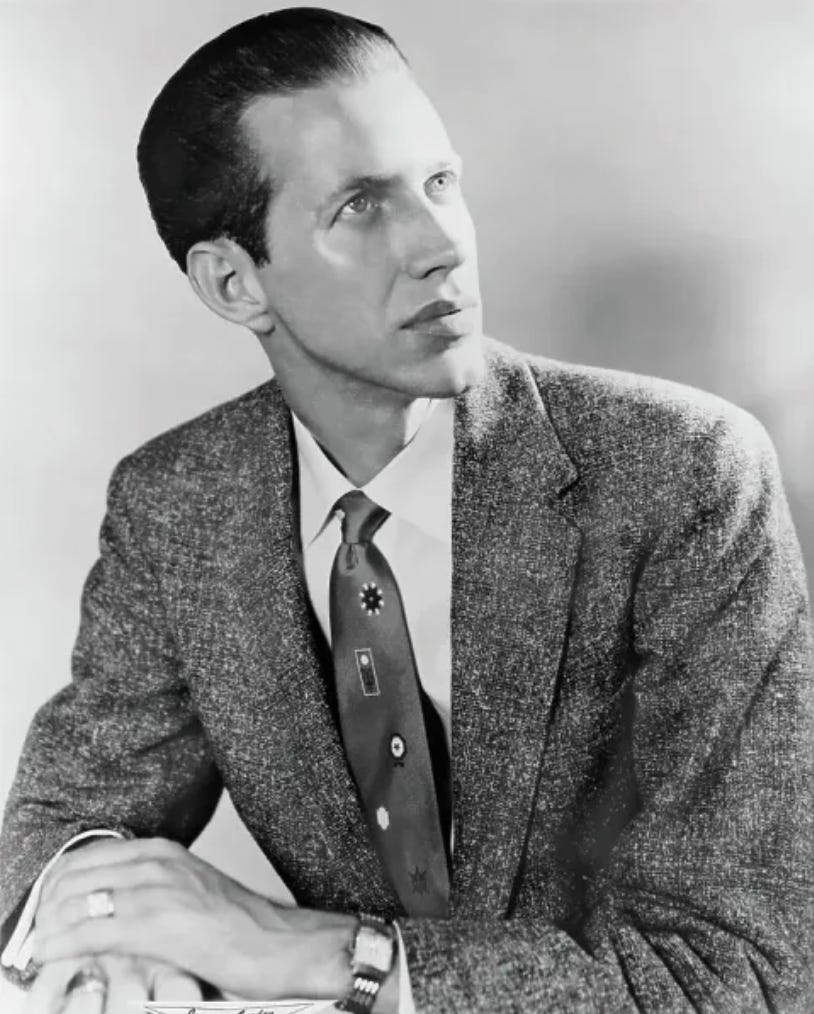
West Plains, Missouri. He remembered where he came from in every song he recorded.
The Visual Language: Gothic in Plain Sight
The gothic tradition in literature and art operates through a specific visual vocabulary: grandeur and decay existing in the same space, the ornate and the terrible in the same frame, the beautiful surface concealing something wrong underneath. Think of the great gothic houses — all that elaborate architecture built around rooms where terrible things happened.
Porter Wagoner’s visual presentation was, whether he consciously intended it or not, a country music version of exactly this. The Nudie suits — those astonishing, hand-embroidered, rhinestone-studded works of art — were the Gothic mansion. The songs were what happened inside it.
His embellished suits were the work of Nudie Cohn, a Russian immigrant whose North Hollywood tailor shop outfitted stars like Hank Williams, Johnny Cash, and Elvis Presley. One suit, designed in the 1960s, was embellished with rhinestones, beads, and embroidered Conestoga wagons, Winchester rifles, wagon wheels, and desert scenery. Winchester rifles. He had Winchester rifles embroidered on the suit he wore while singing about murder and death row.
Whether this was intentional symbolism or simply the visual logic of country showmanship, it doesn’t matter — the effect is the same. The man was a walking piece of dark art walking into the middle of mainstream American entertainment every week and delivering his darkness with a smile and a wave.
Why He’s the First
The usual candidates for “first gothic country artist” are Johnny Cash, or Nick Cave with his Murder Ballads album, or perhaps Townes Van Zandt for his bleakness, or even Hank Williams for the darkness threading through his honky tonk. All of these are reasonable arguments. But here is what separates Porter Wagoner:
It was the totality of the vision. Cash had dark songs but also gospel, redemption, and a persona built partly on salvation. Hank Williams was tragic personally but his songs were often straightforwardly heartbroken rather than gothic. Townes Van Zandt was dark but deeply underground, never charting, never reaching the mainstream at scale.
Porter Wagoner was on television. He was in 100 markets. He had three million weekly viewers. He was charting top-five songs about death row inmates and padded cells and sons burying their fathers’ secrets. He was doing it in rhinestones, in prime time, and he was winning CMA Song of the Year awards for it. He was gothic at scale, gothic in the mainstream, gothic while America watched after dinner on a Tuesday night.
And he got there first.
The modern gothic country movement — if we draw a line from Murder Ballads through Gillian Welch through Sturgill Simpson through the contemporary dark Americana scene — has a spiritual grandfather that rarely gets named in those conversations. He had a blond pompadour. He smiled at the camera. He sang you a song about a man waking up on death row, and the whole time, those rhinestones were catching the light.

He opened for the White Stripes at Madison Square Garden at age 80. Jack White understood exactly what he was.
The Last Chapter: Vindication
Porter Wagoner died on October 28, 2007, from lung cancer, with his family and Dolly Parton at his side. In the months before he died, he released Wagonmaster, produced by Marty Stuart for the Anti- label — the same label that released Tom Waits and Neko Case and other artists operating in the space where country and darkness intersect. The album received the best reviews of his career.
He toured that summer. He appeared on Late Show with David Letterman. And he played Madison Square Garden as the opening act for the White Stripes — Jack White, one of rock’s foremost practitioners of blues-drenched darkness and gothic American imagery, having specifically requested Porter Wagoner for the slot.
Jack White understood. He heard the same thing that anyone who really listens to Porter Wagoner hears: a man who spent five decades encoding darkness inside spectacle, who built a gothic vision so complete and so consistent that it took the rest of American music until the 21st century to fully catch up to what he’d been doing in rhinestones since 1962.
He was Mr. Grand Ole Opry. He was the first gothic country artist. Both things were true. And he dressed for both occasions every single night.
Essential listening: “Green, Green Grass of Home” (1965), “The Cold Hard Facts of Life” (1967), “The Carroll County Accident” (1968), “The Rubber Room” (1971), “Skid Row Joe” (1965), “Confessions of a Broken Man” (1966, full album), Wagonmaster (2007, final album). Start with “The Rubber Room.” It will either make perfect sense to you immediately, or you will need to sit with it for a while. Either response is correct.
Oh...as a dawwwdddy y'allternative. OBSESSED