


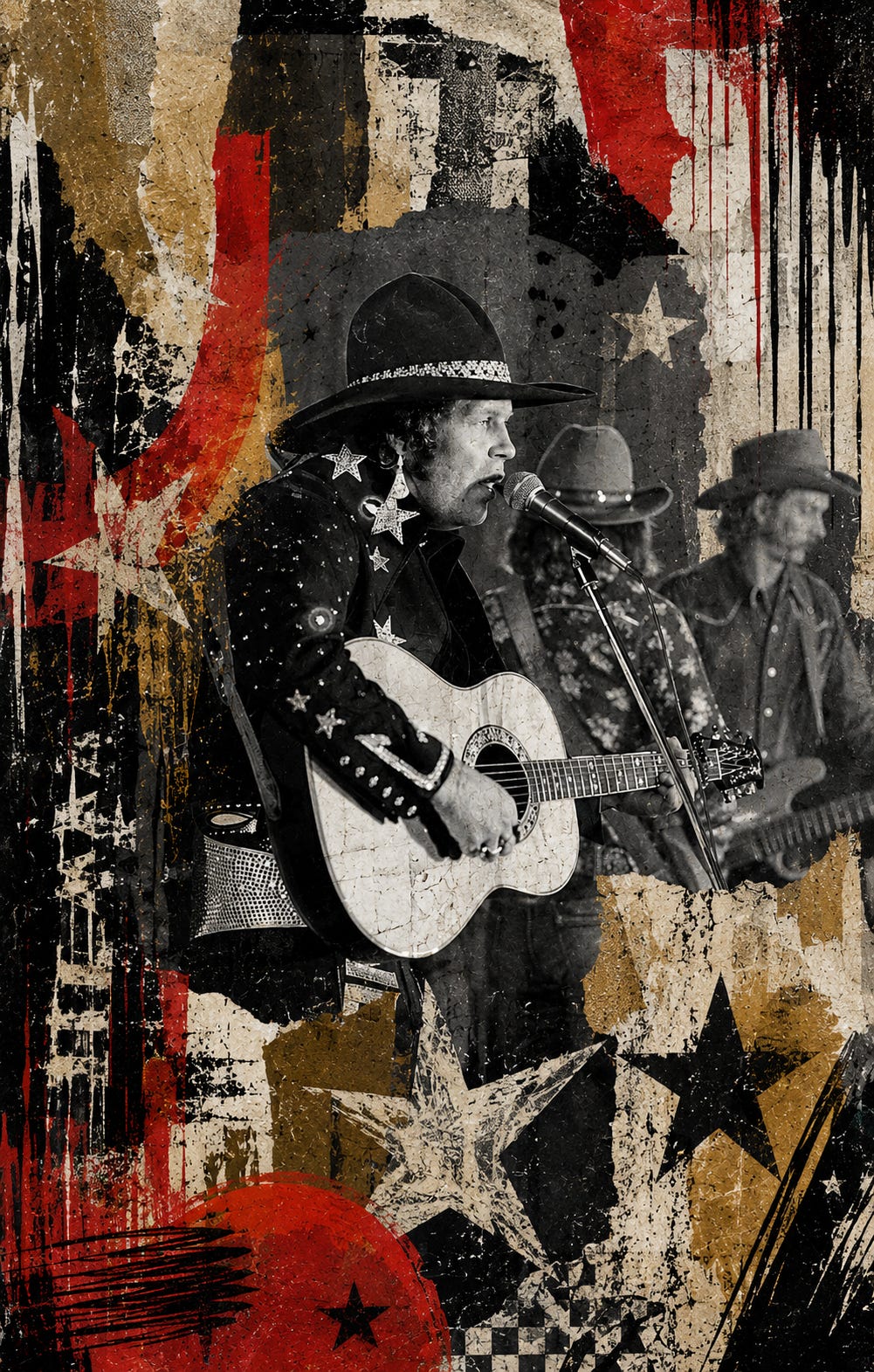
Every Artist Has a Character
You learn a lot in this industry. Whether you are big or small. The time you spend around a place like Nashville can teach you a lot about how it runs just by keeping your eyes and ears open — watching the phenomenon of fame take over someone’s life, watching what it does to them, and watching what they decide to become because of it.
Here’s my free advice to any country music artist:
Sit down and think to yourself — what is my career adding to the country music zeitgeist?
It’s 2026. Take a look on Lower Broadway at any moment of the day or evening and I’ll tell you what you’re going to see. There will be a girl somewhere down there at any point in time wearing a flat brim cowgirl hat and bell bottoms. Why? Lainey Wilson. That’s usually what people think of aesthetically when they think of Lainey Wilson.
When I mention big boobs and blonde wigs, you think of Dolly Parton. The color black and trains, Johnny Cash.
Matter of fact, think of anyone you have ever heard this industry call a legend and you will be able to pick apart the characteristics of whoever they are talking about — most likely aesthetically first.
Every artist in this industry has a character. Even if they play the card of authenticity, the character is mostly an exaggerated version of who they really are — or sometimes altogether someone different. It doesn’t make it fraudulent. It makes it show business. Nashville has always known that. It just doesn’t like to say it out loud.
The Man Who Lived in a Hearse
David Allan Coe understood this from the moment he arrived.
After prison, Coe moved to Nashville, living in a hearse parked near the Ryman Auditorium while busking and pursuing music. Think about that image for a moment. A man sleeping in a hearse outside the Mother Church of Country Music. This is a man who was not going to NOT be noticed.
It worked. People who saw him thought he was a star of some sort, but didn’t know who he was, and so took to calling him The Rhinestone Cowboy — years before Glen Campbell created his huge number one.
He hadn’t released an album at this point. Just a persona.
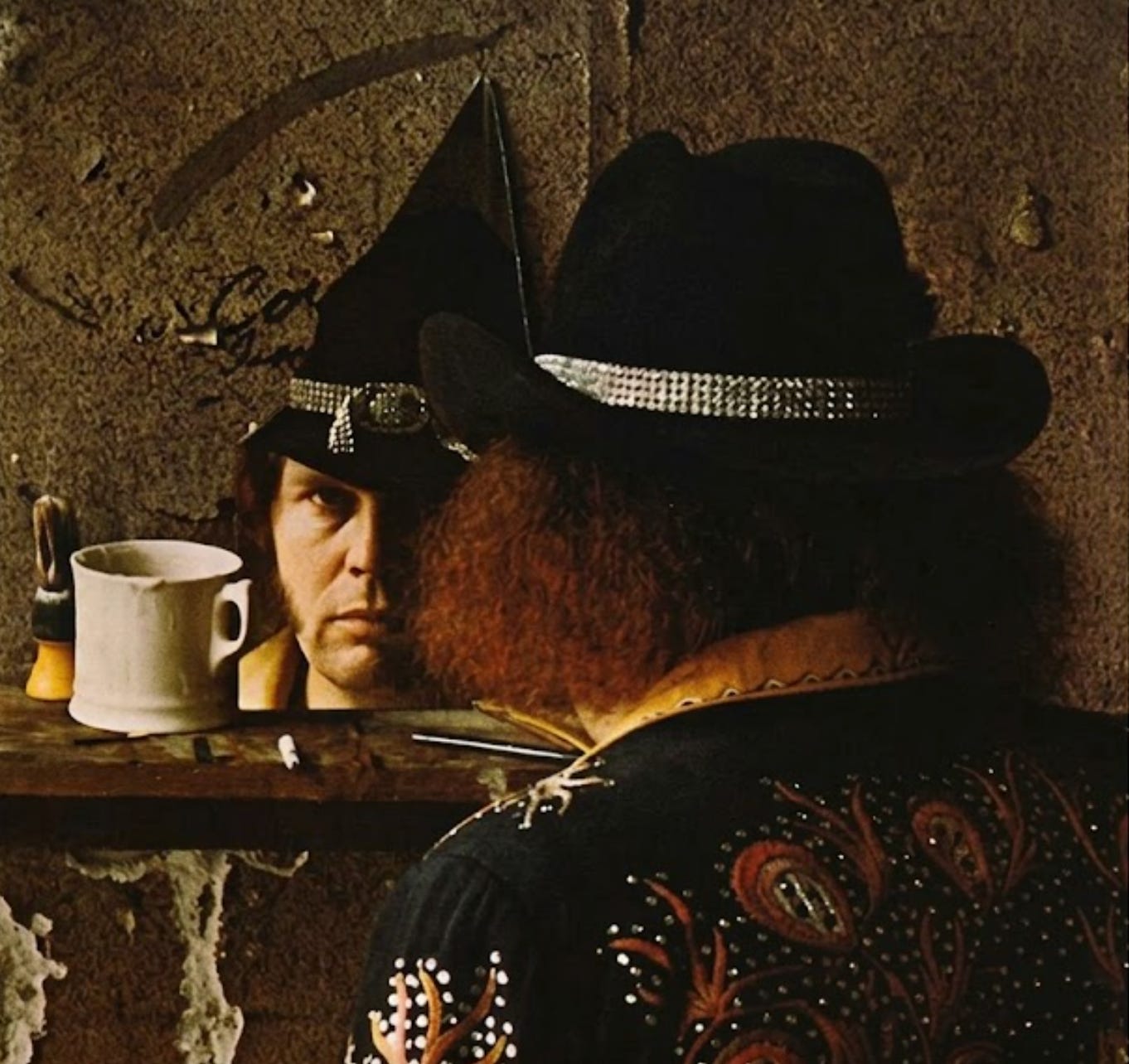
The Mysterious Rhinestone Cowboy: Character I
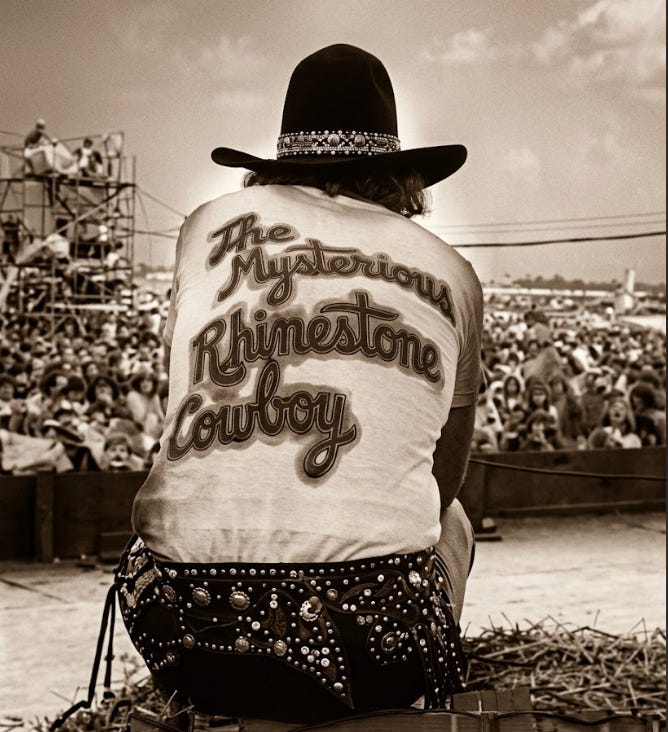
With his mysterious rhinestone cowboy persona, he sometimes performed wearing a gaudy black rhinestone-studded suit, big black cowboy hat, and a black mask over his eyes, accessorized with silver skull earrings. He sometimes rode his Harley onstage as he shouted cuss words at the audience, which cussed back at him.
This was a fully constructed theatrical identity — name, costume, props, and mythology built around it. He titled his major label debut after it. He made a documentary about it. The 1975 KERA documentary follows the ex-convict turned outlaw country star performing, visiting his childhood home, and returning to a correctional institution. He was curating the narrative in real time, on camera, feeding the legend while it was still being born.
And then — when it stopped working — he retired it.
His wild, long hair, multiple earrings, flashy rhinestone suits, Harley Davidson biker boots, and football-sized belt buckles had become obstacles to getting people to take him seriously as a recording artist. Other singers continued to record and succeed with his material, but the author himself languished in obscurity. Rather than tone it down, Coe characteristically shoved the stereotypes in their faces. He retired the Mysterious Rhinestone Cowboy persona and billed his new album as “David Allan Coe Rides Again as the Longhaired Redneck” — something equally off-putting to institution types.
Read that one more time. He retired the persona. Deliberately. Consciously. And replaced it with a new one. That is not the behavior of a man being authentically himself. That is the behavior of an actor that got a new gig.
The Long Haired Redneck: Character II
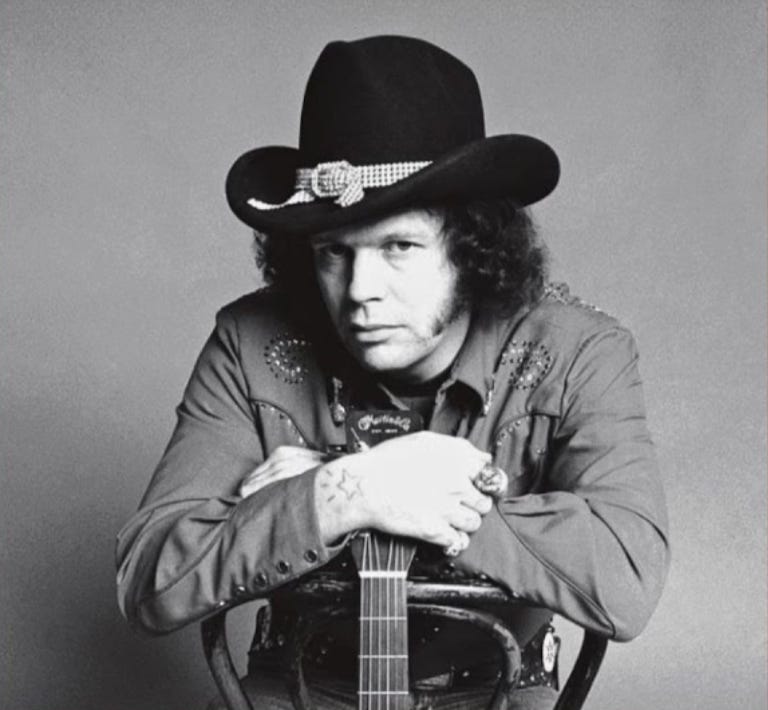
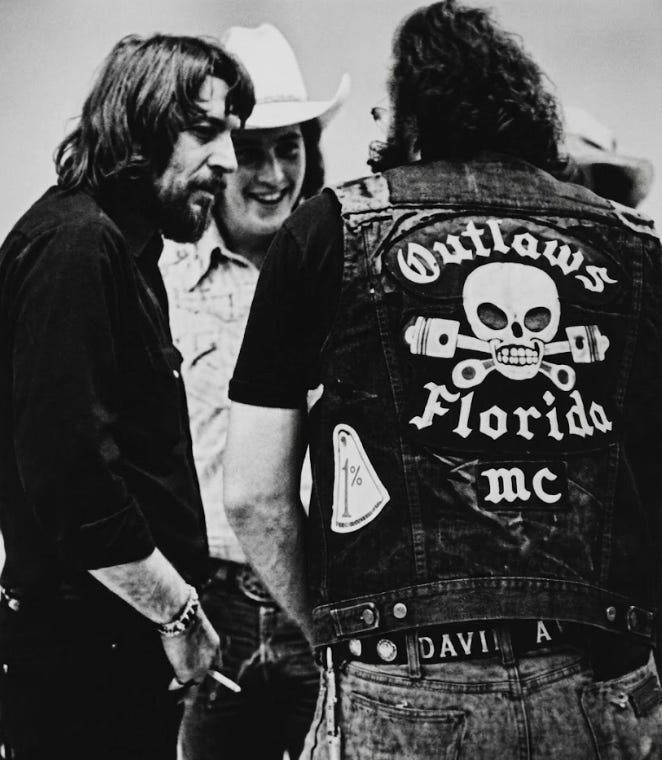
The Longhaired Redneck was a sharper, angrier character than the Rhinestone Cowboy. Where the Cowboy was theatrical — masked, rhinestoned, almost campy in its Roy Rogers’ arch-angel appearance— the Redneck was confrontational. During the outlaw movement heyday, Coe placed himself at the center of the scene with songs like “Longhaired Redneck,” which featured lyrics about performing in dive bars “where bikers stare at cowboys who are laughing at the hippies who are praying they’ll get out of here alive.”
This was a man writing himself into the culture. Putting himself in the room, on the stage, in the mythology — as a character who existed at the intersection of every counterculture at once, belonging fully to none of them. Coe claimed a diverse fan base that included bikers, doctors, lawyers, and bankers. It seemed as if this was done purposefully.
And his peers knew it. Among the outlaw country crowd, Coe was often seen as a poser. Waylon Jennings called out Coe’s prison stories, claiming they were exaggerated for effect. Many of Coe’s peers questioned the authenticity of his wild tales, seeing him as more of a showman than a true outlaw.
That’s Waylon Jennings calling you a fraud. The face of outlaw country, telling you that your version of “outlaw” is just a performance. Make of that what you will.
The Underground Provocateur: Character III
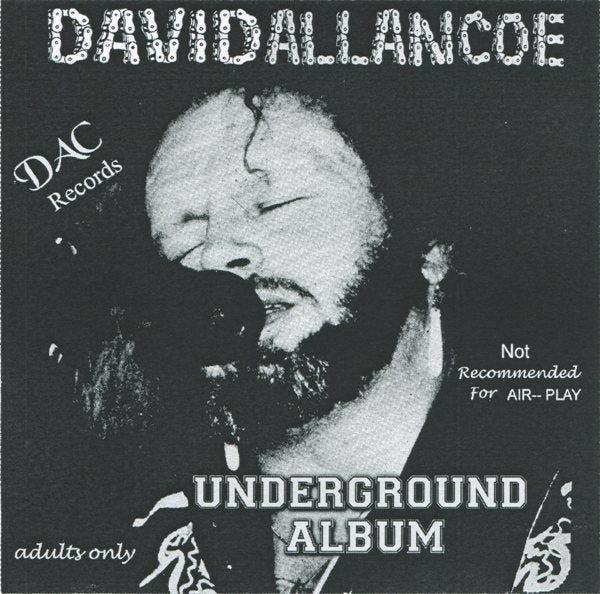
Then there are the records that almost ended everything.
In the late 1970s and early 1980s, Coe released a series of underground albums — X-rated, racist, deliberately transgressive material distributed through biker magazines and later his own website. The content was kept off mainstream shelves by design. According to Coe, it was Shel Silverstein who talked him into recording the first X-rated album, telling him to go into the studio after hearing what Coe had been playing privately.
Shel Silverstein. The man who wrote children’s books and composed some of the most tender, witty songs in the American songbook — he is the one who green-lit the most offensive material of Coe’s career.
That detail alone should tell you something about the nature of what was being made. This was provocation as a creative exercise, taken further than it should have gone, by a man whose instinct was always to push past every boundary in the room.
Coe consistently rejected the labels that followed him. He argued the recordings were intended as satire, shaped by a persona he adopted while associating with outlaw motorcycle culture. In interviews, Coe maintained that his songwriting reflected character work rather than personal belief, and that the material had been misunderstood.
Character work. His words. Not mine.
The Catalog of Contradictions
Here is where the argument becomes impossible to dismiss.
The same man who recorded that really bad underground material wrote “Would You Lay With Me (In a Field of Stone)” — a song so quietly devastating that Tanya Tucker took it to number one. He wrote “Take This Job and Shove It,” a working-class anthem that became a cultural touchstone. He recorded “The Ride” — one of the most spiritually reverent pieces of music in the country canon, a ghost story about Hank Williams Sr. built around the only question that has ever mattered in this town: boy, can you make folks feel what you feel inside?
Given his reputation, his occasional turns doing soft ballads come across as surprisingly gentle — like his biggest chart hit, “Mona Lisa Lost Her Smile,” or “Tanya Montana,” a song about his daughter.
A song about his daughter. Written with the tenderness of a man with heart.
Now you tell me — does that sound like the same guy? Or does it sound like several men living inside one guy?
The catalog doesn’t lie. A man capable of “The Ride” and “Would You Lay With Me” is not a man whose inner world is defined by the ugliest material he ever put to tape. The ugliest material is the character talking. The songs that last — the ones that still make the hair stand up on the back of your neck — those are the man underneath all of that.
The Mask and The Face
Every artist in Nashville is building a character whether they admit it or not. The question isn’t whether you’re doing it. The question is whether the character you’re building is serving your music — or consuming it.
Some artists never find a mask to wear. Some try on several before their career ever lifts off the ground. Donny Lytle became Donny Young, and Donny Young became Johnny Paycheck — a name borrowed from a boxer, worn by a man who spent decades trying to live up to the violence and recklessness it implied, and who paid for it accordingly. The name came first. The mythology followed. That’s how it works.
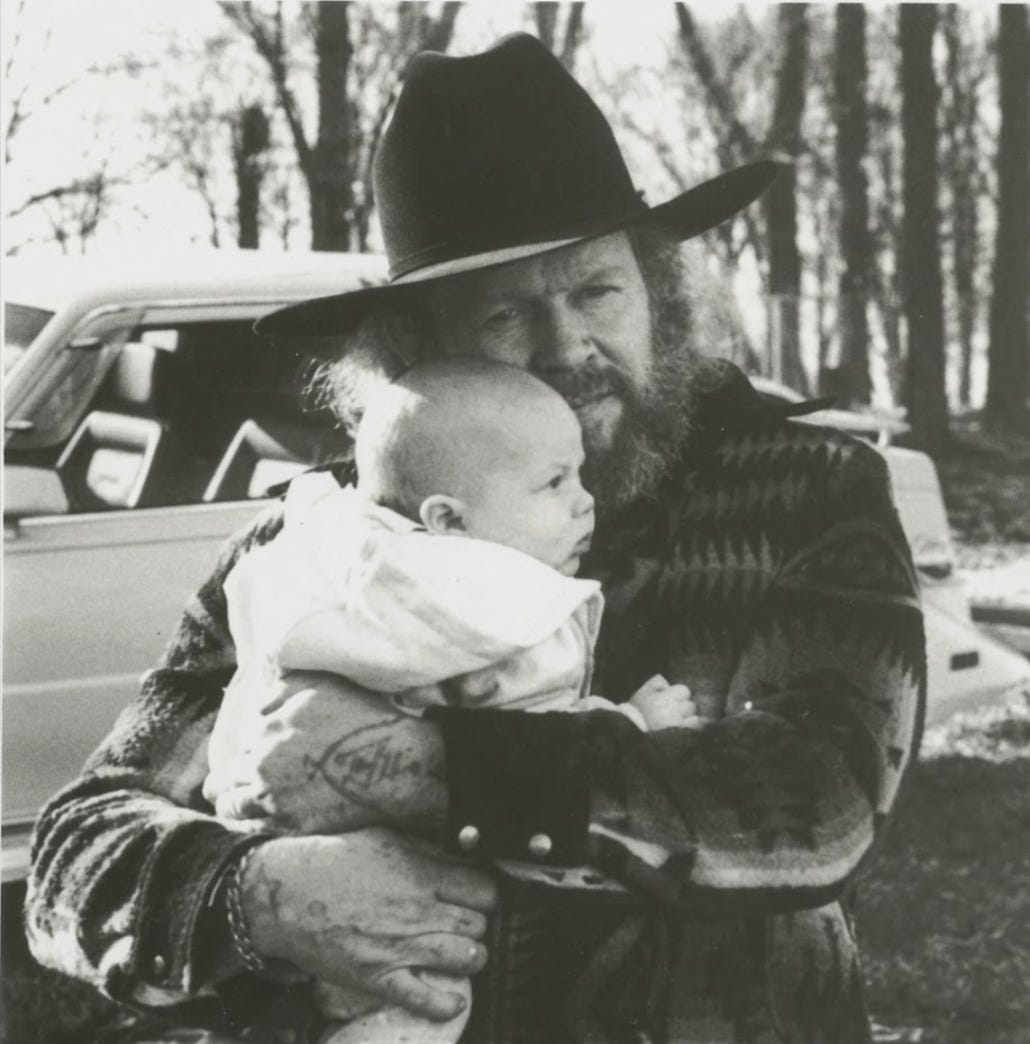
David Allan Coe is the answer to what happens when you can’t tell the difference anymore between the mask and the face underneath it — when the character you built to get in the room becomes the only thing the room will ever talk about, and the music that should have been your legacy gets left standing in the parking lot.. outside of the Country Music Hall of Fame, if you catch my drift.
He had the chops. He had the voice. He had the song sense to write for Tanya Tucker and Johnny Paycheck and to record one of the most haunting tributes to Hank Williams that country music has ever heard. And he buried all of it — or at least gave the opposition everything it needed to bury it for him — under personas engineered to provoke, designed to transgress, and ultimately unable to distinguish between outlaw and irredeemable.
There’s a lesson in that. A hard one.
MESSAGE FROM THE AUTHOR:
This is truly the first “opinion” based piece I have written on this publication.
The truth - I don’t know why DAC did or said or sang the things he did.
What I do believe is that DAC portrayed fictional characters.
Everyone has their opinion - this is just my hot take.
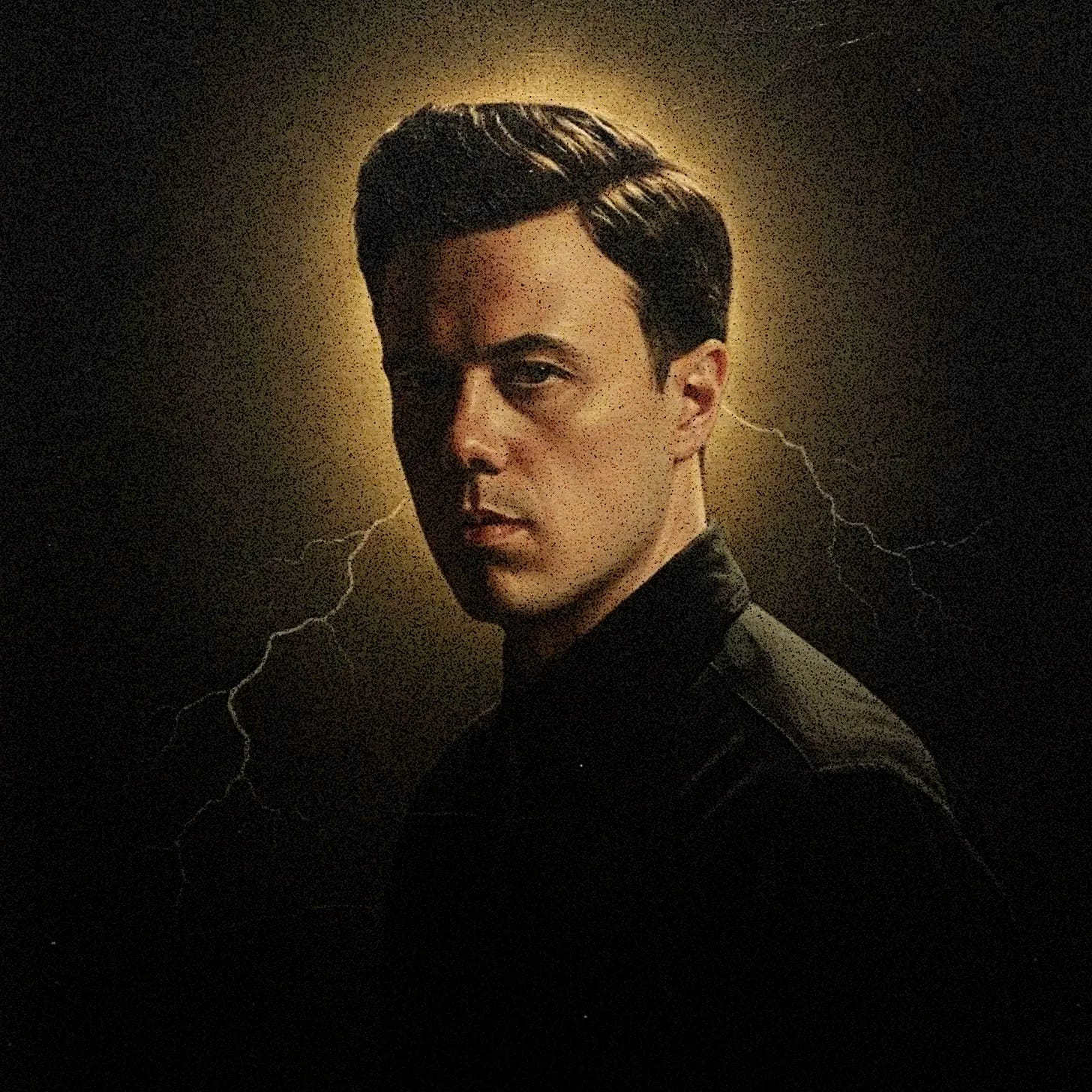
Zachariah Malachi — known as The Count of Country Music — is a singer, musician, actor, and writer based in Nashville, Tennessee. He works somewhere in the tradition between Hank Williams and the end of the world, and has a particular interest in the parts of country music history that the Hall of Fame keeps in the back room. Between working as Johnny Cash, Conway Twitty and Jimmie Rodgers in Nashville-production CountryRoadsUSA and playing music live 6+ times a week on Nashville’s Lower Broadway. He loves the dark and has been known to shapeshift..?
A friend of mine opened for hime a few times. DAC was chaos personified, according to him, and you didn't ven know who was going to show up from one minute to the next. It is no surprise that his music is the same.
Shel Silverstien also wrote some of the best songs Dr. Hook ever recorded. Just sayin'.