


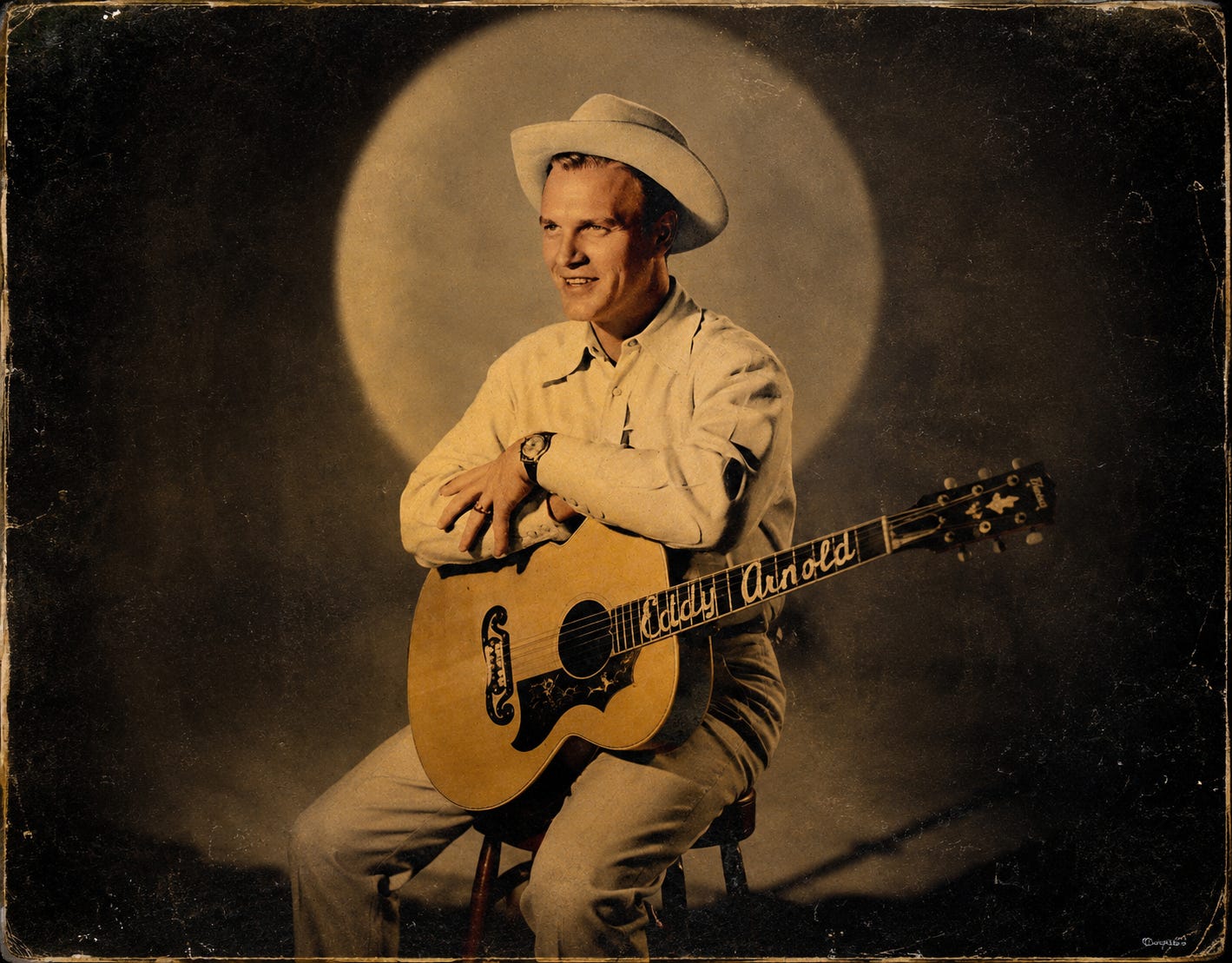
I moved to Nashville on Valentine’s Day, 2020. Not to Nashville, exactly — to Brentwood, a few miles south of the city, into a house that once belonged to a man who’d been close friends with Eddy Arnold.
At the time, I didn’t think much of it outside of how cool that fact was. Brentwood is the kind of place where half the houses have stories like that — somebody famous, or somebody who knew somebody famous, tucked into a cul-de-sac that looks like every other cul-de-sac. But I was running a Zachariah Malachi merch operation back then, which meant trips to the Brentwood Post Office with boxes under my arm several times a week. And it was there, waiting in line, that I started hearing about Eddy Arnold from people who’d actually known him — not the Hall of Fame bio, but the neighbors.
The picture they painted was consistent: a happy-go-lucky man, generous, the kind of guy who’d stop and talk to anybody. And he drove a clunker. Everyone in town knew Eddy Arnold was richer than most of them — richer than almost anyone — and he drove around in a beat-up old car like he didn’t have a dime. That’s surely the sign of a smart millionaire.
It’s a good story on its own. But it’s also a thread into something bigger, because the post office, the cul-de-sac, the quiet wealth hiding behind an old car — none of that existed in Brentwood before Eddy Arnold helped form it all.
What Brentwood Was
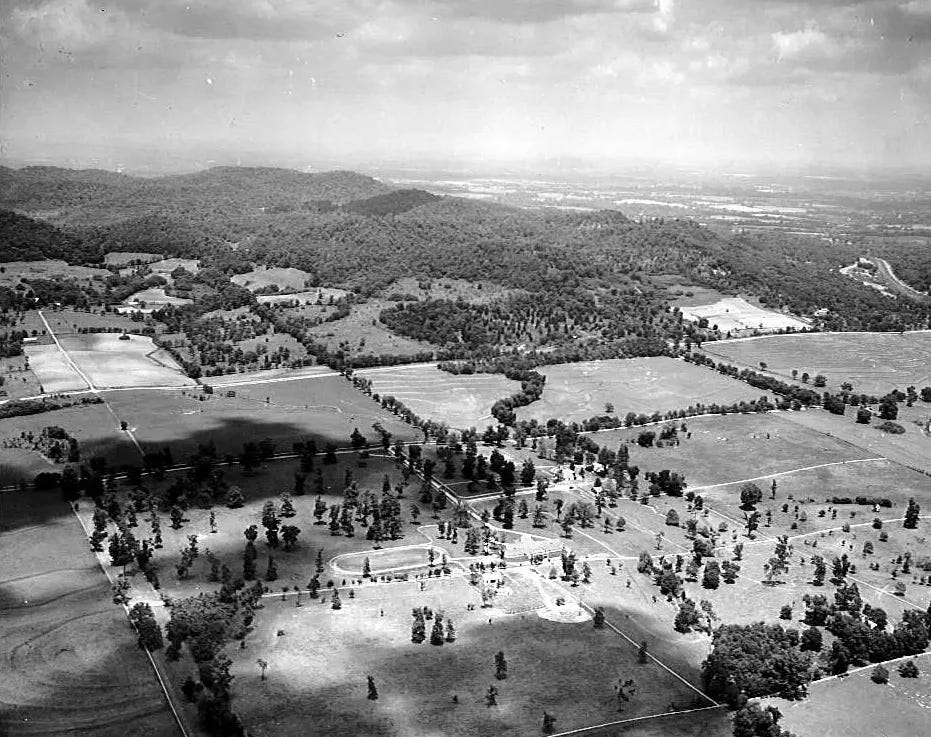
When Eddy Arnold bought his land in 1950, Brentwood wasn’t a town. It wasn’t even close. It was a rural agricultural area characterized by tobacco and horse farms — open country between Nashville and Franklin, the kind of place with a post office and a church and not much else. It wouldn’t incorporate as a city for another nineteen years. When it finally did, on April 15, 1969, its population was 3,378. Before that, the population was barely 1,000 people.
That’s the Brentwood Eddy Arnold rode into — not a suburb, a direction. South of Nashville, past the city limits, where land was cheap because nobody with money wanted to live that far from town yet.
Arnold did.
The Plowboy Buys Land
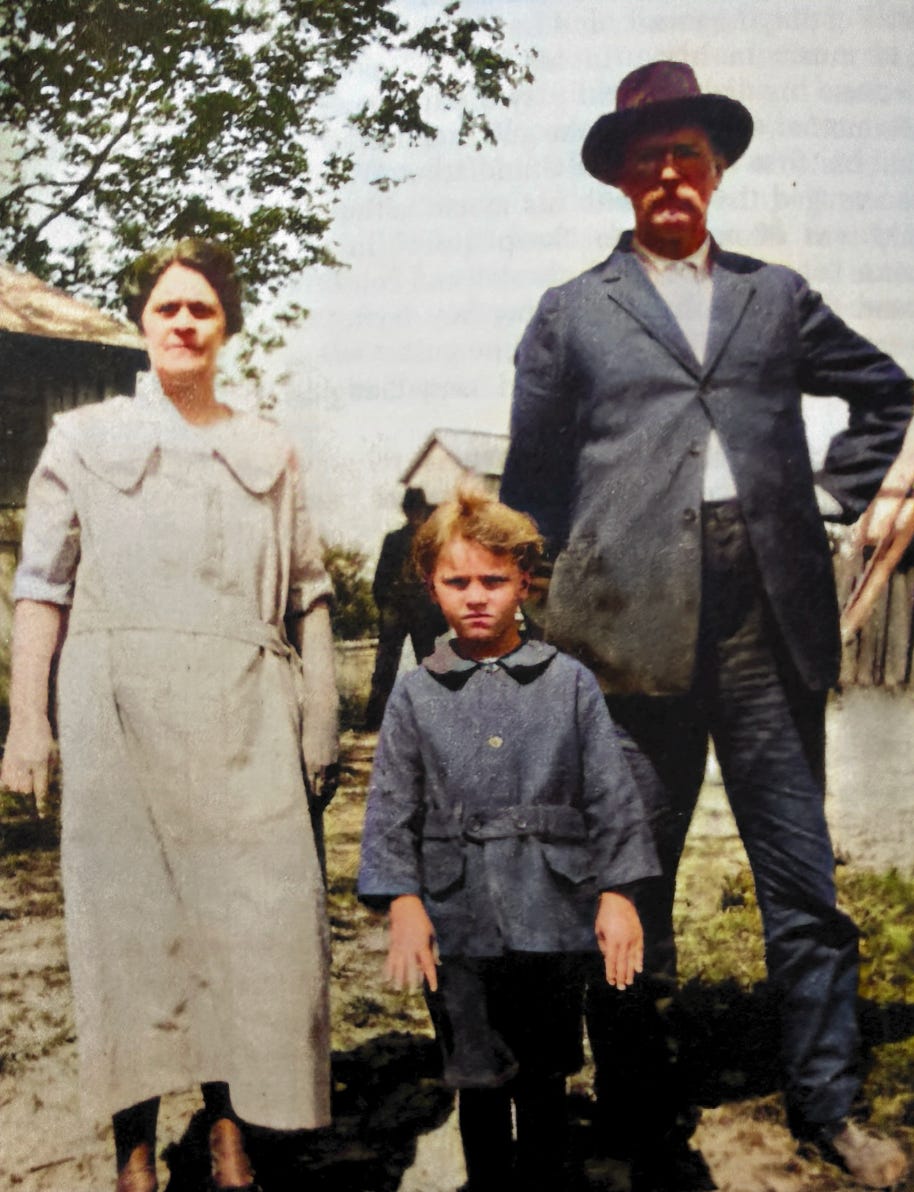
Richard Edward Arnold was born May 15, 1918, on a farm near Henderson, Tennessee. His father, a sharecropper, played the fiddle, while his mother played guitar. Arnold’s father died when he was just 11, forcing him to leave school and begin helping on the family farm. That’s where the nickname came from — the Tennessee Plowboy — and it never really left him, even after he became one of the biggest stars in American music.
By 1950, Eddy was at the height of his first great run of success. His earnings from recordings and road shows—together with a lucrative song scouting arrangement with music publisher Hill and Range Songs—enabled him to diversify his investments and build a fine home in Brentwood, Tennessee. Mind you, this was back when you made THAT kind of money playing music. He was determined never to be poor again, and he succeeded.
That’s the official version, but hey, it’s true. The historical marker in his hometown puts it more bluntly: mindful of the poverty of his youth, he had invested primarily in real estate, purchasing large swaths of land in the Nashville suburb of Brentwood.
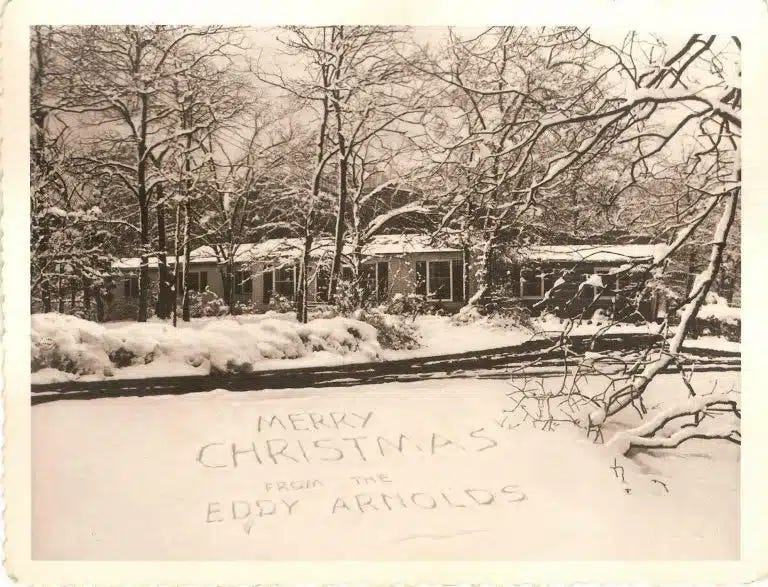
The first piece of that land was a 61-acre tract off Granny White Pike, which Arnold called “Windy Ridge.” In 1950, at the height of his career, country singer Eddy Arnold bought 61 acres of Nashville property he dubbed “Windy Ridge.” He moved his young family onto the land and went on to become a country music legend, helping pioneer what’s now known as the “Nashville Sound.” He called this property home from 1950 until his passing in 2008.
But Windy Ridge was only the start. Decades later, Arnold still owned a separate 197-acre tract on the south side of Murray Lane — land he held onto well into his 80s. Arnold put the property on the market in May 2003 for an asking price of about $35,000 per acre, or a total asking price of nearly $7 million ($12.6 million in 2026). Southern Land Co. officially closed on the purchase of the 197 acres formerly owned by country music icon Eddy Arnold the following year, building the upscale Wynstone subdivision on it.
Two tracts. Roughly 258 acres, confirmed. A sharecropper’s son who lost his father at eleven, plowing fields to keep his family fed — and by his thirties, he was the largest individual private landowner in what would become one of the wealthiest zip codes in Tennessee.
Not Just a Resident — a Builder
Here’s the part that doesn’t get told often enough: Arnold wasn’t just a famous guy who happened to live in Brentwood. He was part of making it. The Tennessee Encyclopedia’s official entry on him doesn’t bury this fact — it’s right there in his biography, alongside the chart records and the Carnegie Hall date: “In addition to his success as a country music artist, Eddy Arnold has been a successful businessman and community leader, active in developing and promoting Brentwood, a suburb of Nashville.”
Think about the timeline. Arnold buys his first tract in 1950. Brentwood incorporates in 1969 — the same era Arnold’s career was hitting its second commercial peak, the Nashville Sound years, 1964 to 1970, when country music embraced the “Nashville Sound” and became the music of the middle class. The man who helped create the polished sound that brought country music into suburban living rooms across America was, at the very same time, helping turn the literal suburb he lived in from farmland into a city.
And “active in developing” wasn’t just a phrase for the bio. Brentwood in those early days had a problem nobody talks about anymore: there wasn’t enough water to support the kind of growth a town needs. So Eddy — along with Jack Corn and a handful of others — started the Brentwood Water Company, a privately held outfit that pulled water from the springs around Meadow Lake and ran it out to the subdivisions going up around town. He ran it for years before eventually selling it to the city. The man who’d write a check from his own personal checkbook for a park project also laid the pipe, in a manner of speaking, that let Brentwood become a place where pipes could go at all. You don’t get a Você or a Wynstone without water lines first — and Eddy had a hand in both ends of that story, the land and the infrastructure underneath it.
What It Is Now
Both of Arnold’s tracts are now exactly the kind of development his old farmland was bought up to become.
Windy Ridge — the original 61 acres, the place he actually lived and raised his family — is now Você, a high-end residential community... designed from the ground up to retain and embrace the natural beauty of the land, developed by his own grandson, Shannon Pollard. Today, Eddy Arnold’s grandson, Shannon Pollard, lovingly oversees Eddy’s real estate holdings and formidable musical legacy.
The Murray Lane tract is now Wynstone — an upscale community consisting of 116 homes.
And down at Crockett Park, the second largest park in Brentwood’s system, with 164 acres, there’s an amphitheater that carries his name — Crockett’s Eddy Arnold amphitheater, home to the annual Summer Concert Series and Fourth of July celebration.
A 2.81-acre buildable lot in Brentwood today lists for whatever the market will bear — and the math on that alone tells you what happened to the land Eddy Arnold was buying by the hundreds of acres for a fraction of that per-acre price.
The Man in the Clunker
Which brings it back around to the post office.
By every account — the official ones and the ones told to me over a counter on Concord Road — Eddy Arnold was warm. Happy-go-lucky. The kind of guy who’d talk to you like you were old friends, whether or not you’d ever met. And he drove a car that looked like it belonged to anybody — a clunker, by the description I kept hearing — while owning, at various points, hundreds of acres of some of the most valuable real estate in Middle Tennessee.
That’s not a contradiction. If anything, it’s the most consistent thing about him. The boy who lost his father at eleven and had to leave school to work the farm never stopped being that boy, even after he’d become rich enough to reshape an entire town. He bought the land because he was “mindful of the poverty of his youth” and “determined never to be poor again.” But he didn’t need anyone to see it. The land said it for him.
ABOUT THE AUTHOR:
My name is Zachariah Malachi. I’m a full-time, self-employed honky tonk musician in Nashville, Tennessee. This Substack Publication was created for the purpose of sharpening my mind on more Nashville and Country Music history to share with the honky tonk patrons downtown during my shows - but I wanted more folks to benefit from the research so - it’s my gift to the country music fans of the world AND the people who WANT to be. Subscribe and come along for the ride.
You are a great storyteller. I’m enjoying all of these tales about Nashville and its musical history. Also happy to known Mr Arnold’s stage persona was just like his real one.
Thanks for this. 1924 photos were a serious business!