


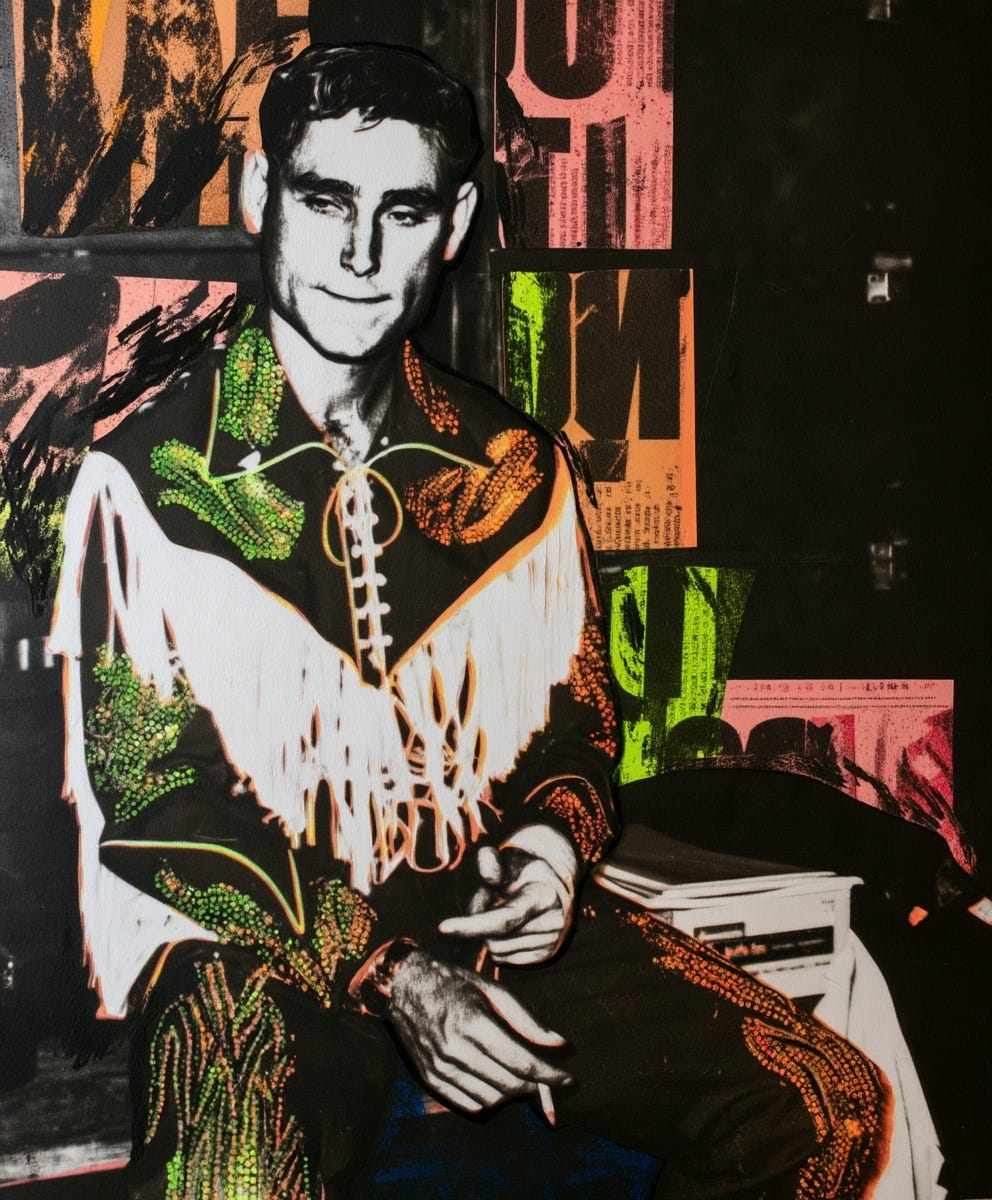
Before anyone was calling him No-Show Jones, and long before the big weepers he’s remembered for, George Jones was a wild kid out of the East Texas piney woods. He was born in Saratoga, Texas, right on the edge of the Big Thicket, into poverty, oilfield roughnecks, and a father who handled his disappointments with music and whiskey, in roughly that order depending on the night.
By twelve he was working the sidewalks of Beaumont with a secondhand guitar, singing Hank Williams and Roy Acuff for whatever quarters people would throw him. From there it was honky-tonks, and in the honky-tonks the teenage Jones figured out two things about himself. One, he could sing like almost nobody else alive. Two, liquor made him brave, and it was the kind of brave that gets you hurt.
Harold W. “Pappy” Daily and Jack Starns started Starday Records in 1953 and found Jones singing in regional clubs. Daily had been a jukebox distributor. He became Jones’s manager, his producer, and something uncomfortably close to a father. His first job was getting the kid to quit doing impressions. After hours of one early session Daily had heard enough: “George, for the last few hours you’ve sung like Roy Acuff, Lefty Frizzell, Hank Williams, and Bill Monroe. Can you sing like George Jones?”
It turned out he could. In 1955 he cut “Why Baby Why” at Bill Quinn’s Gold Star Studio in Houston and it broke him nationally, which is a nice clean story until you hear about the session. Jones showed up hours late, worked his way through a fifth of whiskey while they were rolling tape, and blew the lyrics so many times the fiddler swore he would never record with the man again.
That Gold Star date is more or less a template for the next ten years. Through the late 1950s, while Starday was hooking up with Mercury and getting Jones onto the Grand Ole Opry, he was drunk most of the time, and the people who paid for it most directly were sitting in Starday’s own offices.
The Mercury-Starday years
By 1957, after the Mercury-Starday joint venture came together, Jones was one of the fastest-rising names in country music. “Don’t Stop the Music” and “Just One More” were all over the jukeboxes in the South. He was also about as badly equipped for fame as a person can be.
He was depressed most of the time and treated it with bourbon and amphetamines, which is a combination that works right up until it doesn’t. The schedule made everything worse. He bounced between his home in Texas and Nashville, where he kept a cheap room at the Clarkston Hotel, and his recording was split the same way: Gold Star in Houston, where Daily liked to cut tracks on the cheap, and Owen Bradley’s Quonset Hut on 16th Avenue South in Nashville.
Nashville never felt like his town. The men in suits who ran the business didn’t have much use for East Texas hillbillies playing three-chord songs, and Jones could tell. “Most of the record-buying public regarded us as hillbillies,” he said later. “Even in Nashville there were folks who looked down on those of us on Sixteenth Avenue South.”
So he drank harder, in the city that was making him famous. The benders became Music Row folklore. Bloody Marys for breakfast, whiskey all afternoon, hotel parties that ran two or three days and usually ended with somebody getting hit or a piece of furniture going through a wall.
“It wasn’t but $1,200”
Starday co-founder Don Pierce said later that managing Jones was about half business and half crisis management, and most of the crises landed on Pappy Daily personally.
On one West Texas tour Jones went on a bender, got into a fight, and ended up in a county jail. Daily drove out there, posted bail, and got him out of the cell with just enough time to drive him to a well-paid show in Houston.
The Houston show went fine. Jones walked out with $2,500 in cash, which was serious money for a country singer in the mid-1950s. The bank did not come into it. He rounded up some musicians and some fans, bought whiskey by the armload, and threw an all-night party at the hotel.
Somewhere in the small hours, blind drunk and convinced somebody at the party was going to rob him, Jones went into the bathroom, pulled out the roll of bills, and flushed it. All of it. He stood there and watched it go.
Daily heard about it within a day or so. When Jones turned up at the Starday offices two days later, hungover and broke, Daily lit into him.
“Golly George,” he said, “I get you out of jail, get you a date, I give you front money and buy you a new uniform, and you go and flush $2,500 down the toilet!”
Jones, still in the same rumpled clothes, looked him dead in the eye. “Pappy, that’s a goddamn lie. It wasn’t but $1,200!”
I have thought about that line more than I probably should have. He wasn’t denying it. He was correcting the figure.
The Saturday morning rampage
Flushing his own money was one kind of problem. Jones could also turn on the label, and the worst example happened at Starday’s business office in Madison, Tennessee, a few miles north of downtown Nashville.
One Saturday morning Jones pulled into the Starday lot after driving all night from a gig on booze and pills. Somewhere on that drive he had decided the label was sitting on his royalties and getting rich while he wore himself out on the highway. He went in the front door with that idea fully formed.
He walked straight into the office of one of Daily’s administrative assistants and demanded cash, right then, for every record he had sold.
The assistant was the only person in the building. He tried to explain that he was a mid-level employee with no access to the royalty ledgers or the checkbook, and certainly not on a Saturday. Jones didn’t want to hear it.
“Well, just how many records have sold?” he said, leaning over the desk.
The assistant froze. Jones wrote in his autobiography that the poor man couldn’t produce a single real number. “The only number he seemed to know was eleven.”
“I’d say about eleven thousand,” the assistant said.
So here is Jones, with a string of records that had charted across the country, being told they had moved eleven thousand copies total. That was the end of the conversation.
He picked up wooden chairs and threw them against the walls. He kicked over filing cabinets, swept paperwork and promo material off the desks, and smashed whatever office equipment he could get his hands on.
Pierce said later it got genuinely dangerous in there. The assistant managed to slip out and call the Madison police. When officers pulled up they found Jones standing in the wreckage, still yelling about his money. They could see the shape he was in, so they took him in and kept him in a cell until he sobered up.
Why they kept him
In just about any other business, an employee who wrecked the office and left in the back of a squad car would be fired by Monday and sued by Friday. Starday wasn’t any other business, and calling Jones an employee is generous.
Pierce and Daily knew exactly what they had, and I think they had made their peace with the cost. Jones had no business sense and a private life that was a slow car wreck. He was also the reason Starday made money. When he sang, the hurt came through in a way nobody had pulled off since Hank Williams, and working people heard it and bought the records.
The day after he got out of jail, sober and ashamed, Jones wrote Pierce a letter apologizing for tearing up the Madison office. Pierce took the apology, quietly got the furniture repaired, and kept putting the records out.
The Starday era ended when Daily and Pierce split up and Daily took Jones with him to United Artists and later Musicor. But the legend got built in those Texas and Nashville years. The wrecked office, the flushed cash, the bar fights. He wasn’t just singing those honky-tonk songs. He was, for better and mostly for worse, living inside them.
ABOUT THE AUTHOR:
My name is Zachariah Malachi. I’m a full-time, self-employed honky tonk musician in Nashville, Tennessee. This Substack Publication was created for the purpose of sharpening my mind on more Nashville and Country Music history to share with the honky tonk patrons downtown during my shows—but I wanted more folks to benefit from the research, so it’s my gift to the country music fans of the world AND the people who WANT to be. Subscribe and come along for the ride.