


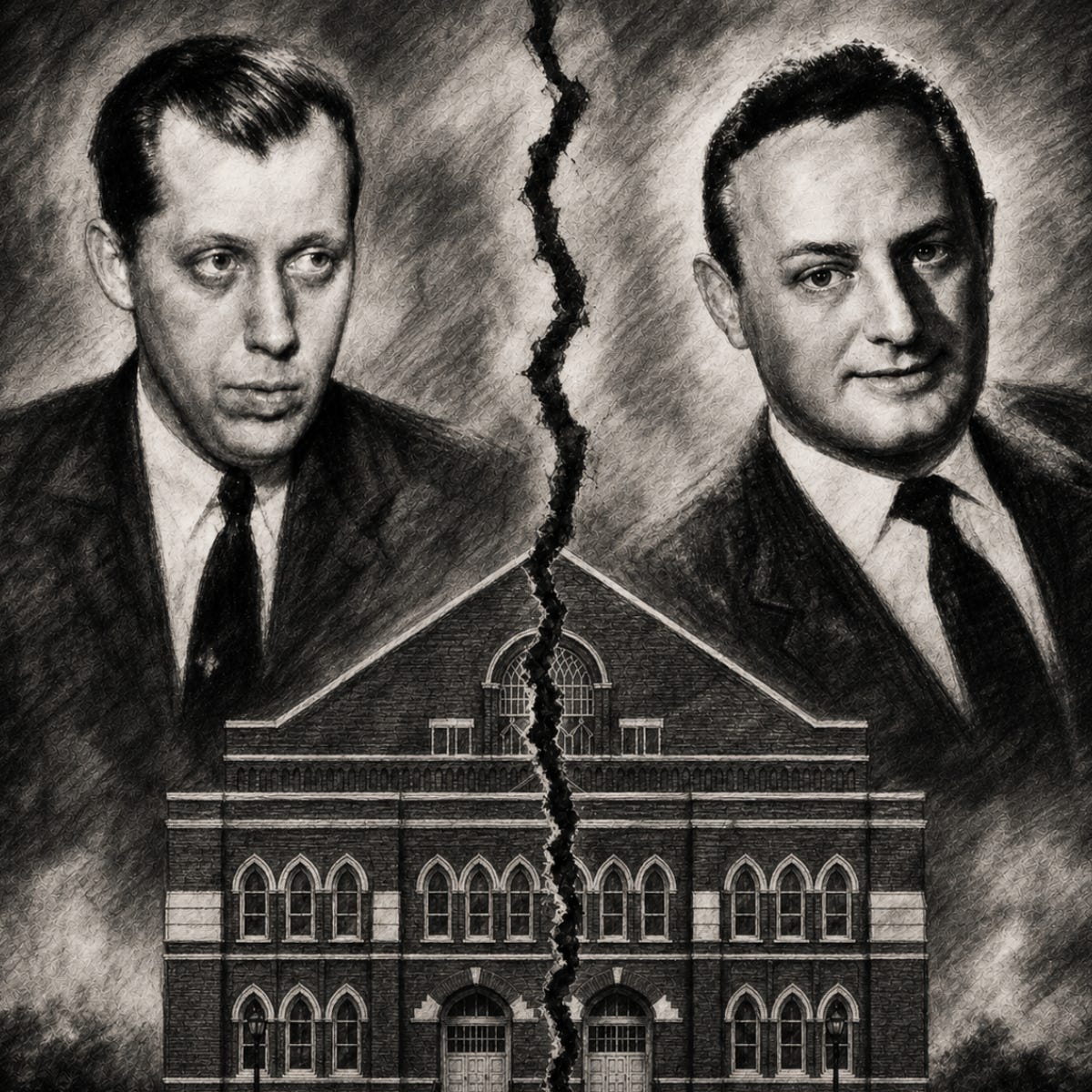
I. The echo
On January 10, 1946, a lieutenant colonel named John H. DeWitt Jr. aimed a radar antenna at a fixed spot low in the eastern sky over the Jersey Shore and waited for the moon to rise into it.
Most people called him Jack. He was a Nashville boy, a judge’s son, the kind of kid who built that city’s first radio station in 1922 when he was sixteen years old. (Hang on to that. It matters later.) He’d spent the back half of the war running the Army’s Evans Signal Laboratory near Belmar, New Jersey, and he’d been given the Legion of Merit for his work on the radar proximity fuse.
Now the war was over. The lab had a lot of idle people and a lot of surplus radar, and DeWitt had a question he’d already tried and failed to answer once, back before the war.
Could you throw a signal all the way to the moon and catch it coming back?
The moon came up at 11:48 that morning. A few minutes later the pulses went out. And then, roughly two and a half seconds after each pulse left the antenna, something came back. A little bump on the oscilloscope. A tone in the speaker. DeWitt said afterward that it had to be the moon, “because there was nothing else there but the moon.”
Two and a half seconds. That’s how long it takes a signal to go a quarter of a million miles out and come home again. Hold on to that number, because everything in this story works the same way. Somebody sends something out. It’s gone just long enough that you stop thinking about it. Then it comes back, weaker and a little bent, and it never looks exactly like what you sent.
The next year DeWitt went home to Nashville to run a radio station called WSM. Ten years after he heard the moon answer him, he fired the most powerful man in country music.
I see the Ryman Auditorium almost daily and I’ve thought about this story on more nights than I’d honestly like to admit.
II. The boy from Buffalo Valley
His name was James Rae Denney, and somewhere along the way he dropped the second E in his last name (legally).
He was born February 28, 1911, in Buffalo Valley, out in Putnam County, which is considered poor country and was poorer then. Around 1922 the family hit hard times and the boy was sent off to live with an aunt. By the early twenties he was in Nashville running telegrams for Western Union. He took accounting classes at the Watkins Institute. And while he was still a teenager, he got a job in the mailroom of the National Life and Accident Insurance Company.
You need to understand what National Life was, because hardly anybody remembers now. It was an insurance company. In 1925 it put a radio station on the air because its owners believed broadcasting would sell more policies, and it took the call letters from the company slogan: “We Shield Millions”. W-S-M. The Saturday night barn dance that grew into the Grand Ole Opry started out as part of that pitch.
Denny worked his way up into the company’s accounting division, but he kept drifting backstage. Whatever odd job the Opry had going, he took it. From 1939 to 1946 he sold tickets and souvenirs at the shows. I like to picture him counting the take after a Saturday night, a kid from Buffalo Valley who’d figured out that the music wasn’t the only thing in that building worth money.
By 1946 Denny worked his way up the ladder to running WSM’s Artists Service Bureau, the booking office that sent Opry acts out on the road. By 1951 he was general manager of the Opry itself. Between those two jobs, he decided who got on the most important stage in country music and who got the good road dates once they were on it. He and Jack Stapp, the station’s program director and the man who’d run the Opry before him, get most of the credit for turning the show from a barn dance into a parade of stars. Under the two of them the cast grew enormously, and an Opry spot became something a country singer more or less had to have.
It still holds that prestige.
The Country Music Hall of Fame describes him as a hard-nosed businessman, and says the people who dealt with him gave him respect and devotion, “sometimes tinged with fear.” That’s about as fair a summary as you’re going to get.
III. Call me in December
By the summer of 1952, Hank Williams was coming apart at the seams, and everybody at WSM could see it.
He was missing shows. When he made them, he was often drunk. In the second week of August, Denny and Carl Smith drove out to the house Hank was renting with Ray Price and they gave it to him straight. Management wanted him gone. Denny had bought him one more chance. All Hank had to do was show up for the Opry on Saturday, August 9, and for a show the next day.
Did he? No.
On Monday, August 11, Denny called him and let him go. Ernest Tubb said later that he heard the call. Denny told Hank to phone him in December, and they’d talk about the next year. When he hung up, Tubb said, there were tears in his eyes.
Hank never made that call. He died on New Year’s Day 1953 in the back seat of his Cadillac, somewhere in West Virginia.
Remember that Ernest Tubb was in that room. He comes back.
That fall, with a hole in the lineup the exact size and shape of Hank Williams, the Opry brought in a singer off the Louisiana Hayride named Webb Pierce. He had a high, hard, nasal voice that cut through a honky-tonk like a steel guitar, and in the 1950s he put thirteen records at number one, more than any of his rivals.
Two years later, on October 2, 1954, a nineteen-year-old from Memphis sang “Blue Moon of Kentucky” on the Opry. It was the only time Elvis Presley ever played the show. You’ve probably heard that Denny told him afterward to go back to driving a truck. Maybe he did. That line gets hung on Denny in a hundred places, almost always with an “allegedly” parked somewhere nearby, and I’ve never seen it pinned down by anyone who was standing there. So I’ll hand it to you the way it was handed to me: as a story people tell.
IV. Cedarwood
Early in 1953, Jim Denny and Webb Pierce went into business together. They called it Cedarwood Publishing.
Publishing is the part of the music business most people never think about, so let me put it plainly. A publisher owns a piece of a song. Every time somebody records it, every time a jukebox spins it, the publisher gets paid. If you’re a publisher, the most valuable thing on earth is a famous singer who needs material.
Cedarwood did very well. Its staff writers included Mel Tillis, Danny Dill, Wayne Walker, and Marijohn Wilkin, and over the next decade the company’s name turned up on records like “Detroit City” and “Tobacco Road.” Denny set up a second company, Driftwood Music, with Carl Smith. Later, he and Pierce bought radio stations together.
On March 3, 1956, Billboard’s annual poll named Jim Denny the Country and Western Man of the Year for 1955. Second place went to Steve Sholes of RCA Victor, who’d just bought Elvis Presley’s contract from Sun Records. (I told you things come back around.)
He had a little more than six months left at WSM. He didn’t know that. Nobody ever does.
So here’s where Denny stood in the spring of 1956. He ran the Opry. He ran the Opry’s booking office. He co-owned one publishing company with one of the Opry’s biggest stars and another one with a second. You don’t have to believe he did a single crooked thing to see the problem. When the man handing out the road dates also gets paid for the songs the singers record, every decision he makes is going to look like it might be about the songs, whether it is or not.
V. The man with the tower
Now go back to Jack DeWitt.
He wasn’t a music man. He was an engineer, and in a lot of ways he was the reason anybody outside Middle Tennessee had ever heard of the Grand Ole Opry. He’d helped take WSM from 5,000 watts to 50,000, and he oversaw the station’s 878-foot tower, for years the tallest in North America. That tower is why the Opry came in clear on kitchen radios hundreds of miles away on a Saturday night. When DeWitt came home from the Army in 1947, it was as president of the station.
WSM’s problem with the way things had grown up around the Opry had a name: conflict of interest. National Life paid its people to work for WSM. At some point in the middle of the decade, the word came down. The station was going to rein in its employees’ outside music businesses.
It didn’t stop at Jim Denny’s door.
Back in 1946, three WSM engineers, Aaron Shelton, Carl Jenkins, and George Reynolds, had started recording on the side. They called their operation Castle, after the station’s nickname, the Air Castle of the South. At first they worked in WSM’s own studios after the broadcast day ended. Hank Williams cut his first demos with them in December 1946 and recorded almost everything at Castle after that. In 1947 they took out a thousand-dollar bank loan and turned a second-floor banquet room in the Hotel Tulane on Eighth Avenue into Nashville’s first real commercial recording studio. Kitty Wells recorded “It Wasn’t God Who Made Honky Tonk Angels” there in May 1952, and it became the first number one country record by a woman singing on her own. Between 1947 and 1955, close to half the songs on the country charts came out of Castle.
Castle closed in 1956. The new WSM policy was one reason. The other was that the Hotel Tulane was coming down. All three engineers kept their jobs at the station.
Jack Stapp had co-founded a publishing company called Tree back in 1951. Two of Tree’s writers co-wrote “Heartbreak Hotel.” Stapp left WSM in 1957 and kept Tree.
Craig Havighurst, who wrote the book on WSM, has made the point that this is exactly how Nashville’s music business got built: people from the station peeling off to start record labels, studios, publishing houses, and booking agencies, until all the parts of an industry were sitting there in one town. I think he’s right. I also think it’s the knot at the center of this whole story. The station’s own people were building the industry, and the station needed those people to work for the station. Both of those things were true at the same time.
VI. September 24, 1956
For a while, nothing happened. Denny kept Cedarwood. He kept his jobs. If you’d asked around town that summer, I imagine plenty of people would have told you WSM would never fire the man who ran the Opry. He was the Man of the Year.
On September 24, 1956, WSM fired him.
Who pushed for it, and how hard, depends on whose memories you’re reading. Some accounts put Opry stars in the front office complaining about favoritism. I haven’t been able to pin down who said what to whom, and I’m not going to put words in anybody’s mouth. What every account agrees on is the reason: conflict of interest, growing out of his booking and his publishing.
The next day, September 25, the Opry had a new general manager, a Mercury Records producer named D Kilpatrick.
Denny didn’t leave town, and he didn’t slow down. He opened the Jim Denny Artist Bureau and started booking shows, and according to the Hall of Fame he signed most of the Opry’s top acts. Over the next few years his roster would include Webb Pierce, Carl Smith, Red Sovine, Goldie Hill, Moon Mullican, the Duke of Paducah, and Opry pillars like Minnie Pearl and Hank Snow.
He’d been with National Life since he was a teenager. He was forty-five years old.
VII. Paying to play
To understand what happened next, you need to know about a problem the Opry had long before Jim Denny ever made a dime off a song.
The Opry gave you the signal. Fifty thousand watts on a Saturday night meant people across a big piece of the country knew your name by Monday morning, and that’s what filled the seats when you came through their town. The catch was that the Opry wanted you back in Nashville on Saturday, and Saturday is the best night of the week to play anywhere else. A night on the road paid a lot more than a night on the Opry.
Roy Acuff found that out in April 1946. He was one of the biggest stars the Opry had, and he walked away from it, fed up with having to come back every Saturday when personal appearances paid him far better. Without that weekly exposure, the demand for him started to thin out. He came back. He stayed for the rest of his life.
Ten years later the same tug-of-war was back, and this time there was a man in town who knew every promoter in America by his first name.
Carl Smith left the Opry near the end of 1956, in the middle of what the Hall of Fame describes as a lot of politics going on behind the scenes. Webb Pierce quit on February 19, 1957, the second time he’d walked out in two years. The Opry put out word that the problem was his “unwillingness to conform.” Pierce said he was tired of losing money to play the show, and tired of the insurance company using his picture to sell policies. Little Jimmy Dickens, who’d come to the Opry in the first place because Roy Acuff heard him in Cincinnati and put in a word, left in 1957 too.
Not everybody went for the same reason. Some of them were loyal to Denny. Some of them just did the arithmetic. My guess is most were a little of both.
VIII. Free show tonight
About three months after the firing, Denny signed a deal with the Philip Morris tobacco company. The Hall of Fame says it was billed at the time as the biggest single package sale in the history of country music.
The idea was simple. Philip Morris paid for the whole thing. Denny’s office supplied the talent. The public got in free.
The Philip Morris Country Music Show opened in Louisville, Kentucky, on January 13, 1957. When it rolled into Greenville, Mississippi, that winter, the local paper told folks the show was free and the seats went first come, first served, and the town’s Jaycees were helping put it on. Biff Collie, a disc jockey, was the emcee. Carl Smith was the star. Red Sovine was there, and fiddler Gordon Terry, and a young singer named Mimi Roman, and Goldie Hill, the Golden Hillbilly, who’d topped the charts a few years earlier with an answer song called “I Let the Stars Get in My Eyes.” Later on, Little Jimmy Dickens and George Morgan turned up in the cast, along with Ronnie Self, Shirley Caddell, and Smith’s band, the Tunesmiths.
Some nights the crowd was so big the cast went back out and did a second show on the spot for the people who couldn’t get in. Some shows were taped for radio. One of them, recorded in Indianapolis on December 17, 1957, was set to air a few weeks later over WBBM, the CBS station in Chicago.
Sit with that a second. A cigarette company was putting some of the biggest names in country music in front of America for free, and putting them on the radio too.
Carl Smith and Goldie Hill were both on that bus when they got married in 1957. She retired not long after. They stayed married until she died in 2005.
You’ll sometimes read that you needed empty Philip Morris packs to get through the door. One history of the show says some stops asked for proof you’d bought the brand. The period newspaper notice I found just says free. I’ll leave it right there.
The show ran until about the end of May 1958. Call it a year and a half.
IX. The lobby
In the early morning hours of a day in late May 1957, Ernest Tubb walked into the lobby of the National Life Building in downtown Nashville carrying a .357 Magnum.
This is the same Ernest Tubb who’d heard Jim Denny fire Hank Williams with tears in his eyes. The Texas Troubadour. The man who’d opened a record shop on Broadway in 1947 because country fans couldn’t find their records anywhere else, and who broadcast a show from that shop every Saturday night after the Opry went off the air. There wasn’t a better-liked man in the business. He’d been drinking, and he was waiting for Jim Denny.
A man came in through the doors. Tubb fired. It wasn’t Denny. It was Bill Williams, WSM’s news director, coming in to work. Tubb missed. He was arrested.
Why Tubb was that angry at Denny depends on who’s telling it, and I haven’t found two tellings that agree. I’m not going to invent a reason. Here’s what I can tell you. Nobody got hurt. Tubb kept playing the Opry for the next twenty-five years. His Midnite Jamboree still airs after the Opry to this day. But if you want one picture of how hot things were running in Nashville in 1957, it’s hard to beat one of the best-loved honky-tonk singers in America standing in an insurance company lobby with a revolver in his hand.
X. Rebuilding the house
While all of that was going on, D Kilpatrick was rebuilding the Opry.
He went after new blood. Porter Wagoner moved down from Missouri and joined the cast on February 23, 1957. Years later Porter remembered that on his first night, Roy Acuff called him into his dressing room, told him the Opry needed his kind of people, and handed him a slip of paper with his home phone number on it. Under Kilpatrick, the Everly Brothers came aboard, and so did Wilma Lee and Stoney Cooper. The show had lost some big names, and it went right on broadcasting every Saturday night with new ones.
Kilpatrick left the job in 1959, and here’s one of those echoes I warned you about. He went on to help launch the Acuff-Rose Artists Corporation, a booking agency Roy Acuff started that year with his publishing partner, Wesley Rose. Acuff had co-founded Acuff-Rose, one of the first big publishing houses in Nashville, back in 1942. So by 1959 the Opry’s most famous star owned a piece of a publishing house and a piece of a booking agency, both outside WSM, and the man who’d replaced Jim Denny was helping him run the second one.
I don’t say that to catch anybody out. Acuff was a performer, not a WSM employee, and the station’s rule was about its own people. It just tells you how fast the ground was moving under everybody’s feet.
Jack Stapp, gone from WSM, was programming a Nashville rock and roll station called WKDA by early 1958. Tree turned into one of the biggest publishers in town.
And the Saturday problem never went away. In April 1963 the Opry put it in writing: members had to play at least twenty-six shows a year. On Sunday, December 6, 1964, the Nashville Tennessean ran a front-page headline that read “Opry Drops 12 Top Stars.” Faron Young’s photo was on the front. A WSM spokesman called it a routine matter. Some of those twelve came back eventually. Faron never did.
Two and a half seconds. Eight years, give or take.
XI. 1963
In December 1962, Jim Denny found out he had colon cancer, and he stepped away from the business.
If you’ve been reading me a while, you know 1963 was a brutal year for the Opry family. On March 5 the plane carrying Patsy Cline, Cowboy Copas, Hawkshaw Hawkins, and Patsy’s manager Randy Hughes went down in the woods outside Camden, Tennessee. Two days later Jack Anglin was killed in a car wreck on his way to a memorial service for Patsy. I’ve written about that spring. What I didn’t realize until I started digging into this one is that the man who used to decide who walked onto that stage died the same summer.
Jim Denny died at St. Thomas Hospital in Nashville on August 27, 1963. He was fifty-two.
By then his bureau was booking close to four thousand shows a year. After he died, a promoter named Lucky Moeller took it over, and within a few years it had withered away. Cedarwood lasted longer. Denny’s sons, Bill and John, ran it for twenty years, until 1983, when they sold it to Mel Tillis, the stuttering kid from Florida who’d written hits for Webb Pierce as a Cedarwood staff writer.
Bill Denny had joined the board of the Country Music Association in 1961. In 1966 he was its president. That October, on the 22nd, the Country Music Hall of Fame inducted four new members: Eddy Arnold, Uncle Dave Macon, George D. Hay, and Jim Denny.
George D. Hay was the man who gave the Grand Ole Opry its name. So there it is. The Opry’s founder and the Opry manager WSM fired went into the Hall of Fame on the same night.
Jack DeWitt ran WSM until 1968. He gave a lot of his later years to astronomy, much of it at Vanderbilt’s Dyer Observatory, and in his eighties he was still up there motorizing the slit in the dome himself. He died on January 25, 1999. He was ninety-two.
Little Jimmy Dickens rejoined the Opry in 1975 and played it until the day before his ninety-fourth birthday. Webb Pierce died in 1991, and the Hall of Fame inducted him ten years later. Carl Smith went in in 2003.
XII. Two and a half seconds
This is how it looks to me, standing on Lower Broadway with the Ryman over my shoulder.
Jack DeWitt ran a radio station that an insurance company built to sell policies, and he did what a man in that chair does when he sees his people working two sides of the same street. He drew a line. Jim Denny had spent almost thirty years making himself the most useful man in that building, and when the line came, he decided he’d rather be useful somewhere else. The singers went where the microphone was, or where the money was, and some years those were two different places. Philip Morris wanted to sell cigarettes. Nobody in this story set out to build Music Row.
They built it anyway.
The tower is still standing south of town, still blinking red at night. The Opry is still on the air every Saturday. The Row is still the Row. Both of them outlived the fight, and both of them outlived every man who was in it.
Some nights after a late set, when Broadway finally thins out, I think about Jack DeWitt at that lab in New Jersey, waiting on the moon. You send something out. You wait. A couple of seconds later it comes back to you, fainter and a little changed, and you have to decide what it means.
It’s September of 1956 in Nashville. Somebody just sent a signal.
We’re still hearing it.
ABOUT THE AUTHOR:
My name is Zachariah Malachi. I’m a full-time, self-employed honky tonk musician in Nashville, Tennessee. This Substack Publication was created for the purpose of sharpening my mind on more Nashville and Country Music history to share with the honky tonk patrons downtown during my shows—but I wanted more folks to benefit from the research, so it’s my gift to the country music fans of the world AND the people who WANT to be. Subscribe and come along for the ride.
Fantastic Read Zach…kudos
What a great read, your detail shows how much you care. Always learn something new and most times a whole lot of new. Some of my favorite memories of my maternal grand parents are spending the weekend with them in the 50's. Especially on a winters Saturday night all snuggled down in the bed under my grandmother quilts. All the lights are off and I hear my grandfather turn on his table radio next to his bed. I hear the tubes crackling and humming as it is warming up. Then the WSM call letters and the Grand Ol Opery show starts. It's a cold winters night and we are 35 miles north of the Fla. State line and the Opery sounds like it is broadcasting right next door it is so clear. In awhile I am drifting off the sleep to the legends of country music. Now at 74 I feel very fortunate to have heard those greats.