


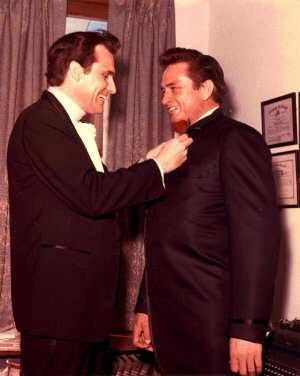
In the high-flying, amphetamine-fueled trenches of mid-century country music, Johnny Cash had plenty of peers, but only one full-time accomplice in pure bedlam: Merle Kilgore.
Standing well over six feet tall, with thick dark hair, sharp cheekbones, and rumbling baritones, the two men looked so uncannily alike that promoters, fans, and front-desk clerks regularly confused them. Rather than finding it a professional nuisance, they weaponized the resemblance into an ongoing, decades-long war of practical jokes, high-stakes mischief, and roadside theater.
If Johnny Cash was country music’s brooding outlaw poet, Merle Kilgore was the imp on his shoulder whispering, “Bet you won’t.”
The Phantom Voice and the Cleared Hillside
Kilgore’s impersonation of Cash was pitch-perfect. He had the Man in Black’s slow shuffle down cold, along with the gravelly cadence and the trademark, dry throat-clearing cough. Cash was so endlessly entertained by it that he would routinely wake Kilgore up in the dead of night just to hear his own voice thrown back at him across a dimly lit hotel room.
Naturally, the bit was used to terrorize Cash’s long-suffering manager, Saul Holiff. At two in the morning, Cash would egg Kilgore on to dial Holiff’s room from down the hall:
“Saul, this is Johnny. We’ve got a serious problem. You know those flowers planted outside the county courthouse? Kilgore and I just ran right through ’em in the Cadillac, and the sheriff has locked us up. We need bail money right now.”
Holiff would bolt out of bed in a sheer panic, sprinting down the corridor in his pajamas while Cash and Kilgore collapsed in hysterics behind a cracked door.
Eventually, Kilgore turned the gag back on Cash himself.
While Cash was out on a grueling road stretch, Kilgore picked up the phone, dialed the Cash estate in Tennessee, and reached the housekeeper, Ms. Kelly. Dropping his voice into Cash’s subterranean rumble, Kilgore gave a matter-of-fact order:
“Ms. Kelly, this is Johnny. You know all those tall trees covering the hill next to the house? I want them cut down. Call a crew and have them clear it clean out. I want a tennis court put there.”
Days later, Cash’s tour bus rumbled up the driveway. Johnny stepped off, looked up, and stopped dead in his tracks: the lush, timbered hillside had been completely scalped, reduced to raw dirt and sawdust.
He stormed through the front door, roaring, “Ms. Kelly, what in the hell happened to my timber?!”
A bewildered Ms. Kelly blinked back at him. “What do you mean? You called me. You said to cut them down so you could build a tennis court.”
Cash looked back out the window at the ruined landscape, paused for a long second, and shrugged.
“Well,” he muttered. “I don’t remember that. But it’s a hell of an idea.”
The tennis court stayed on the property for the rest of his life.
Midnight Mediums in the Pasture
Their brand of humor went back to their earliest days on the Shreveport Louisiana Hayride circuit, often egged on by singer Johnny Horton’s earnest obsession with the supernatural.
One evening in Horton’s parlor, Kilgore offered to hypnotize Cash, dimming the parlor lamps, lighting candles, and lulling him toward a trance state. Cash went limp and began solemnly describing visions of robes, sandals, and pyramids, whispering that he was wandering the sands of ancient Egypt. Just as Kilgore and Horton were frozen in awe, convinced they had breached the astral plane, Cash snapped his eyes open and howled with laughter, leaving the parlor mystics completely duped.
The supernatural followed them onto the highway. After Horton died in a 1960 car crash, an offhand comment he once made—that if reincarnation existed, he’d probably come back as a cow—resurfaced during a sleepless night on tour. Fuelled by highway exhaust and prescription uppers, Cash and Kilgore hopped a pasture fence in the dark before dawn, dead set on investigating.
The two country stars marched through the damp clover, leaning over grazing heifers and asking: “Are you Johnny Horton?”
When one cow answered Kilgore’s plea to “Moo twice if it’s you” with a deep, mournful bellow, Kilgore sprinted across the pasture toward Cash, waving his arms and swearing through the fog that Horton’s spirit had just co-written a song with him.
Firehose Diplomacy in Las Vegas
Surviving tour life with Cash required fast reflexes and zero modesty.
During an engagement at the Golden Nugget in Las Vegas, the air conditioner on their tour bus died, leaving everyone sweltering through triple-digit desert heat. Matters grew worse when Kilgore checked into his hotel room only to find the wall unit blowing warm exhaust.
Kilgore stripped down to a single bath towel, snatched up the phone, and gave the front desk a blistering piece of his mind. A few minutes later, a heavy knock rattled the door frame. Expecting maintenance, Kilgore yanked the door open.
Standing in the hallway was Johnny Cash, staring back at him with deadpan eyes and his hands tucked behind his back.
“You cooled down yet, Kilgore?” Cash asked quietly.
Before Kilgore could speak, Cash whipped out an industrial hotel firehose, yanked the valve wide open, and let loose.
The pressurized wall of water hit Kilgore square in the chest, blew the bath towel clean off him, blasted him backwards across the shag carpet, and pinned him naked against the balcony glass while Cash leaned against the corridor wall, breathless with laughter.
Balcony Artillery at Carnegie Hall
In May 1962, Cash booked a watershed country showcase at New York’s Carnegie Hall. Kilgore wasn’t originally on the bill and had already packed his bags to fly home when Saul Holiff casually asked what tracks he intended to perform. Cash had secretly written him into the setlist without telling a soul, catching Kilgore so off guard that he dropped his coffee cup, shattering porcelain across the floor.
The true ambush waited backstage right before showtime.
A courier knocked on Kilgore’s dressing room door with a massive wardrobe package. Inside was an ornate, tailored gray Confederate soldier’s uniform—cavalry boots, an officer’s cap, an authentic saber, and a handwritten note from Cash: Wear this onstage tonight when you sing “Johnny Reb.”
With no way out, Kilgore marched onto the stage of Carnegie Hall before a packed room of Northern urbanites, dressed head-to-toe in rebel gray.
He leaned into the microphone and belted out the song with full theatrical gusto. The performance caught the hall so off-guard that an over-enthusiastic spectator in the nosebleed balcony caught the spirit, leaned over the railing, and let out an explosive, deafening rebel yell: “Yee-haw!”
The roar was delivered with such sheer acoustic force that the man’s false teeth ejected from his mouth like artillery.
The dentures plummeted through the open air of Carnegie Hall and struck an unsuspecting woman sitting in the orchestra section directly on the skull, knocking her cold out of her seat.
Watching the paramedics haul her away while he stood onstage holding a cavalry saber, Kilgore remarked that he had just borne witness to the very last casualty of the Civil War.
The Sharkskin Rip and “Malcolm Kilgore”
When Cash married June Carter in Franklin, Kentucky, on March 1, 1968, he called Kilgore with a directive: “You’re going to be my best man. You’re our old war buddy.”
Kilgore rented a sharp sharkskin suit that fit like a glove days earlier. But after a week of hard driving, irregular meals, and wedding-day nerves, fluid retention had turned the fabric into a tourniquet. By the time the preacher asked for the wedding bands, the hot chapel air had sealed the trousers shut.
Kilgore slid his hand down to retrieve the ring, only to realize his fingers were swollen and the slit pocket was pressed flat against his thigh.
He clawed frantically at his hip while the chapel went tomb-silent. Cash turned his head, fixing his best man with a piercing, side-eyed glare that silently warned him not to botch the moment. Desperate, Kilgore jammed both thumbs into the waistband, braced himself, and yanked back.
An ear-splitting RIIIIIP echoed off the sanctuary walls, tearing the pocket clean down the seam before Kilgore meekly produced the gold band.
That camaraderie wasn’t just backstage vaudeville; it was the foundation of an enduring creative brotherhood. Kilgore co-wrote “Ring of Fire” with June Carter—a song Cash immortalized after hearing Mexican horns in a dream—and stood by Johnny through his darkest descents and redemptions.
In Cash’s later years, when declining health forced him into hospitals for quiet treatments, he made sure his plastic patient wristband bore a very specific alias: Malcolm Kilgore.
Whenever doctors or close friends asked about the fake name, Cash would offer a faint, crooked smile. He figured that if the Angel of Death ever came wandering down the hospital halls looking for Johnny Cash, he’d read the clipboard, shrug his shoulders, and walk right past the door.
ABOUT THE AUTHOR:
My name is Zachariah Malachi. I’m a full-time, self-employed honky tonk musician in Nashville, Tennessee. This Substack Publication was created for the purpose of sharpening my mind on more Nashville and Country Music history to share with the honky tonk patrons downtown during my shows—but I wanted more folks to benefit from the research, so it’s my gift to the country music fans of the world AND the people who WANT to be. Subscribe and come along for the ride.