


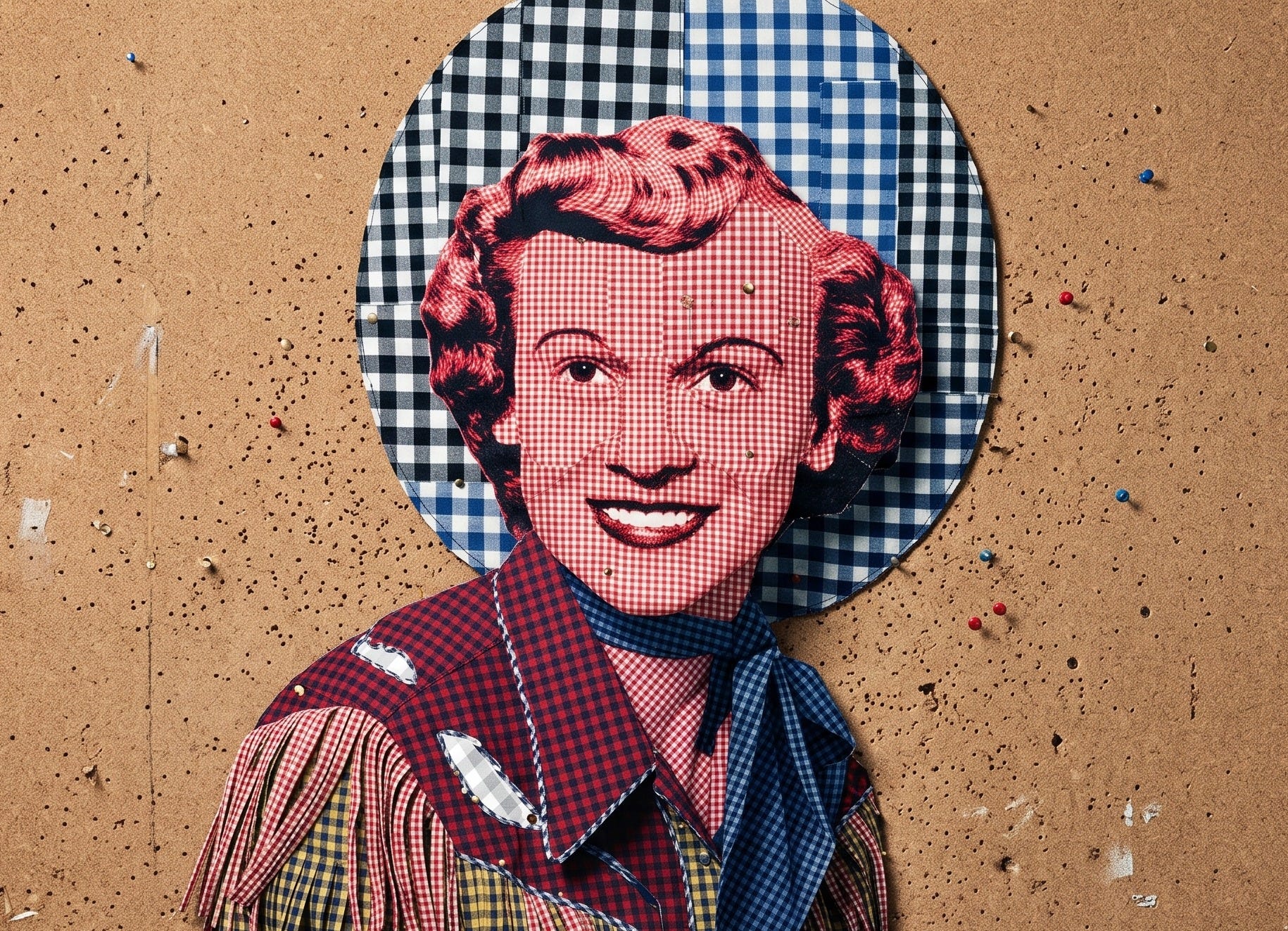
I love Jean Shepard. She had a powerful and unique voice, and more than that, she knew how to use it like a bazooka. There was always a blunt realness to her, in a time when blunt realness was not something a woman in country music was allowed to have. This is her introduction.
I. The rule nobody wrote down
In the early 1950s the country music business ran on a rule nobody bothered to write down. A woman could sing. She just had to sing from inside a very small room. She could be a Sunbonnet Sue. She could be somebody’s mom. She could be a country maiden in gingham, standing there looking wholesome for an audience that had come home from a world war and wanted to be told nothing had changed. Love songs ended at the altar. Sad songs happened to her, never because of her. The good girl, you know?
Then Capitol Records signed a teenager from Visalia, California named Ollie Imogene Shepard.
She was five foot one and ninety nine pounds, and she opened her mouth and out came a chest voice with the weight of a much bigger person behind it. An agile larynx. A brassy alto with the southern nasal twang still in it. She did not sing to soothe anybody. She bellowed. She sang about adult love and adult wanting, about cheating and divorce and the specific misery of being a working class southern woman who had, as she put it, seen the inside of a barroom and was not going to pretend otherwise.
Kitty Wells is the name everybody reaches for first, and she earned that. But Wells sang in a different way. She had a more constricted, strained delivery that still sounded like a sweet and modest. Jean Shepard sang loose and rebellious. She sang with rhythm and swing and a roadhouse looseness that was pointed somewhere the rest of Nashville hadn’t gotten to yet. She wasn’t asking to sit at the table. She was standing at the center of the stage telling a room full of men that women ought to be running the place.
II. Okies, dance halls, and the Melody Ranch Girls
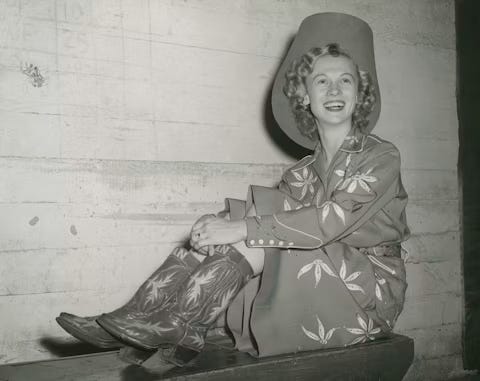
You can hear the geography in that voice if you know where to listen for it.
She was born in 1933 in Paul’s Valley, Oklahoma, one of eleven children born to sharecroppers with nothing. Like a few hundred thousand other families, the Shepards loaded up and went west, out from under the dust and the ruin of the Plains. In 1943, when she was ten years old, they landed in Visalia in the San Joaquin Valley.
That is the important part. She did not grow up on the Opry. She grew up in the California country scene of the 1940s, which was loud, electric, dance driven, and completely uninterested in parlor manners.
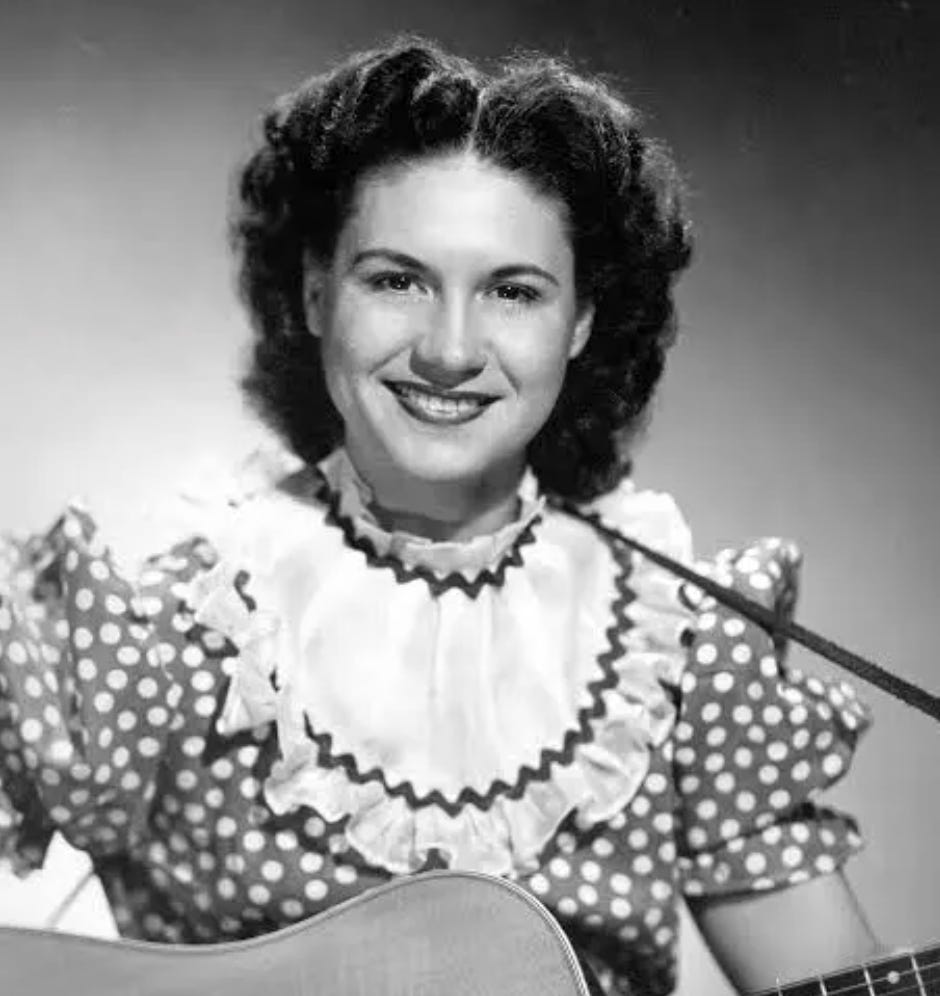
While she was still in high school she put together the Melody Ranch Girls, an all female western swing outfit. This was not a novelty. They were a working band. Shepard played drums, stand up bass, and guitar, holding down the bottom end while she learned to sing over a room instead of into a microphone. The Melody Ranch Girls worked the valley circuit and packed roadhouses playing a breezy brand of western swing that made a fair number of male bandleaders jealous. By the time she was a schoolgirl she was already a regular on Jelly Sanders’s radio program out of Porterville, and the migrant farm families of the valley had claimed her as their own.
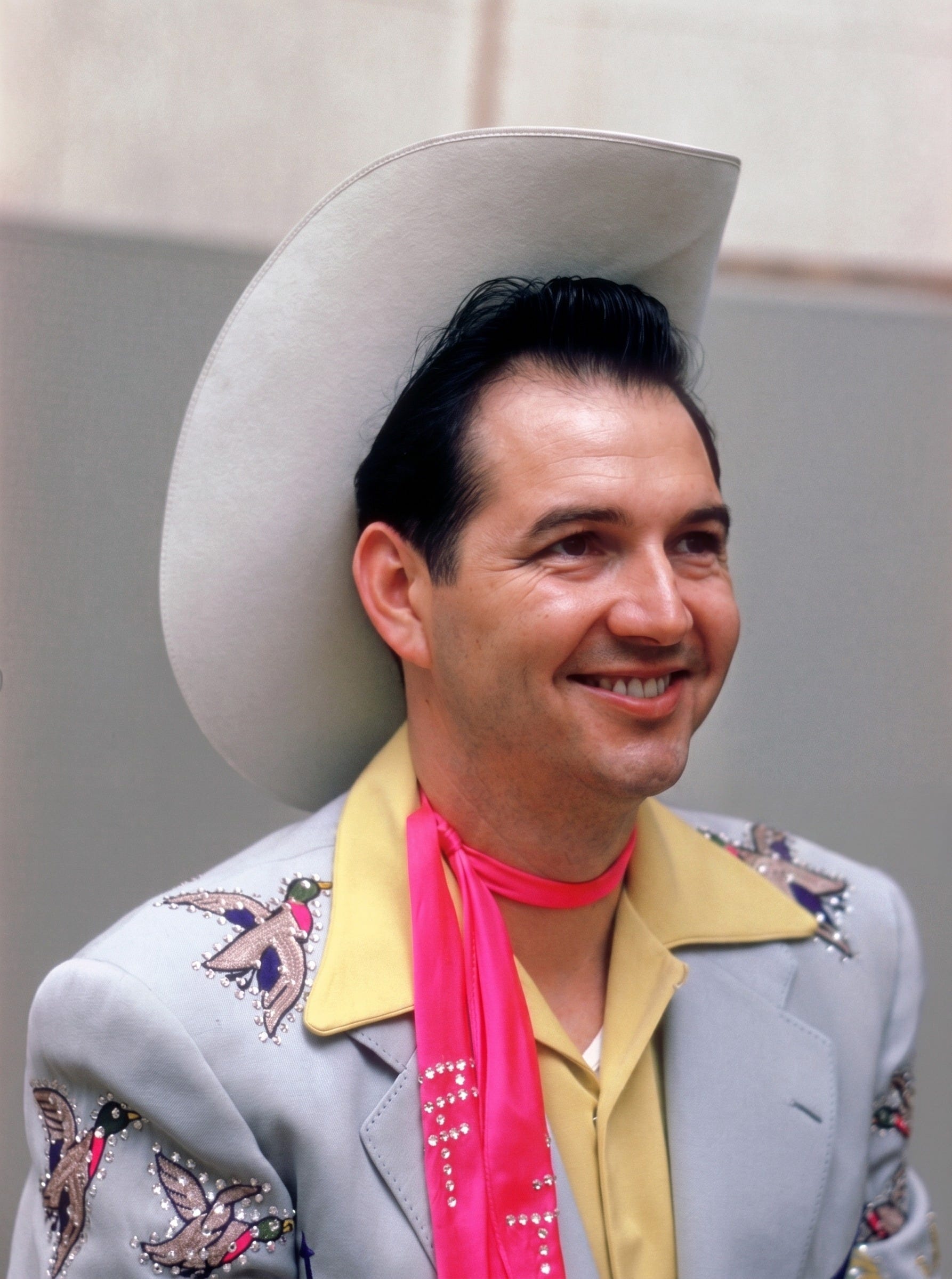
The break came on a West Coast booking with Hank Thompson and the Brazos Valley Boys. Thompson, a sharp dressed Texan who had built his own western swing operation on the coast, heard the tiny teenager sing and did not waste time going through the usual channels. He walked her straight to Ken Nelson, who ran the country division at Capitol Records in Los Angeles.
III. Ken Nelson, a war letter, and a court appointed guardian
Nelson was a Chicago man, a former big band singer, dapper, and he had only taken over Capitol’s country A&R desk in 1952. When Thompson brought him a sixteen year old girl singer, Nelson was not moved.
“Girls don’t sell records,” he told him flatly.
He had his reasons, or thought he did. Patsy Montana in the thirties. Kitty Wells the year before. Beyond that, distributors treated solo female country records as money set on fire. He also griped about the paperwork, because Shepard was too young to legally sign her own contract.
Thompson had the leverage, and Nelson signed her anyway. Boom.
Her first solo single went nowhere. Casting around for something that would work, Nelson and producer Fuzzy Owen paired her with a twenty eight year old ex Marine who was scuffling as a singer and disc jockey under the name Terry Preston. His real name was Ferlin Husky.
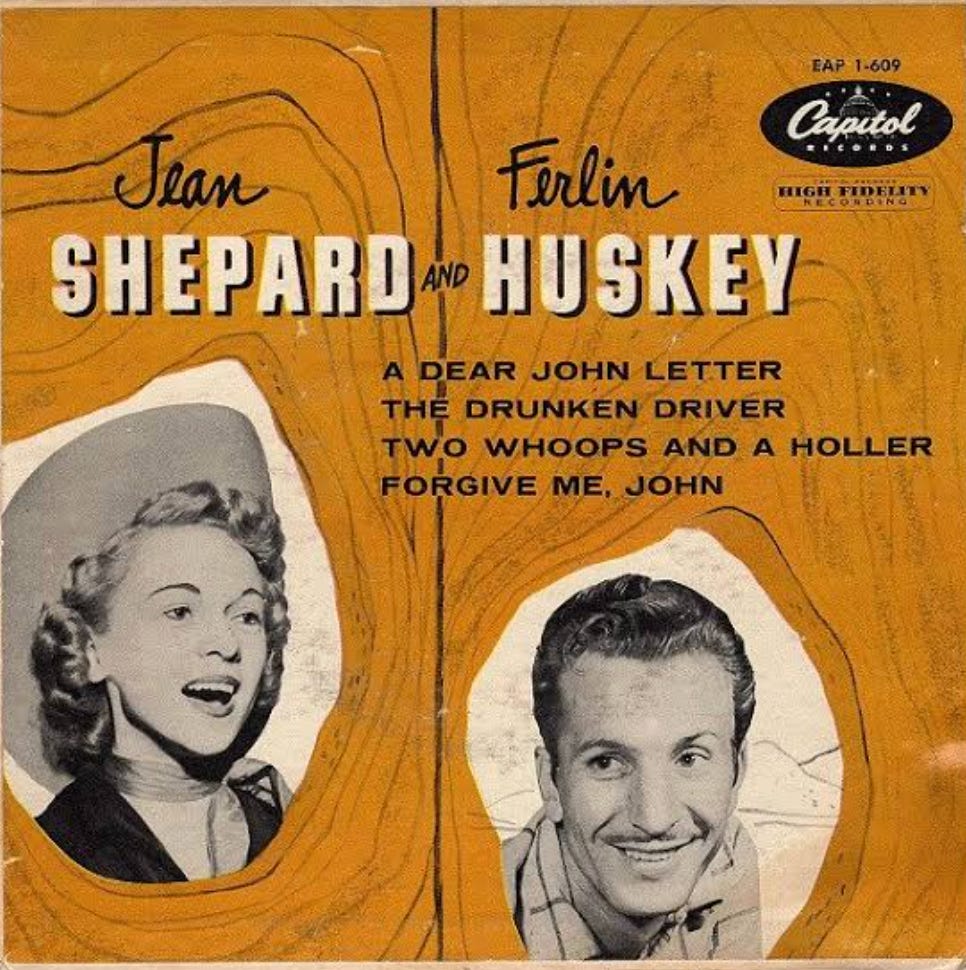
In June of 1953 Capitol put out “A Dear John Letter.”
It hit a nerve that was still raw. Korea was in every family’s mail. Husky delivered the spoken word recitation, Shepard sang the lead like her heart was coming apart, and the record went to number one country for six weeks and climbed to number four on the pop charts. It sold over half a million copies and made both of them stars overnight.
It also created a small legal circus. Shepard still could not sign a binding contract, and she could not cross state lines with a package tour without an adult responsible for her. So a court appointed Ferlin Husky as her legal guardian. For roughly a year, the teenage girl on the record spent her life on the highway under the court ordered custody of the man singing on the other half of it.
They cut the answer song that fall, “Forgive Me, John,” and it went to number four. But the sentimental war duets are not where her legacy lives. It lives in the solo honky tonk sides she was cutting for Nelson at the same time.
IV. “Women ought to rule the world”
After “Dear John” she moved to Tennessee and landed alongside Kitty Wells and Goldie Hill at the front of women’s honky tonk. Damn, what a crew.. right? Wells was marketed as a housewife who happened to sing, high necked dresses, gingham aprons, modest as a Sunday. Shepard wasn’t playin’ that part.
Her records went straight at the things nobody was supposed to name. The juke joint. Divorce. What it actually costs a poor woman to be left. On “My Wedding Ring” in 1953 she sang about “drinkin’ and livin’ this honky-tonk life” and told the married women in the audience, plainly, that her ruined existence as a divorced mother could be theirs by next year. Being a divorced woman in Eisenhower’s America was a class marker and a stain, and she said it out loud on a Capitol single. She sang it with an open throat, sliding note to note with a modern, amplified swagger that made Wells’s gospel strained delivery sound like it came from another century.
Then there is “Two Whoops and a Holler.”
A man wrote it. Shepard sang it like she meant every syllable, up tempo and funny and full of contempt. It called out a country that let men drink, smoke, cuss, fight, and cheat, and then ruined any woman who “drinks or smokes or tells a joke.” And in the chorus she offered a solution:
“Stick by me, and you’ll see... Women ought to rule the world.”
That was 1953. It went nowhere.
Wells’s tamer, sorrier “It Wasn’t God Who Made Honky Tonk Angels” had gone to number one even after the Opry and NBC banned it. “Two Whoops and a Holler” did not chart at all. Shepard’s biographer Chris Skinker makes the case that the audience never rejected it, because the audience mostly never heard it. The record was quietly buried by local disc jockeys, a nearly all male fraternity who did not care to be told any of that from a car radio. I believe this.
Shepard read the room and adjusted. She never again put a structural argument about power in a chorus. What she did for the rest of the decade was something more useful and more sly. She kept taking men apart one at a time. “Girls in Disgrace” in 1955. “The Root of All Evil (Is a Man)” in 1960. “Second Fiddle (to an Old Guitar)” in 1964. She just stopped saying who ought to be in charge.
And she hid the rest of it in comedy. Watch her 1955 television performance of “Sad Singin’ and Slow Ridin’” on Albert Gannaway’s syndicated Opry program. She comes out in a rustic gingham dress and plays it broad, with exaggerated hillbilly hiccups and vocal slides and big comic gestures, borrowing the old vaudeville trick that Lulu Belle and Rose Maddox had worked before her. Playing the rube let her get away with the actual content of the song, which is a woman informing her drunk, philandering husband that if he keeps coming home like this he can look forward to sad singing and slow riding at his own funeral.
V. A wedding on the radio, and March 5, 1963
Nashville never solved the problem of how to sell her. She was a single woman singing about cheating and divorce and wanting, and the publicity department worked overtime to file those sharp edges off (wait till they see Gretchen Wilson, right?). The trade papers kept pairing her enormous voice with her cute five foot one frame, kept using the word modest, kept calling her “Just Plain Jean,” all of it designed to reassure people that nothing here threatened anybody’s living room. Goldie Hill got written up in terms of her marriage prospects. Shepard got written up as harmless.
In 1960 the industry finally got the story it had been waiting for. She married Hawkshaw Hawkins, a tall, handsome West Virginian and fellow Opry star, and the wedding was staged as a full country music spectacular.
It happened at the Forum Auditorium in Wichita, Kansas, and it went out live as an official segment of the Grand Ole Opry. Four thousand people bought tickets to a wedding. Tex Ritter, Carl Perkins, Moon Mullican, and the Plainsmen Quartet played the first half. Then the curtain closed, the organ came up, the Plainsmen sang “True Love” and “Her Hand in Mine,” and Nick Sanders, who owned the local country station KSIR, stepped to the microphone and narrated an actual legally binding wedding ceremony to the country.
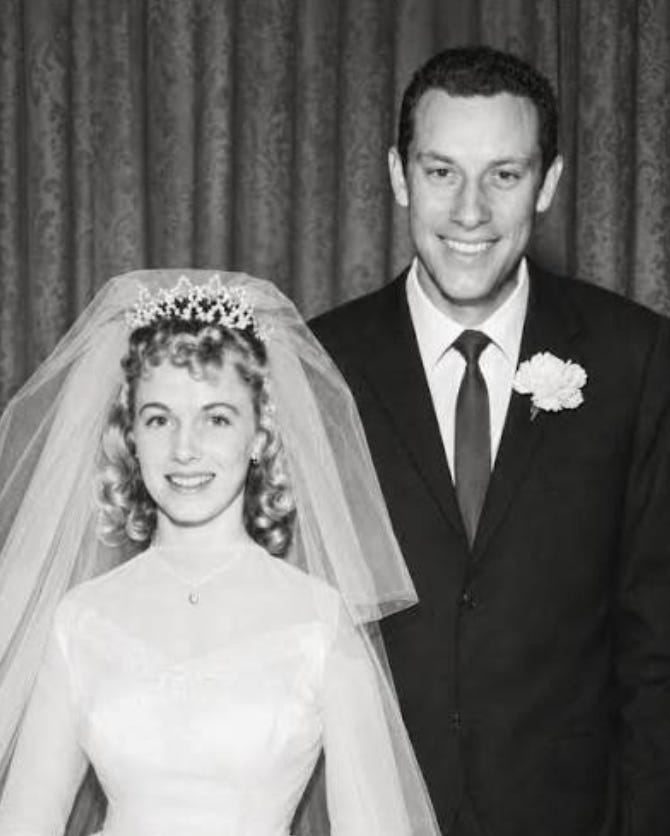
They had three years.
On March 5, 1963, Hawkshaw Hawkins, Patsy Cline, Cowboy Copas, and their manager Randy Hughes were flying home to Nashville from a benefit show in Kansas City when their chartered plane went down in heavy timber near Camden, Tennessee. Nobody survived.
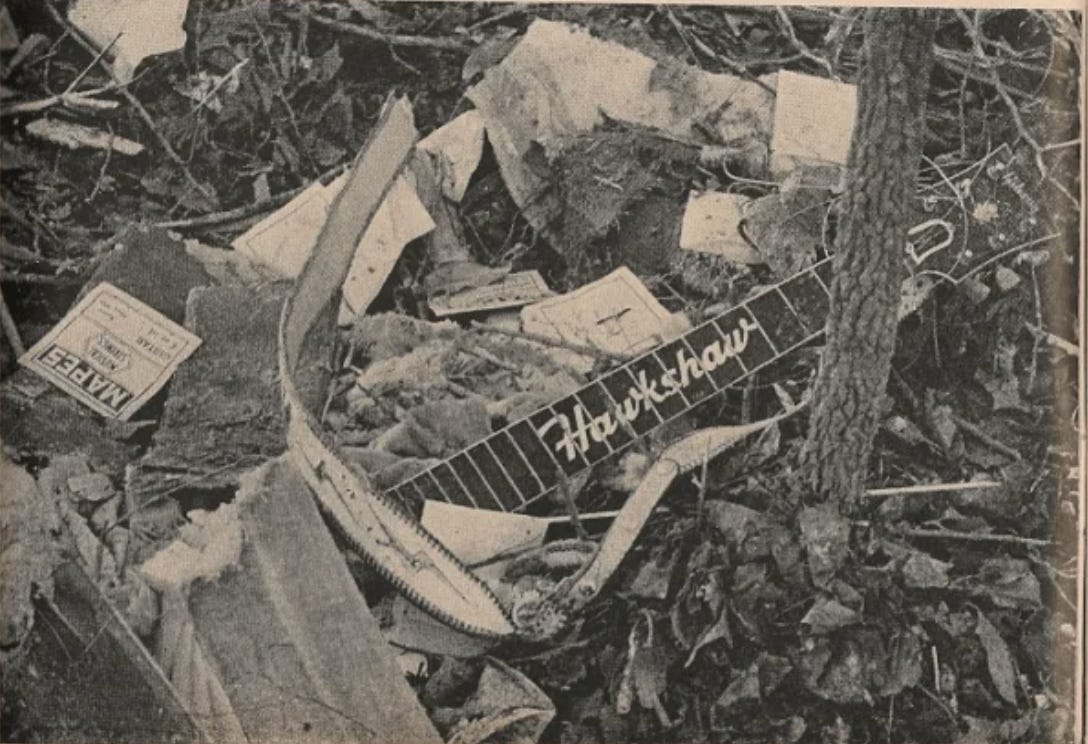
Jean Shepard was at home in Nashville, eight months pregnant with their second child. Years later she told Ellis Nassour, for his biography of Patsy Cline, what that evening was like:
“An hour after Kathy’s call, I took my baby, Don Robin, and put him in the kitchen sink to give him a bath before bed. I was eight months pregnant, so the sink allowed me to stand up. A little after seven, this weird, completely weak feeling came over me for about ten minutes. I was afraid to move away from the sink, because I thought I was going to faint. Don was splashing water, but I kept bathing him. My first thought was, ‘Oh, my God, the baby!’ I froze and held onto the edge of the sink. Then I said out loud, ‘No, Jean, the baby’s not due for another month. What’s the matter with you?’”
She went to bed telling herself the plane had turned back because of the weather. A friend called at eleven o’clock, crying, and told her it hadn’t.
VI. “Slippin’ Away” and sixty years on the Opry stage
She kept working. In the years after Hawkins died she let go of the hard California honky tonk and moved toward the smoother countrypolitan sound Nashville was selling like a lot of others did.
By the early seventies most of the business had written her off as finished. Then in 1973 she signed with United Artists, got put together with Tree Publishing’s Larry Butler, and cut a Bill Anderson song called “Slippin’ Away.” Big polished Nashville arrangement, hard driving, and it went top five country and crossed onto the pop charts. Twenty years after “Dear John,” the woman who invented the female honky tonk wail had another hit on the radio, and a generation that had never heard “Two Whoops and a Holler” found out who she was. This song slaps.
She stayed on the Opry for sixty years and never once got quiet about what she thought the music was becoming. She cut more than seventy singles. She said the words that let Loretta and Dolly and Tammy and Tanya Tucker say theirs. She died in Tennessee in September of 2016, at eighty two, of Parkinson’s disease.
There is a version of this story where the important record is “A Dear John Letter,” because it sold half a million copies and put her on the map. That is the version the charts tell.
The record that actually mattered is the one the disc jockeys wouldn’t play. In 1953, a twenty year old Okie girl from a sharecropper’s family stood up in front of a microphone in Los Angeles and said out loud that women ought to rule the world, and the men who owned the radios made sure you never heard it. Everything that came after in women’s country music is an argument with that silence.
ABOUT THE AUTHOR:
My name is Zachariah Malachi. I’m a full-time, self-employed honky tonk musician in Nashville, Tennessee. This Substack Publication was created for the purpose of sharpening my mind on more Nashville and Country Music history to share with the honky tonk patrons downtown during my shows—but I wanted more folks to benefit from the research, so it’s my gift to the country music fans of the world AND the people who WANT to be. Subscribe and come along for the ride.
Fascinating story! I never appreciated her before. Any idea who plays steel on "Two Whoops and a Holler"?