


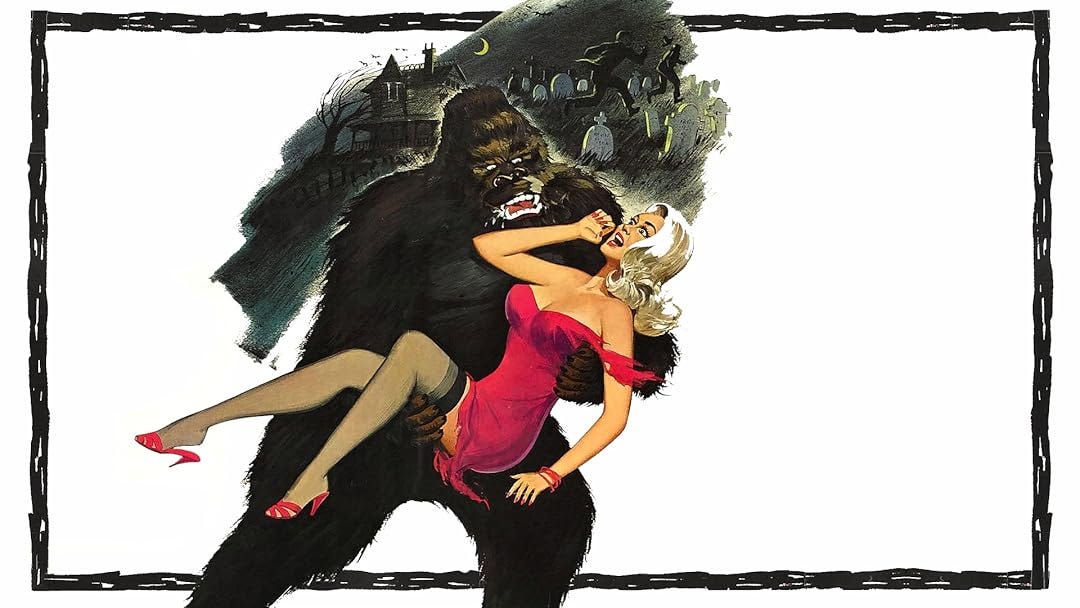
In the spring of 1967, on a soundstage rented by a pair of New Orleans drive-in operators, three of the most distinguished horror actors in motion picture history put on rubber masks and chased a gorilla around a haunted mansion.
Lon Chaney Jr. Basil Rathbone. John Carradine. Men who had carried Universal’s golden age of monsters on their backs — the Wolf Man, Sherlock Holmes, a hundred Counts and Doctors and sinister men in capes — were now playing a trio of bumbling foreign spies named Maximillian, Gregor, and Dr. Himmil, hiding a stolen rocket fuel formula in the basement of a place called Beauregard Mansion. The picture was called Hillbillys in a Haunted House.
Basil Rathbone would be dead in three months.
The last reunion
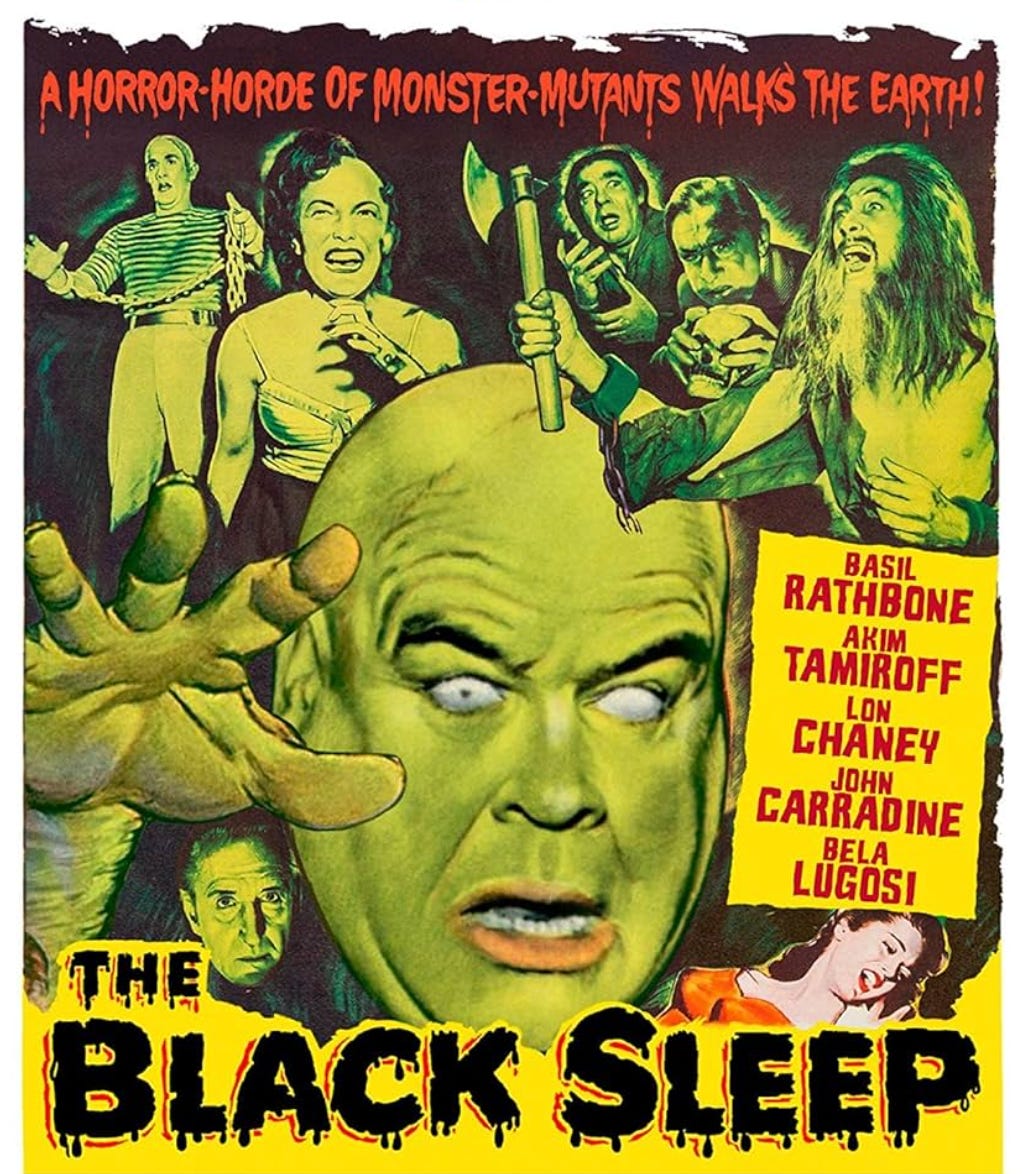
It wasn’t the first time the three of them had been on set together. Eleven years earlier, they had appeared in The Black Sleep — billed, at least, as men of some consequence. By 1967, the terms had changed. Basil Rathbone, in particular, appears disinterested. A man who had been nominated for two Academy Awards, who had played Tybalt and Mr. Murdstone and fourteen incarnations of Sherlock Holmes, was now tangling himself in a bedsheet ghost gag for a company that had made its name with Attack of the 50 Foot Woman.
The studio behind it all was Woolner Brothers Pictures — Lawrence, Bernard, and David Woolner, two of whom had opened some of the very first drive-in theaters in the American South. Their business model was simple and had not changed in over a decade: Like other drive-in owners, the Woolners advanced money to low-budget B picture producers to finance their product. They had bankrolled Roger Corman’s earliest pictures this way. By the mid-1960s they had relocated to California and were producing the product themselves — sword-and-sandal Hercules pictures, sci-fi cheapies, and now, a sequel to a Mamie Van Doren vehicle called The Las Vegas Hillbillys, retooled with country singers and three fading horror legends bolted on for marquee value. I absolutely love it.
Hillbillys in a Haunted House is, structurally, one of the last gasps of a genre that had already died. The Old Dark House comedy had fairly much died away by the 1960s — the genre of creaking doors, secret panels, and bumbling heroes stumbling into men in monster suits, a formula the Bowery Boys had worn smooth through the 1940s. By 1967, it had nowhere left to go but here: a rundown mansion in a town called Sleepy Junction, repurposed as the headquarters of an organization with the acronym M.O.T.H.E.R. — Master Organization To Halt Enemy Resistance — its three ranking agents played by men who, a generation earlier, would have been billed above the title in any picture they appeared in. Times change, don’t they?
Two roads crossing
Ah hell. I’ll be honest with you guys. This movie isn’t really even worth deep diving. Not as a movie, itself. However, it’s about the moment it was made in — a moment when Old Hollywood was visibly ending and a new Nashville was visibly beginning, and for eighty-eight minutes, in a haunted house in Sleepy Junction, they shared the same creative space.
Three country singers — Woody Wetherby, Boots Malone, and their manager Jeepers, played by Ferlin Husky, Joi Lansing, and Don Bowman — are driving to a music jamboree in Nashville when they take shelter for the night and stumble into the spy ring. The film closes with a real concert sequence: a string of actual country artists performing as themselves at the Nashville jamboree the plot has been dragging lifelessly toward the whole time. The last 10 minutes is a country music concert featuring songs from Molly Bee, Merle Haggard, and Marcella Wright.
Merle Haggard’s presence in that lineup is the detail that turns this from a curiosity into something genuinely strange to sit with. “I’m a Lonesome Fugitive” was released on March 4, 1967 — almost certainly while this picture was in production or just behind it — and it became, as Capitol’s promotional machinery and the charts would soon confirm, his first number one country hit, the single that cemented his image as a regretful bad boy caught between the angel and devil on either shoulder. Haggard appears in Hillbillys in a Haunted House as himself, performing for a few minutes in a movie that exists mainly to give three retired monsters something to do. He is on his way somewhere. The picture he is standing in is on its way nowhere — but it doesn’t know that yet, and neither, probably, does he. He is simply where the bill placed him that day, a new name on a marquee that still had Sherlock Holmes’s on it.
Ferlin Husky, on the other hand, was a star whose moment had already been around— a man who’d had his run, doing the kind of work that was now available to him. Joi Lansing, who plays Boots Malone, was a working actress for whom this was, by her own account, exactly the kind of role she’d grown tired of being offered. By this point in her career, Joi Lansing was playing lousy roles like this, and she was unhappy about this. Sadly, she would die of breast cancer within five years.
What was actually haunted?
There’s a way of reading Hillbillys in a Haunted House as nothing more than what it appears to be — a goofy slice cheaply made B-Rated Horror made to be played at a drive-in. That reading isn’t wrong. But it misses what the picture is actually documenting, almost by accident, in the background of every scene.
By 1967, the machinery that had built Lon Chaney Jr., Basil Rathbone, and John Carradine into icons — the Universal horror cycle of the 1930s and ‘40s — had been out the window for two decades, and the men who’d staffed it had spent that time drifting steadily downward through the budget tiers, from Universal to Poverty Row to whatever the Woolner brothers could finance off a string of Southern drive-ins. At the same moment, the machinery that would define the next thirty years of American music — Bakersfield, Capitol Records, the outlaw persona Haggard was just then putting on — was assembling itself a few hundred miles east, in Nashville, with a confidence and a budget that the men playing Gregor and Maximillian could only have envied.
Hillbillys in a Haunted House is the place those two machines briefly touched. One was running down. The other was just getting started. Rathbone, dressed as a ghost, tangled in a bedsheet, three months from a heart attack in a New York hotel — and Haggard, far past San Quentin and one song away from being the most important voice in country music for the next decade, singing for a few minutes on a soundstage borrowed from a horror picture that had already ended, whether anyone on set that day could have said so or not.
The house wasn’t haunted. The film was.
ABOUT THE AUTHOR:
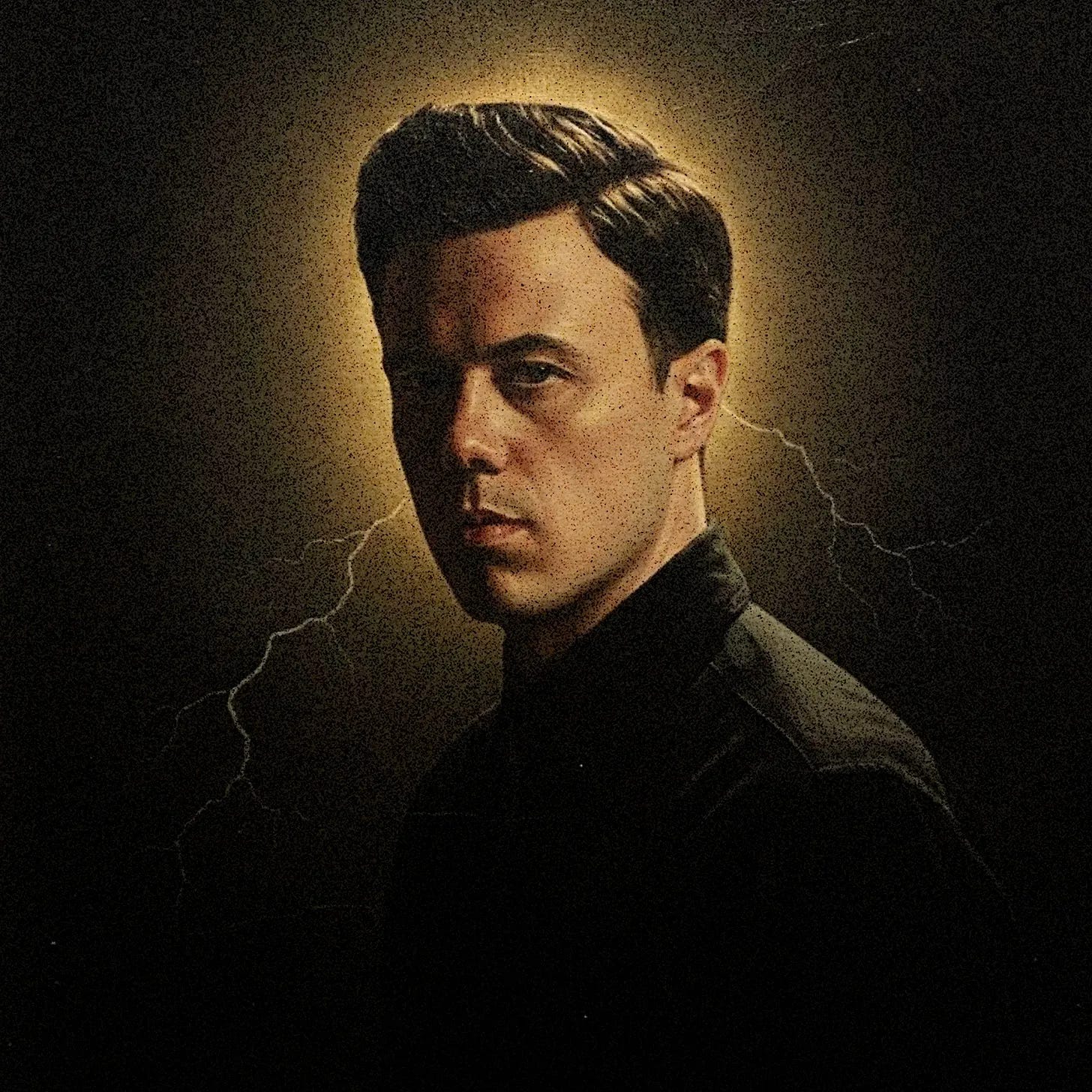
My name is Zachariah Malachi. I’m a full-time, self-employed honky tonk musician in Nashville, Tennessee. This Substack Publication was created for the purpose of sharpening my mind on more Nashville and Country Music history to share with the honky tonk patrons downtown during my shows - but I wanted more folks to benefit from the research so - it’s my gift to the country music fans of the world AND the people who WANT to be. Subscribe and come along for the ride.
Oh man, I've actually seen this one not too long ago via Rifftrax, which made it mildly tolerable. If anyone does try to see it, watch the Rifftrax version.
thanks. this has been on my radar, so to speak, forever for being in joi lansing’s not so illustrious filmography (my wife loves her), & now you’ve managed to make me want to see it—if only on youtube.