



I insinuated to you in the last piece that I’d met Jerry Lee Lewis.
I said I was in the room as the caption of a photo of Jerry Lee and Judith Brown Lewis. Like I’d just dropped a name and moved on. But I owe you more than that — because the story of meeting Jerry doesn’t begin with Jerry. It begins with a gate, a cup of coffee, and a bedroom door that had been stabbed hundreds of times with a pocket knife.
Let me take you back.
It’s early 2022. COVID-era. The world still felt slightly wrong around the edges — quieter than it should have been, people moving through their days like they weren’t entirely sure what came next.
I was living in Brentwood, Tennessee — just south of Nashville, out in the rolling hills where farmland had slowly surrendered to subdivisions. Mansions tucked into the curves of winding roads. Beautifully landscaped lawns pressed up against pastureland that still remembered what it used to be. It was a strange place to live — caught between two worlds, not quite either one.
I was staying with the family of country music singer Jim Ed Brown. But that’s a story for another day.
My friend Kelly had been out at the Lewis Ranch in Hernando, Mississippi — just across the state line south of Memphis — helping with maintenance and upkeep on the property. She reached out one afternoon and asked if I wanted to come out on one of my days off.
The question barely needed answering.
I left early on a quiet southern winter morning with a warm cup of coffee and the kind of light that makes Tennessee look like it’s been painted on glass. The drive from Nashville to Hernando is about three and a half hours if you stay on I-40 West and cut south on 55. I remember it being one of those drives where the road does all the talking — not much traffic, not much noise. Just land and sky and the slow thaw of a January morning.
I had a lot of time to think on that drive. Too much time, maybe.
Because by the time I was cutting off the interstate and rolling through rural Hernando, the weight of where I was going had started to settle in on me. This wasn’t some tribute museum stop on a highway tour. This was Jerry Lee Lewis’s house. The Killer. The man who had sold 100 million records, married his thirteen-year-old cousin, played piano with his feet, shot his bass player, fired guns at his house, and outlived every person who ever told him he’d gone too far.
There’s a long list of people who’ve met Jerry Lee Lewis and walked away with horror stories. People who came in with good intentions and left with a story they still didn’t fully believe years later. Someone told me they were backstage at Viva Las Vegas — the rockabilly festival out in Vegas — when Duane Eddy himself introduced a young woman to Jerry. Beautiful girl, excited to meet a legend. Ten minutes later she was in the hallway sobbing, because Jerry had said something to her that nobody seemed willing to repeat out loud but everybody in the room had heard. Nobody looked surprised. That was just Jerry. He’d been doing some version of that for sixty years and saw no reason to stop.
I’d heard enough stories like that one to know better than to set any expectations going in. Jerry was going to be Jerry. That was the only thing you could count on.
I pulled off a quiet residential road and found myself face to face with a brick wall.
A long, low brick wall running the perimeter of the property. And behind a wrought iron gate at the entrance — the Lewis Ranch.
I put the car in park.
I just sat there for a moment.
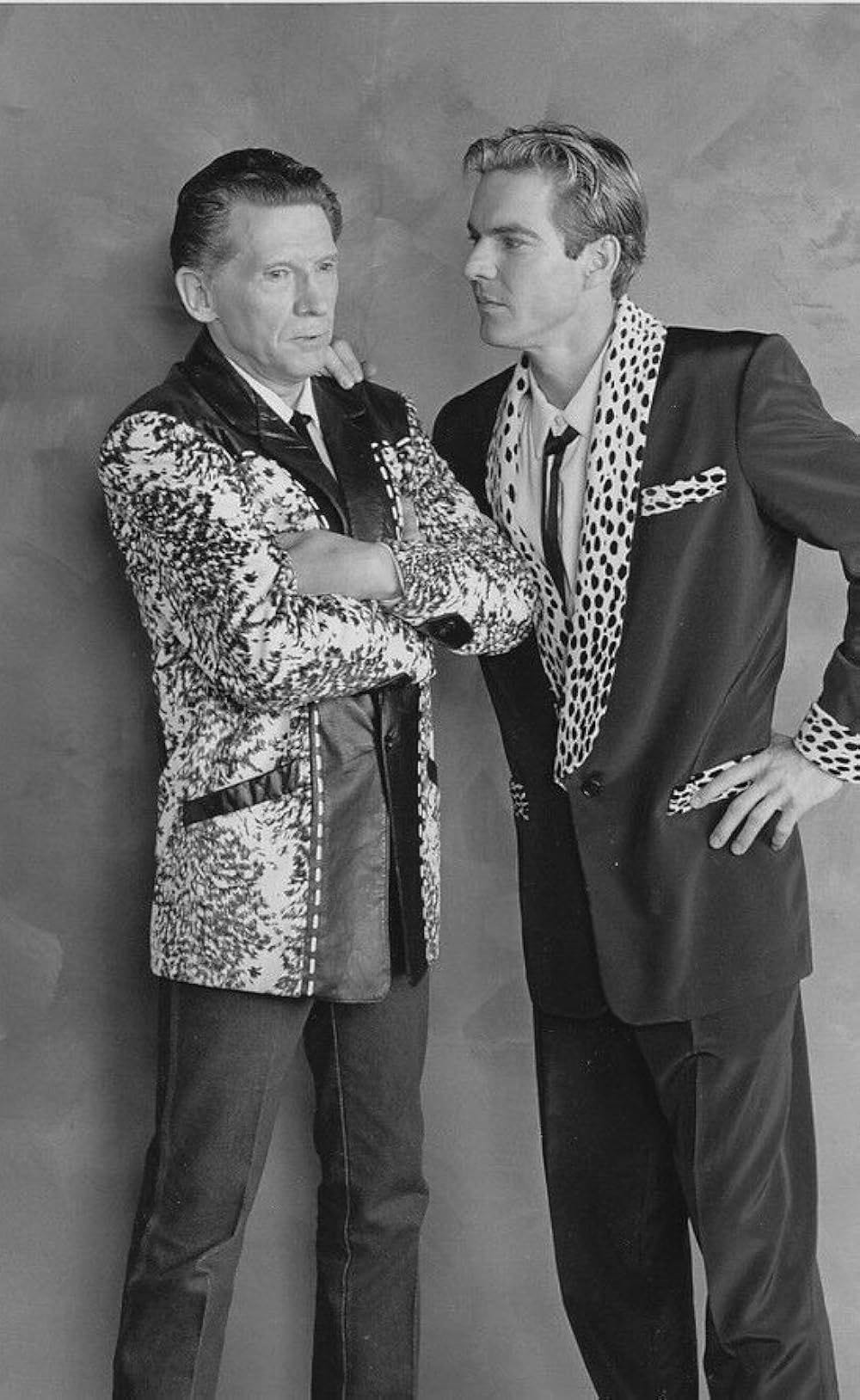
I don’t know how long it was exactly, but long enough. Something about seeing that gate made the whole thing real in a way that the drive hadn’t. My mind started pulling up everything — my Dad buying a janky Jerry Lee CD from a Walmart bin, the recording quality so bad it sounded like it had been recorded inside a tin can during a thunderstorm, but my Dad singing along to every single word anyway because he knew them all. Me at sixteen or seventeen, getting deep into 50s rock and watching Great Balls of Fire for the first time — Dennis Quaid absolutely unhinged at that piano, Winona Ryder watching from the doorway. I’d based most of my initial understanding of who Jerry really was on Dennis Quaid’s performance. And I’ll tell you something — it holds up better than you’d think.
I was still sitting there with my phone out, texting Kelly that I was at the gate, when the gate made that low metallic groan and started swinging open.
I had a brief and embarrassing panic about which direction it was going to swing — toward me or away — because I hadn’t pulled far enough forward and for one second I was genuinely unsure if I was about to be gate-checked in a Rolls Royce driveway. It swung the right direction. I was fine. I should have slept more the night before.
Kelly met me at the door with a fresh cup of coffee. I stepped inside the Lewis Ranch and my brain did something strange — it just stopped for a second. Not in a bad way. In the way it does when you’ve walked into a room that has more history in it than your mind knows what to do with.
But the first thing that actually registered wasn’t history. It was the quiet.
The whole place was still. Not tranquil still — uneasy still. The kind of quiet that sits on a place that hasn’t had regular life moving through it in a while. There was a thin layer of dust on things. Cigarette discoloring on the walls and ceilings in certain spots. Kitchen grime that had just been there long enough to become part of the architecture. The house wasn’t dirty exactly — it was old in the way that only a place that’s been left largely to itself can be old. A real estate agent would have called it a gem with potential. A honest one would have told you to double the renovation budget before you thought about sleeping there.
I found out soon enough that Jerry wasn’t on the premises. It was just Kelly and the silence and everything the house had accumulated over the decades.
The house was frozen in time.
That’s the thing I’ve noticed about the homes of country and rock stars from that particular era. They renovate where they have to, update where they must — but the spirit of the place stays exactly as it was when it was built. Like the house knows what it is and refuses to be talked out of it. Jerry’s place was the purest version of that I’ve ever encountered. Everything in it was original, dated, and completely unapologetic about it.
Kelly answered my first question before I fully finished asking it — Jerry and his wife weren’t living at the Ranch at that point. They were at a condo nearby. The Ranch was being used for events and tours.
We settled in the back room, which was set up like a small, private piano bar — upholstered furniture, a fireplace, and a grand piano at the center of it all, surrounded on every wall and mantle by the accumulated evidence of one of the most extraordinary careers in the history of American music. Gold records, photographs, memorabilia going back decades. The whole room smelled like old wood, history with possibly a hint of gunpowder and illicit substances still in the air.
I had about a thousand questions but couldn’t quite figure out how to start asking them. I was too busy just being in the room. Trying to absorb it.
There was also, underneath the excitement, a thin current of something else. Something harder to name.
I knew, walking into that house, what had happened there. I’d spent a long time researching Jerry’s history for the day that I may write the last article I wrote — including the death of his fifth wife, Shawn Stephens, who passed away in this house under circumstances that were never fully explained. Whatever she was given that night, whatever happened in those rooms — the official story never sat right with the people closest to it, and it still doesn’t. I still have a lot of curiosities.
That knowledge mixed with the cold winter light coming through the windows, the general stillness of the place, and approximately three cups of coffee produced a feeling I can only describe as: a lot.
Excitement. Reverence. A little unease. All of it running at the same time.
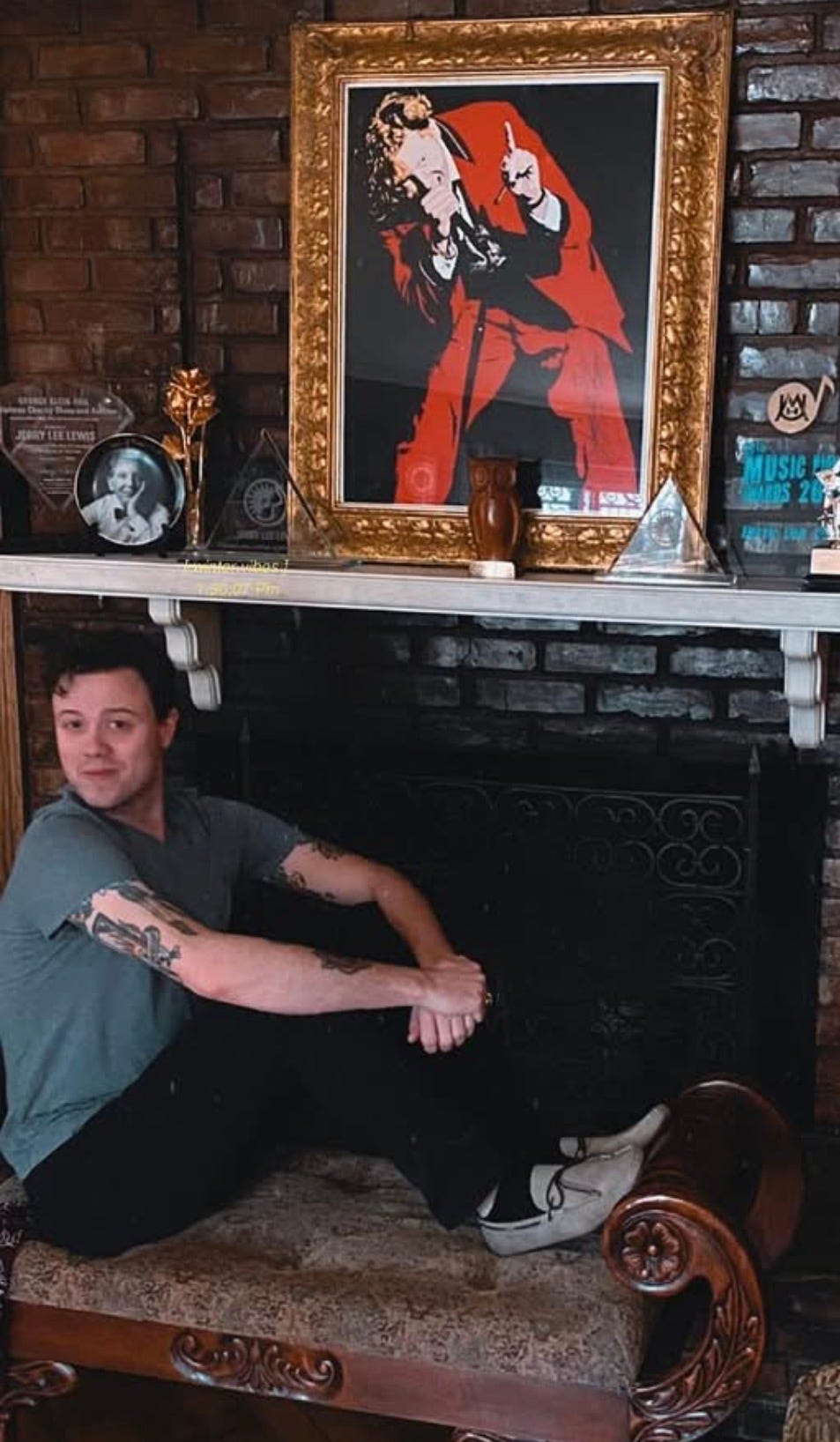
After a while, I got up and sat down at the grand piano.
I don’t know exactly what made me do it — maybe because it felt wrong not to. You don’t sit in a room with Jerry Lee Lewis’s piano and pretend it isn’t there.
I started picking out the opening of “Another Place, Another Time.” It was written by Jerry Chestnut, and the story goes that Jerry Lee actually laughed when someone first pitched it to him — thought it was just some sad, slight honky-tonk number beneath his ambitions. He was wrong about that. He listened to it once, remembered every lyric, and recorded the thing into one of the definitive honky-tonk records of his career.
“One by one, they’re turning out the lights... I’ve been feeding that ol’ jukebox just to hold you tight.”
I’ve said it before and I’ll say it again — whatever else you want to say about Jerry Lee Lewis, his honky-tonk output should be the Webster’s definition of the genre. His rock and roll gets all the attention. The honky-tonk deserves more of it.
I played a few more notes than I probably should have and eventually set the keys loose.
Then Kelly asked if I wanted a tour of the parts of the house that tours didn’t get to see.
BELOW is a YouTube link of Mickey Gilley in the same room I was in singing to Jerry and Judith for Jerry’s 85th Birthday Celebration. Playing keys for him is Jacob Tolliver - an extremely talented guy from Ohio.
We walked through a set of double doors into a hallway that connected to a private section of the house. Kelly mentioned right away that this was where the public tours ended. I assumed that meant administrative offices — and there was one of those — but that wasn’t what she was leading me to.
At the end of the hallway, on the left side, was a door.
In front of the door was a wrought iron bar gate. Heavy, solid, unmistakably intentional.
And hanging from the bars — casually, almost decoratively — were two pairs of handcuffs.
“That’s Jerry’s room.”
I stood there for a second, looking at it.
The story Kelly told me was that Jerry’s years of amphetamine abuse had left him with crippling anxiety — bad enough that he’d had the iron gate installed in front of his own bedroom door. Not a security gate for the house. A gate for his room. So he could be behind two layers of barrier between himself and the world.
The handcuffs — I never got a straight answer on those. I didn’t push. Some things you don’t need explained. I don’t believe Kelly knew the answer to that one, anyways.
His bedroom was as original and frozen as the rest of the house. I sat down on the edge of his bed and looked around slowly, taking inventory.
The bedroom door — the actual door, not the gate — was a massive, heavy oak slab. In the middle of it, at eye level, was a peephole. Which would have been perfectly sensible if it were a front door. It was not a front door. It was the door between his bedroom and the rest of his own house. The man had installed a peephole to see who was coming down his own hallway.
The back of that door told a different story.
It had been stabbed. Hundreds of times. Hundreds of small, precise puncture marks clustered across the surface of the wood — the evidence of years of lying in bed, bored, pulling a pocket knife out and throwing it at the door.
Just to have something to do.
And then there were the bullet holes.
In the walls. In the furniture. Not hidden, not patched — just there. Like they’d become part of the décor. The home’s natural state. Evidence of a man who treated his living space the way most people treat a shooting range, and apparently saw nothing wrong with that.
I had spent years hearing the stories about Jerry Lee Lewis. The mythology. The legend. The exaggeration people always assume must be threaded through any account of a man that large.
Standing in that room, I started to understand — there was no exaggeration. If anything, people had been underselling him.
We wound back through the house and ended up at the back room again. I leaned against the bar and looked out through the sliding glass doors at the property behind the house. Jerry’s pool — shaped like a piano, because of course it was — caught the pale winter light. A small lake sat beyond it, still and quiet. The whole back of the property had a strange peacefulness to it that didn’t quite square with everything I’d just seen. Like the land itself had made peace with whatever had happened on it.
Then I looked down behind the bar I was leaning on.
Boxes of pistol ammunition. Open. Used shells scattered among the full ones.
I didn’t say anything for a second. I just looked at them. Then I looked at the sliding door to the yard. Then I looked at the shells again.
I decided I didn’t need that particular question answered either.
Not long before I left, Kelly walked me out to the carport.
And there it was — Jerry’s Rolls Royce, sitting exactly where he’d left it.
I opened the door and lowered myself into the driver’s seat. Settled in. Put my hands on the wheel without quite knowing why.
I sat there in that car, on that property, surrounded by bullet holes and knife marks and piano-shaped pools and handcuffs on iron bar gates — and I thought about what a life like that even looks like from the inside. What it costs. What it gives you. What you give it and what you get from it.
For a moment, I sat there and just thought about fame and the price of it.. you know.
I thought about Dennis Quaid throwing his hands across a piano in a movie theater when I was a teenager.
I thought about my Dad singing along to a five-dollar Walmart CD with terrible sound quality.
I thought about “One by one, they’re turning out the lights.”
You can have whatever opinion you want about Jerry Lee Lewis the man. I’m not here to clean up his record or make him palatable. But I am here to tell you that there’s something about being in the physical space where a life like that was lived — really lived, in all its ugliness and genius and excess — that changes the way you understand it. You stop thinking about him as a legend and start thinking about him as a man. A deeply strange, deeply broken, deeply extraordinary man who poured all of it into music and somehow made it sound like God was playing through him.
I briefy mentioned in the last piece that I’d met Jerry Lee Lewis.
I meant it.
But this — this trip to the Ranch, this cold January morning, this frozen-in-time house full of bullet holes and grief and genius — this is where the meeting really started. Before I ever walked into the living room to see the Killer himself staring back at me.
That part comes next.
— Part II coming soon.
ABOUT THE AUTHOR:

Zachariah Malachi is a Nashville-based singer-songwriter and actor. He is a self-employed musician and writer that has dedicated his life to learning the craft of becoming a Troubadour while his philanthropic efforts are focused on the preservation of important Country Music History. He writes about the dark corners of country music history that everyone else decided to forget.
Great stories. Keep them coming.
Inspired by the sign at the entrance of Dachau.