


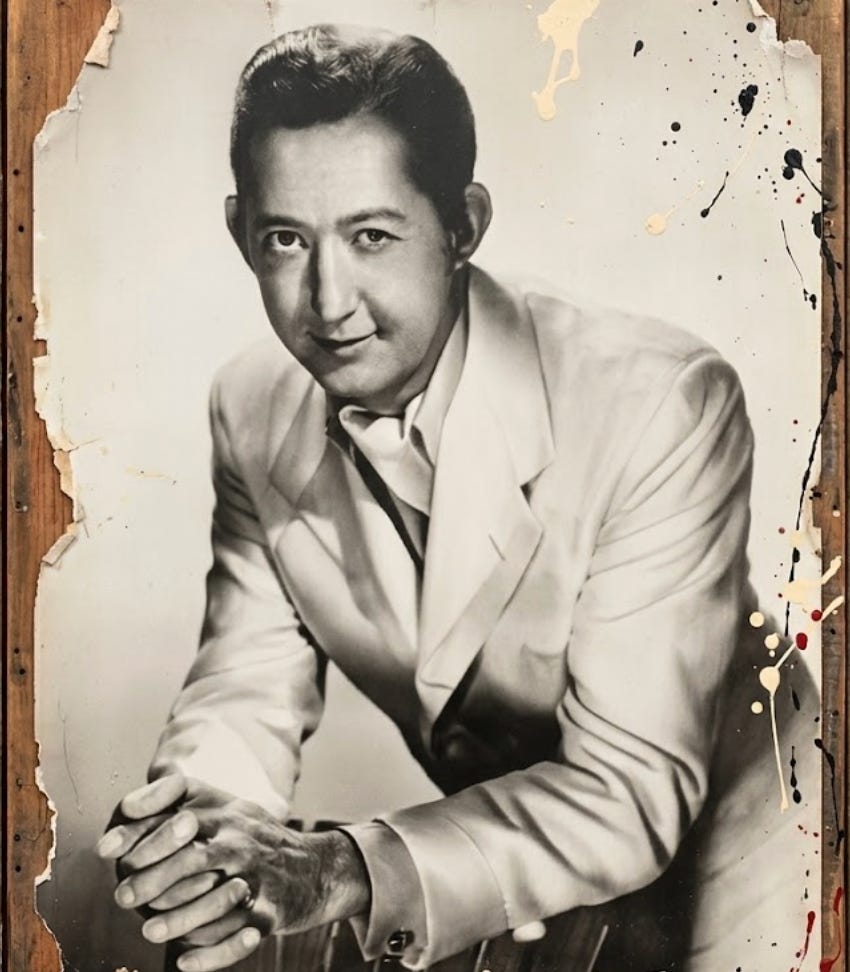
I need to be direct about this: “The Last Letter,” written by Rex Griffin in 1937, is not a metaphor. It is not theatrical heartbreak dressed up in country twang. It is a suicide note. The lyrics were written as a suicide note. The structure is a suicide note. The narrative arc is a suicide note. When you listen to Jack Greene’s rendition on Ernest Tubb Presents The Texas Troubadours—the definitive version—you are listening to a man say goodbye.
This is the saddest country song ever written.
I know what I’m saying. I’m a diehard Hank Williams fanatic. I would die on the hill defending “I’m So Lonesome I Could Cry” as a masterpiece of American songwriting. But I’m here to tell you that Hank’s masterwork, as devastating as it is, doesn’t reach the specific gravity of Griffin’s composition. Hank wrote about the texture of loneliness. Griffin wrote about the act of leaving it behind.. permanently.
The Architecture of Despair

Rex Griffin—born Alsie Griffin in Gadsden, Alabama on August 12, 1912—was a Jimmie Rodgers devotee who learned to bend the lonesome blue note into something new. He worked his way through the Depression on factory floors and small-town radio broadcasts, playing harmonica and then guitar, watching the world fail. He adopted the stage name “Rex” around 1930 in Birmingham because his real name was too difficult for radio announcers to pronounce. Even his identity had to be discarded to fit the machinery of the music business.
By 1937, Griffin was living in New Orleans. His wife had left him. This is the biographical fact that matters most: he wrote “The Last Letter” while experiencing the exact abandonment his narrator describes. The song wasn’t speculation. It was testimony.
He recorded it on May 13, 1937, for Decca Records. It became popular across the South immediately. Jimmie Davis covered it in 1939. The Blue Sky Boys recorded it. The Carter Family. Ernest Tubb, whose version became the standard-bearer. But when the single’s sales numbers came in, Decca dismissed Griffin. Despite creating what would become a country standard—a song that would influence everyone from Hank Williams to Bob Dylan (whose “To Ramona” is, by his own admission, a nod to Griffin’s original)—he was fired for not selling enough copies.
This is how the music industry treated the man who wrote one of its most enduring songs. This is the postscript to his story.
The Lyrics as Evidence
“The Last Letter” isn’t a love song with sad verses like we are used to with country ballads. It’s structured as a suicide letter from start to finish. The narrator is writing to someone—presumably the woman who left him—and he’s making a statement about what her abandonment has cost him. He describes himself as an older man who gave his all to a younger woman who was seeking wealth and luxury. She chose the material world over his love and devotion. The song documents this betrayal with such specificity, such bitter accuracy, that you understand this isn’t poetic license. This is the literal confession of a man at the end of his rope.
The genius of Griffin’s composition is that it never explicitly says “I’m going to die.” The song doesn’t need to. The form itself—the letter, the final words, the tone of goodbye—tells you everything. This is a man settling accounts before he walks out.
Jack Greene understood this. On the 1963 album Ernest Tubb Presents The Texas Troubadours, Greene delivers the song with a weight that most other versions miss. There’s no sentimentality in his reading. There’s just heaviness. The steel guitar doesn’t cry—it tolls. Jack’s voice has the exhaustion of someone who has already buried people, who understands that some heartbreak is terminal. The Texas Troubadours arrangement creates a funeral mass in three minutes and forty seconds. You don’t listen to that recording; you experience it.
Why This Beats Hank
Here’s where I need to stand in front of my own conviction and be honest: “I’m So Lonesome I Could Cry” is technically superior. It’s more elegant. The metaphors are more sophisticated—that whippoorwill, those falling leaves, the silence expanding like a canyon. Hank achieved something almost impossible: he made loneliness feel like a physical phenomenon, something you could touch. It’s a masterpiece, and I mean that without reservation or hesitation.
But Hank was writing about the experience of loneliness. Griffin was writing about the decision to end it.
“I’m So Lonesome I Could Cry” is loneliness as existential condition. “The Last Letter” is loneliness as a terminal diagnosis. One describes the ache. The other describes what happens after you stop fighting the ache. One is the illness. The other is the final letter on the nightstand.
Hank’s song leaves the story up to you. Griffin’s tells you the ending.
The Life as Echo
Rex Griffin died in New Orleans near the end of the 1950s. The details vary depending on the source, but the through-line is consistent: alcoholism, diabetes, tuberculosis, and a kind of profound obscurity that only befell the people who’d already been forgotten by the industry that used them. He was inducted into the Nashville Songwriters Hall of Fame in 1970—eleven years after he died. The institution recognized his genius when recognition could no longer reach him.
His influence, though, spread like a virus through the bloodline of country music. Hank Williams’ “A Mansion on the Hill” exists in direct conversation with “The Last Letter.” Willie Nelson, Merle Haggard, Waylon Jennings, Glen Campbell—they all came to this song and understood that Griffin had mapped the absolute bottom of American heartbreak. The Beatles knew it. Bob Dylan knew it. He knew it well enough to reference it directly.
But Griffin himself lived the trajectory he documented in his most famous composition. He went from having something (a marriage, a recording contract, a moment of recognition) to watching it all exit. The music industry, which had briefly seen value in his work, dismissed him when the numbers didn’t align. He spent his remaining years in the city where he’d written his masterpiece, drinking himself to death with the specificity of someone who understands exactly what he’s doing.
The song and the life became the same thing.
Why This Matters Now
We live in an era where we’re supposed to talk about mental health, about crisis, about the specific agony of abandonment and rejection. We have language for it now, frameworks, treatment options. But we also have the songs that documented this landscape before we had the vocabulary. “The Last Letter” is one of those documents. It’s a primary source from someone who lived at the bottom of that particular hell.
Rex Griffin wrote it in 1937. He wrote it while it was happening. He recorded it so that people like you and me, eighty-seven years later, would understand that this specific kind of despair—the kind that comes from being replaced, from watching someone you loved choose something else—is real enough to kill you. He was documenting his own death. He was leaving a record.
When Hank Williams wrote (?) “I’m So Lonesome I Could Cry,” he was writing about loneliness as an affliction. When Rex Griffin wrote “The Last Letter,” he was writing about what happens after the loneliness wins.
I don’t say this lightly: “The Last Letter” is the saddest country song ever written. It’s the saddest because it’s not trying to be beautiful. It’s just trying to be true. And Griffin was telling the truth about the moment when a man decides he’s finished.
The Jack Greene recording preserves that truth. Listen to it. Really listen. You’ll hear someone acknowledging, for the record, that he understands what Griffin was trying to say. That’s not sentimentality. That’s witness.
That’s what we do with songs this dark—we bear witness. We make sure the record stays clear about what happened and why.
Griffin died forgotten. But the song outlived him by decades. It’s still outliving him now.
“The Last Letter” was written by Rex Griffin in 1937 and recorded for Decca Records on May 13, 1937. The definitive version remains Greene’s recording on Ernest Tubb Presents The Texas Troubadours (1963). Secondary recordings worth hearing: Jimmie Davis (1939), Willie Nelson, Merle Haggard, and The Blue Sky Boys.
ABOUT THE AUTHOR:
My name is Zachariah Malachi. I’m a full-time, self-employed honky tonk musician in Nashville, Tennessee. This Substack Publication was created for the purpose of sharpening my mind on more Nashville and Country Music history to share with the honky tonk patrons downtown during my shows—but I wanted more folks to benefit from the research, so it’s my gift to the country music fans of the world AND the people who WANT to be. Subscribe and come along for the ride.
Great essay. Sounds like a song Ray Price would've sung.
Any discussion of the saddest songs in country music would have to include “He stopped loving her today” by George Jones, and, ”The green green grass of Home,” by Curly Putnam!