


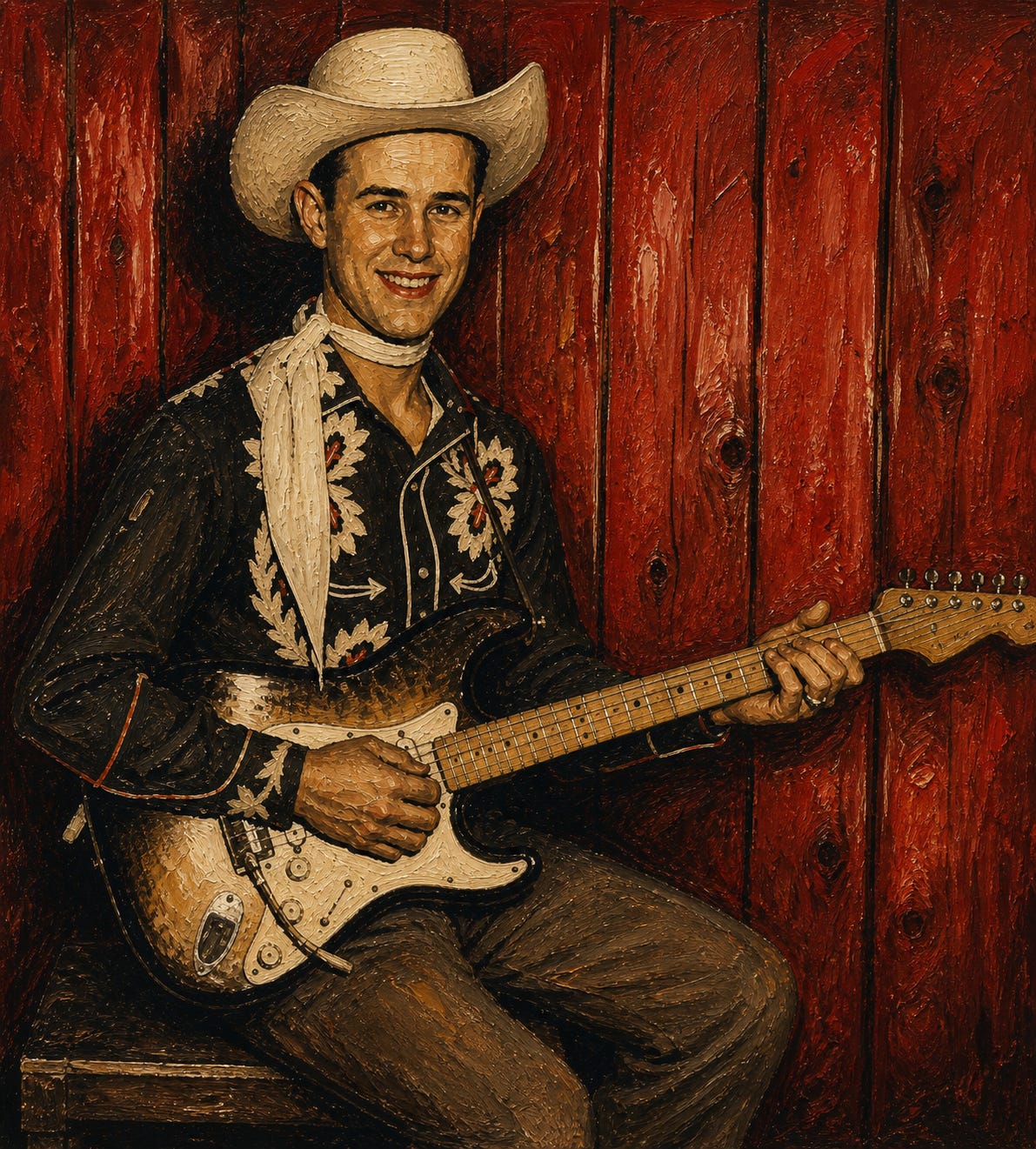
Dangerous Don Rich. The legend. The King of Bakersfield, California Cool.
Pull up any footage of Buck Owens and the Buckaroos in their prime — the Ranch Show clips, the Carnegie Hall recording, the early Hee Haw reels — and look at the stage. Do not look at Buck. Not yet. Look to his right. There is a young man standing there in a matching Nudie suit, champagne sparkle Telecaster slung low, face split by a grin that looks like it was put on this earth specifically to make other people feel glad to be alive. That is Don Rich. That is the other half of everything you are hearing.
Most people never learned his name. That is one of the great injustices in the history of this music.
I want to correct the record today.
Washington State, 1957
Donald Eugene Ulrich was born in Olympia, Washington in 1941 — the adopted son of a family who started him on fiddle when he was barely old enough to hold one. His parents entered him in talent contests from childhood, and he was appearing on local radio broadcasts by age five. By the time he was a teenager, he was playing Steve’s Restaurant in South Tacoma for tips and instinct. In September 1957, at age sixteen, he opened for Elvis Presley at the Tacoma Lincoln Bowl. Sixteen years old. Opening for Elvis. Most musicians never get within fifty feet of a moment like that. Don Rich had it before he had a driver’s license.
Now understand what was happening in Tacoma at that same moment. A transplanted Texan named Alvis Edgar Owens Jr. — who went by Buck — was working at radio station KAYE, trying to build something, trying to figure out what he had and how to aim it. Buck Owens attended one of Rich’s shows and immediately went to speak with him. Rich was soon playing fiddle with Owens at local venues, and they were featured on the weekly BAR-K Jamboree on KTNT-TV, where Loretta Lynn made her television debut as a guest.
Think about that room for a second. Buck Owens and Don Rich, finding each other in a television studio in Tacoma, Washington. Loretta Lynn across the stage from them. 1957. Nobody in that building knew yet what any of it meant.
Buck knew enough to know that Don Rich was something he could not afford to lose.
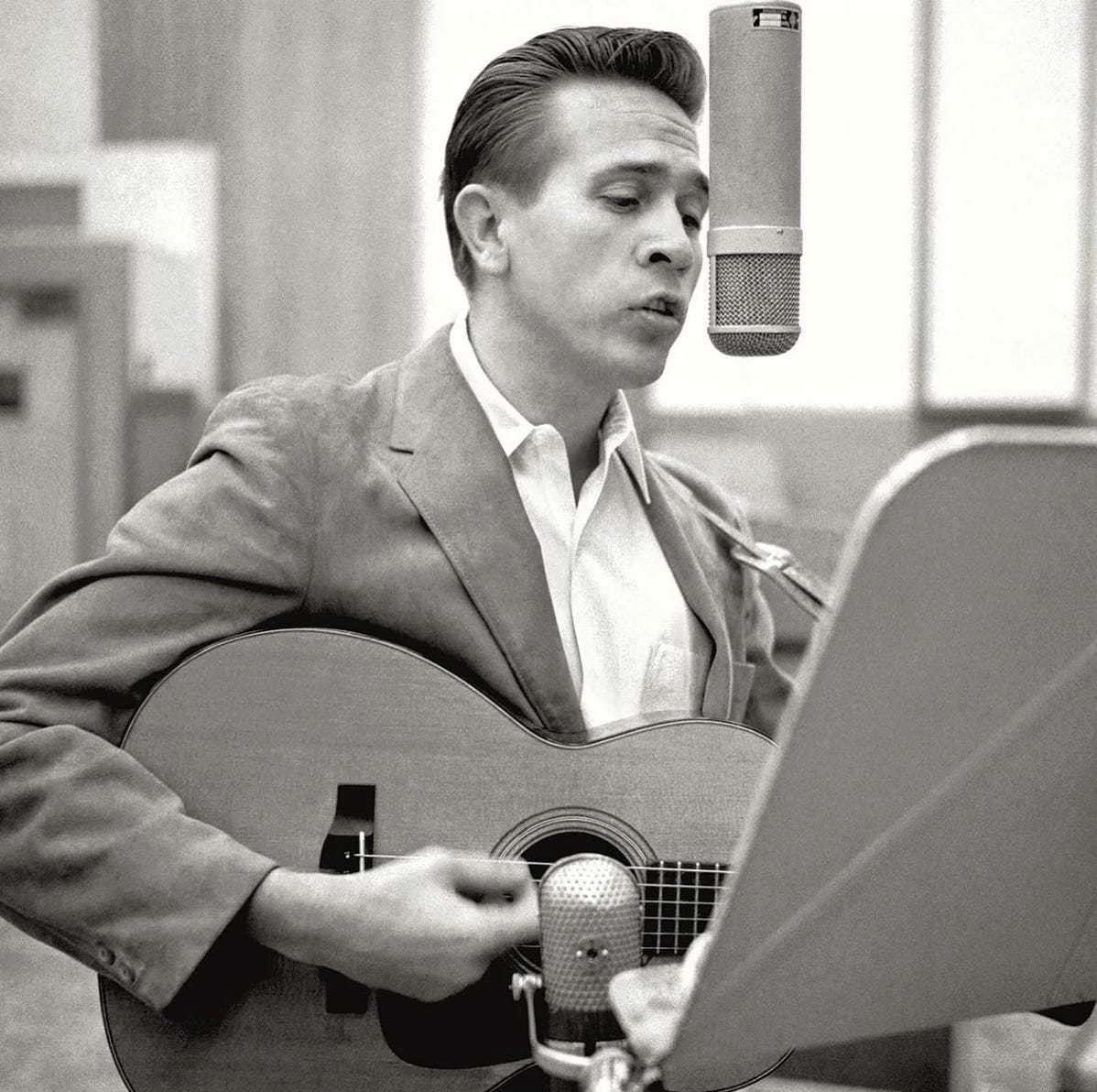
This is a famous image of Buck that I have seen several times. Even on the “Buck ‘Em” album cover.
The Freight Train
When Buck’s record “Under Your Spell Again” cracked the charts, Capitol Records pulled him back to Bakersfield to record more. He went. Don Rich chose college instead — for about a year. After a year of college, Rich dropped out and joined Owens in Bakersfield in December 1960, signing on for $75 a week. The first single he played on, “Above and Beyond,” peaked at number three.
Seventy-five dollars a week. That was the price of the partnership that changed American music.
In those early days, Owens and Rich toured haphazardly — throwing Buck’s acoustic guitar and Don’s fiddle into the back of an old Ford pickup, hopping from bar to bar, dance hall to dance hall, playing with whatever musicians they could find. This is the image I want you to hold. Not the Carnegie Hall stage, not the matching suits, not the Fender endorsements. Two men in a pickup truck, driving the California dust, working out something they didn’t have a name for yet.
The sound came together in 1962. The shuffle on the snare drum became a tightly closed high-hat. The offbeat was accented by a quick half-rimshot on the snare. Don compared the result to a “runaway locomotive.” Buck called it a “freight train.” The world came to call it the Bakersfield Sound.
And then came “Act Naturally” in 1963. Buck was initially unimpressed with the Johnny Russell song, but Rich liked it, and they recorded it with the Buckaroos on February 12, 1963. It entered the charts in April and spent four non-consecutive weeks at number one — Buck’s first number-one hit. Don Rich heard a hit that Buck couldn’t hear yet, and went and got it for him. That is how it worked between them, more times than the history books know.
Between 1963 and the early 1970s, the partnership was essentially unstoppable — twenty-one number-one hits. They were so dominant that every other act in country music was simply trying to find space between Buck Owens singles. They were so big that The Beatles covered them. The biggest band in the world was sitting in London listening to a couple of guys from Bakersfield.
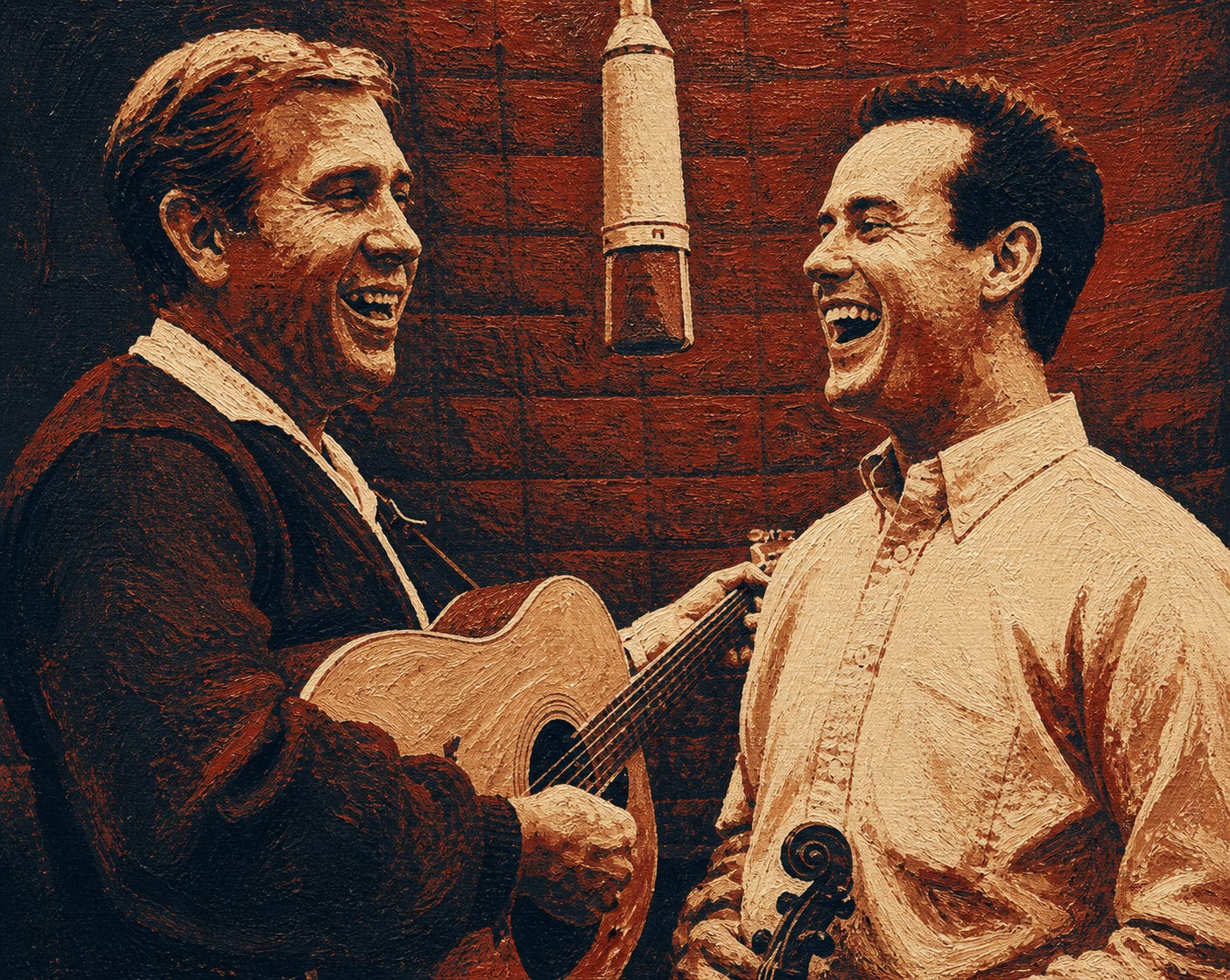
Two peas in a pod. Buck and Don. Immortal friendship surpassing the grave, I’m sure.
What Don Rich Actually Was
I need to stop here, because the history has done Don Rich a disservice that still grates on me.
He is written about as a sideman. He is described as Buck’s guitarist. He gets footnoted. He gets parenthesized. This is wrong. This is profoundly, historically wrong.
Don Rich was the most important side player in the history of country music. Country music would sound significantly different without him. As bandleader, co-writer, lead guitarist, and the other voice in every harmony Buck ever sang — Don Rich was not a supporting character. He was a co-author. Of the sound, of the records, of the entire Bakersfield mythology.
People call the vocal blend between them “blood harmony,” a term usually reserved for brothers like the Louvins or the Everlys. Buck and Don weren’t related, but their voices locked in a way that defied logic. Don had a high, lonesome tenor that shadowed Buck’s phrasing perfectly — they didn’t even have to look at each other to know when to slide or when to cut a note short.
He was also the reason Nashville never swallowed them. Nashville was all about smooth strings and polite hollow-body jazz guitars. Buck and Don wanted grit. They wanted that treble turned all the way up until it hurt a little. Those champagne sparkle Telecasters weren’t just an aesthetic choice. They were a declaration of war against polish and propriety.
Buck insisted that Don was as much a part of the Buck Owens sound as Buck himself. He considered Don to be a brother, and in some ways, a son.
That line. Sit with that line. A brother and a son at the same time. That is a complicated and enormous love. That is not a professional relationship. That is someone who became family in the way that only music can make happen — through shared sweat and shared belief and thousands of miles of shared road.
The World They Built
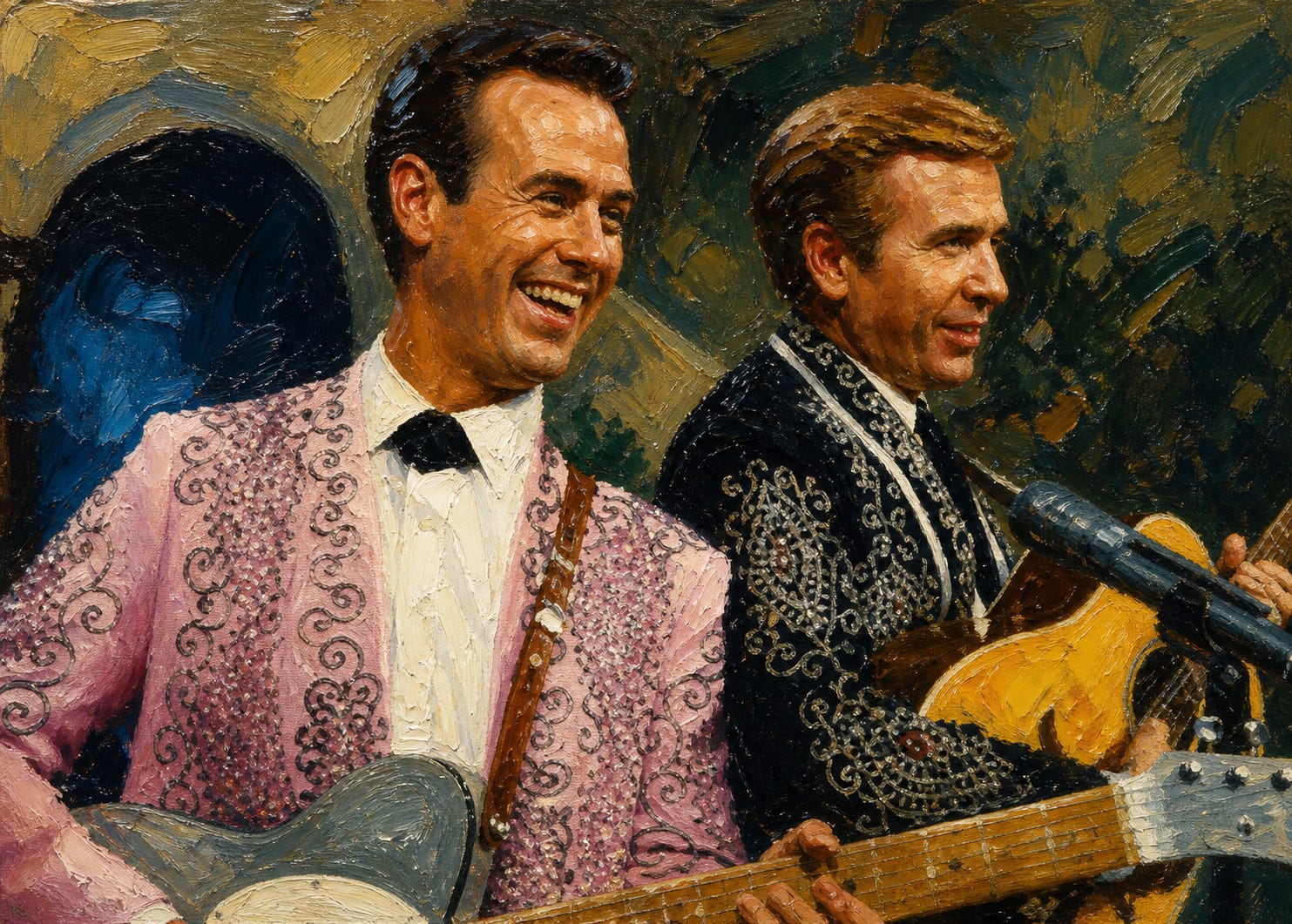
By 1965, the machine was running at full power. Fender gave Buck a golden sparkle Telecaster and Don a champagne sparkle Fender Telecaster of his own. They scored hits with “I’ve Got a Tiger by the Tail,” “Before You Go” — co-written by Rich — and “Buckaroo,” the only instrumental ever to reach number one on the country charts.
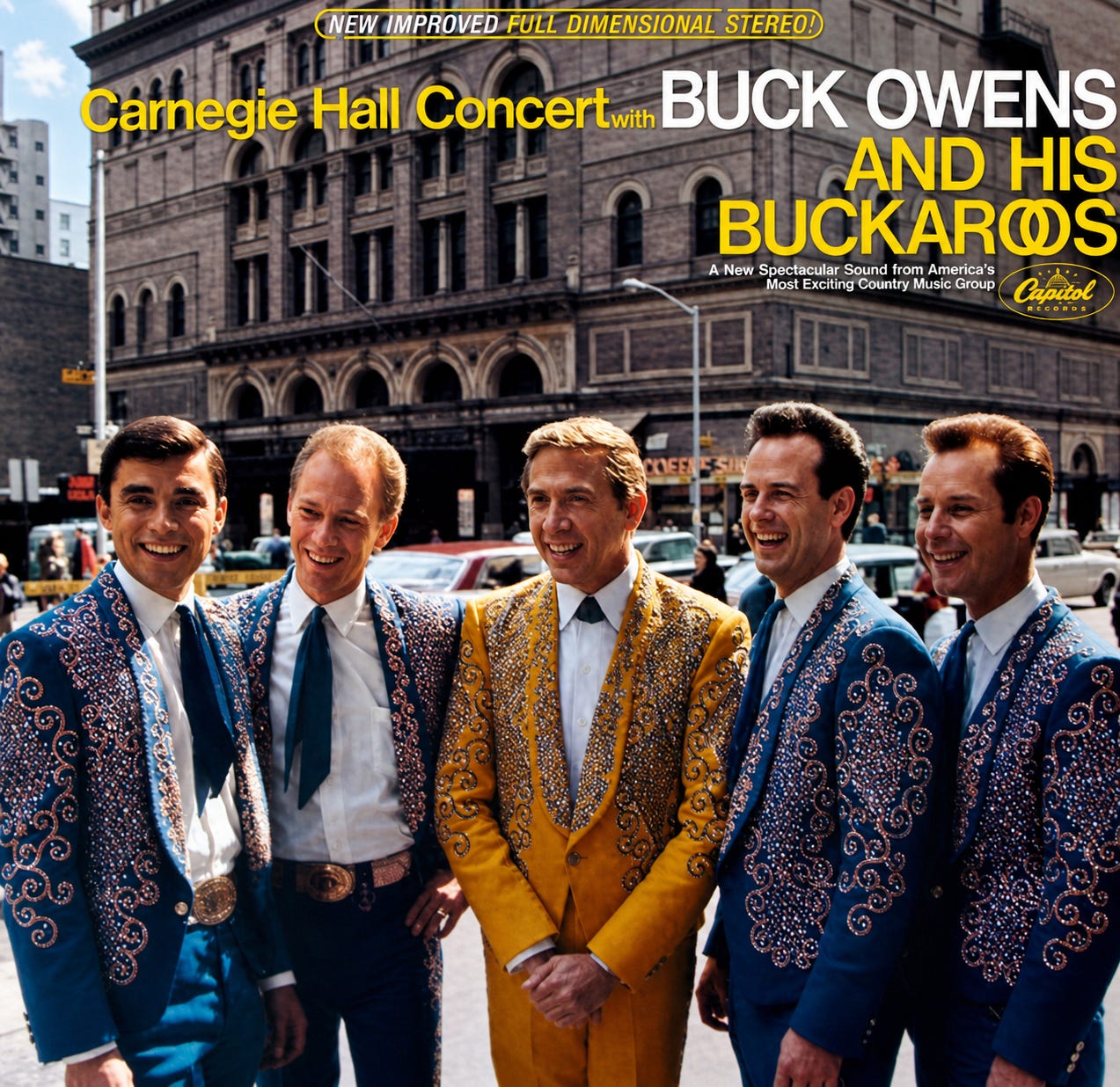
Then came Carnegie Hall, March 1966. Buck had almost not booked it — he wasn’t sure New York City wanted real country music. It sold out two weeks in advance. The Carnegie Hall Concert album is widely regarded as one of the best live albums ever made in any genre. The band was so tight that they did not have to go back in to recut anything.
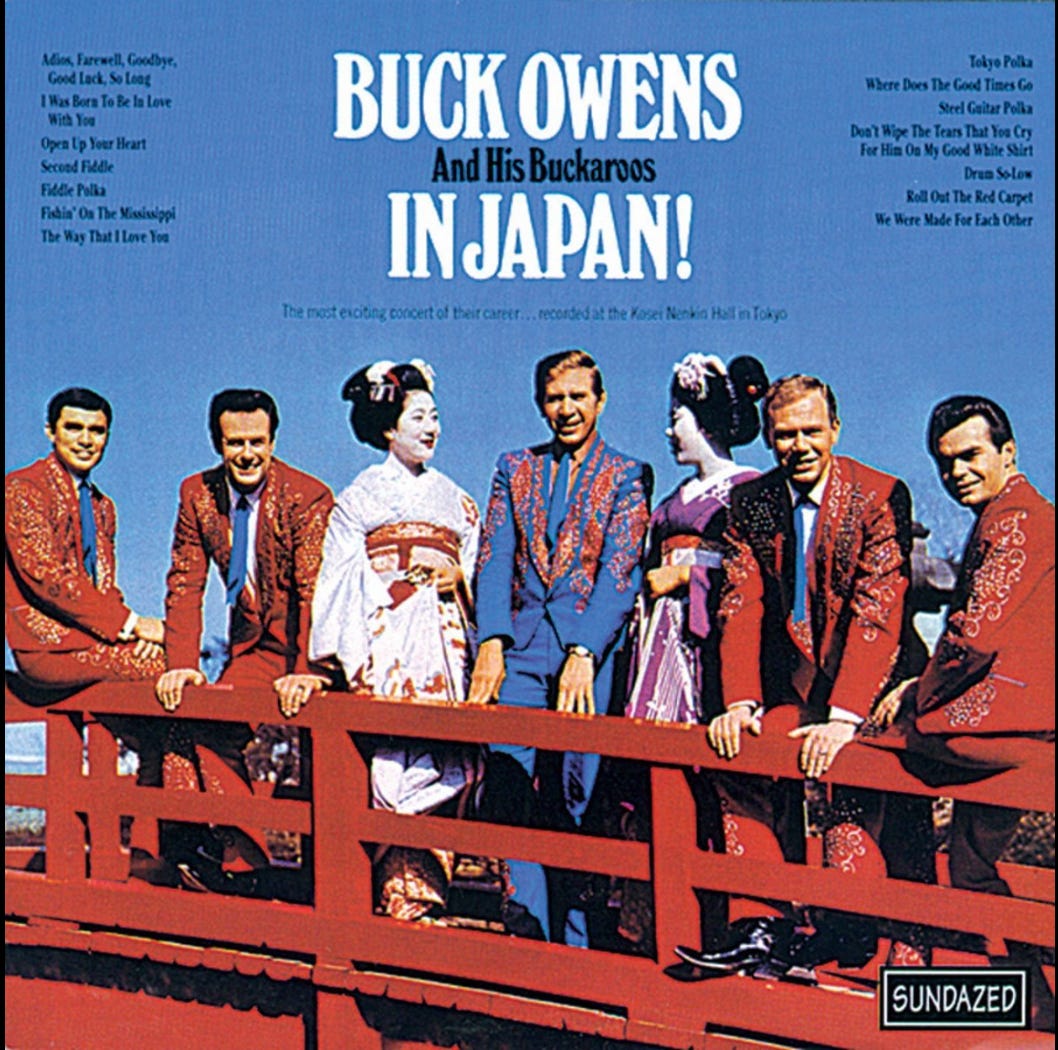
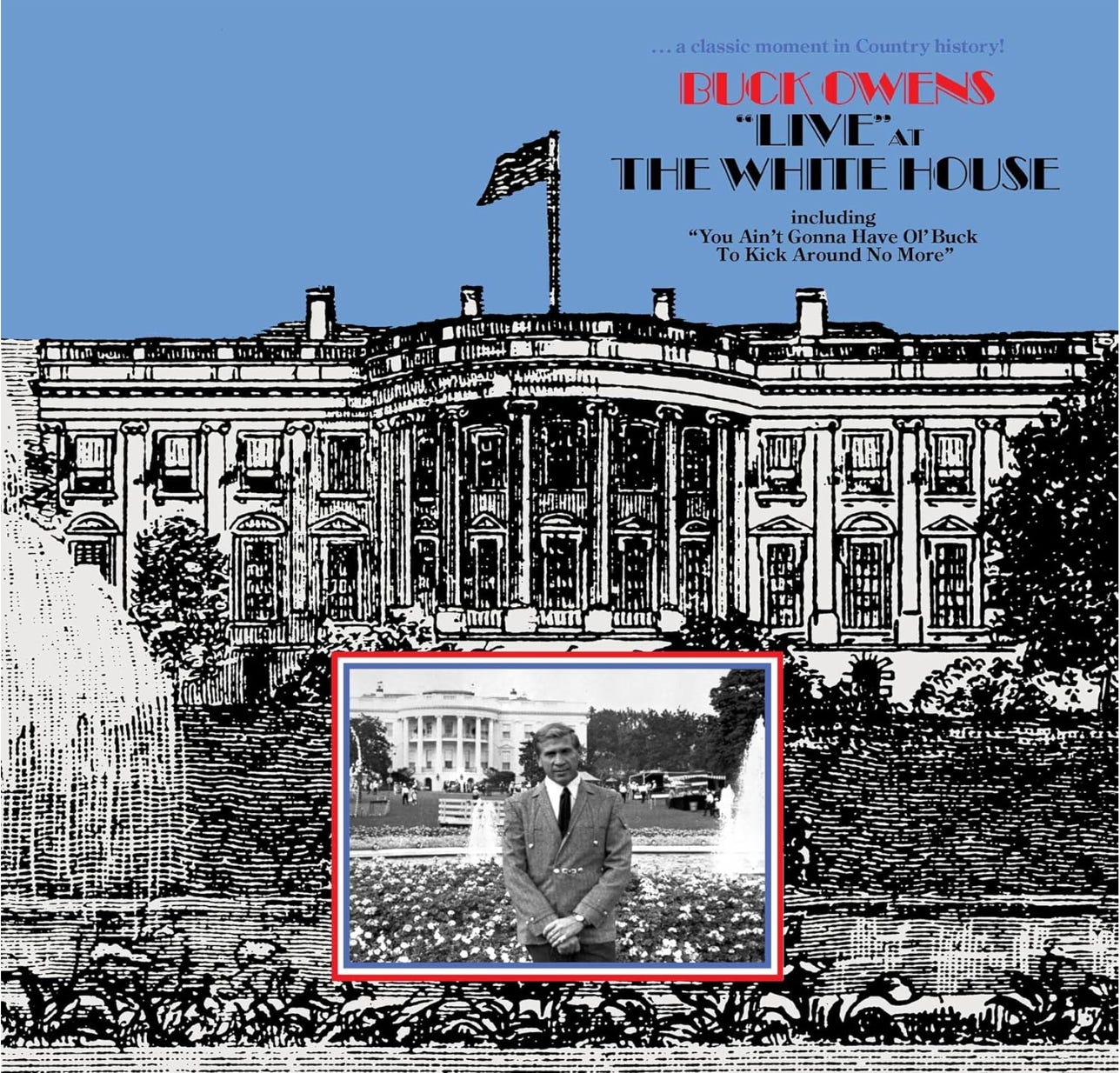
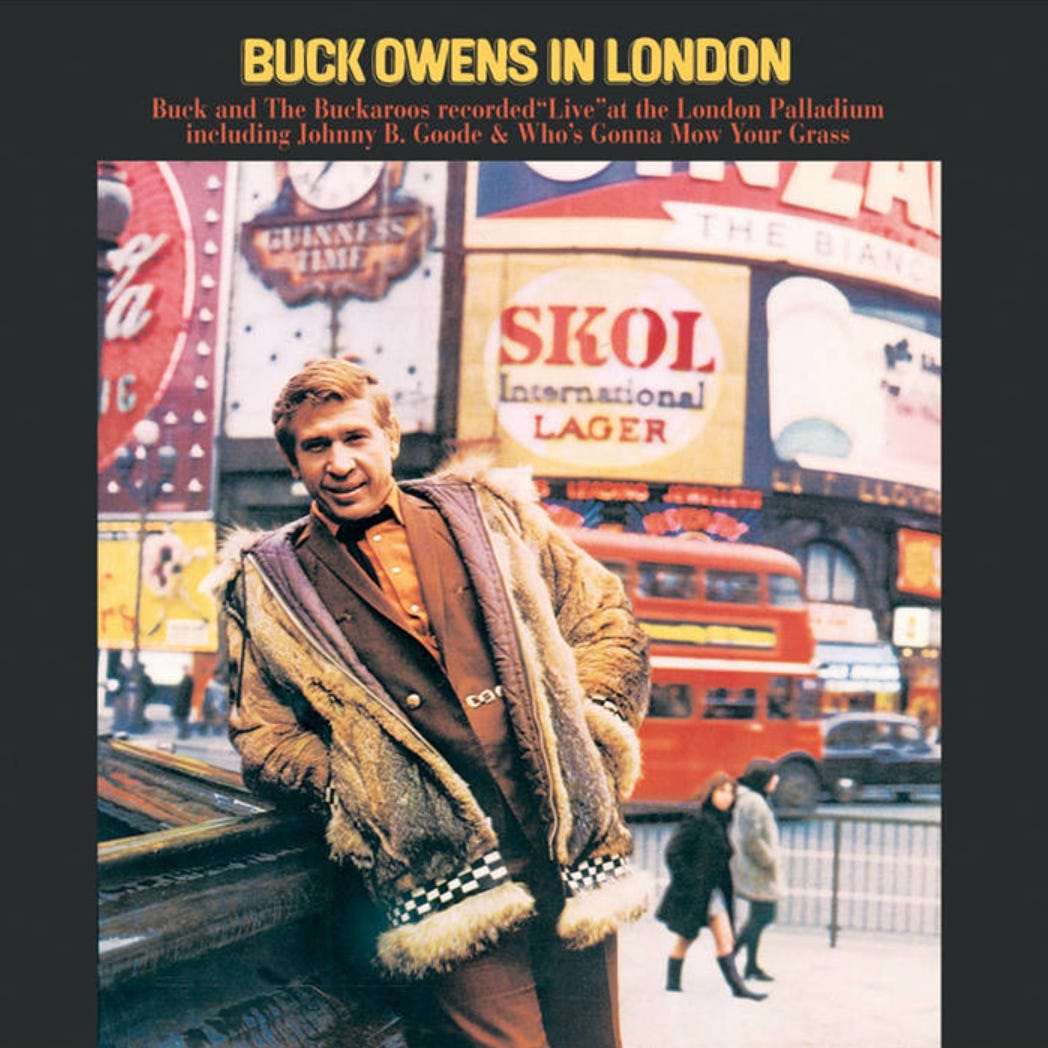
They went to Japan that year. They played the White House for Lyndon Johnson. They recorded in London. They went everywhere that mattered, and they dominated everywhere they went. And Don Rich was standing to Buck’s right at every single stop.
In 1969, Buck signed on to Hee Haw, with Don Rich named as the show’s musical director. The show ran on CBS until 1971, then went into syndication and stayed there for another two decades. Buck Owens became a household name. A national face. The grinning man in the overalls.
This is where something important began to quietly corrode.
Hee Haw made Buck famous in a way that the music alone never quite had. And it cost him something. It began to flatten him. The comedian started to eclipse the artist. The corny sketches started to overshadow the freight train sound. From Hee Haw‘s debut, there was a noticeable drop in the quality of his records, although he still made gems. They were still working. Don was still there. But the edge was softening in the public’s perception, even as the music itself was starting to find its way back.
In 1972, after three years without a number-one single, Buck and the Buckaroos finally hit the top again with “Made in Japan.” They were turning back toward the old sound. The freight train was getting its fire stoked again.
And then July 17, 1974 arrived.
The Night the Music Died — and Nobody Wrote a Song About It
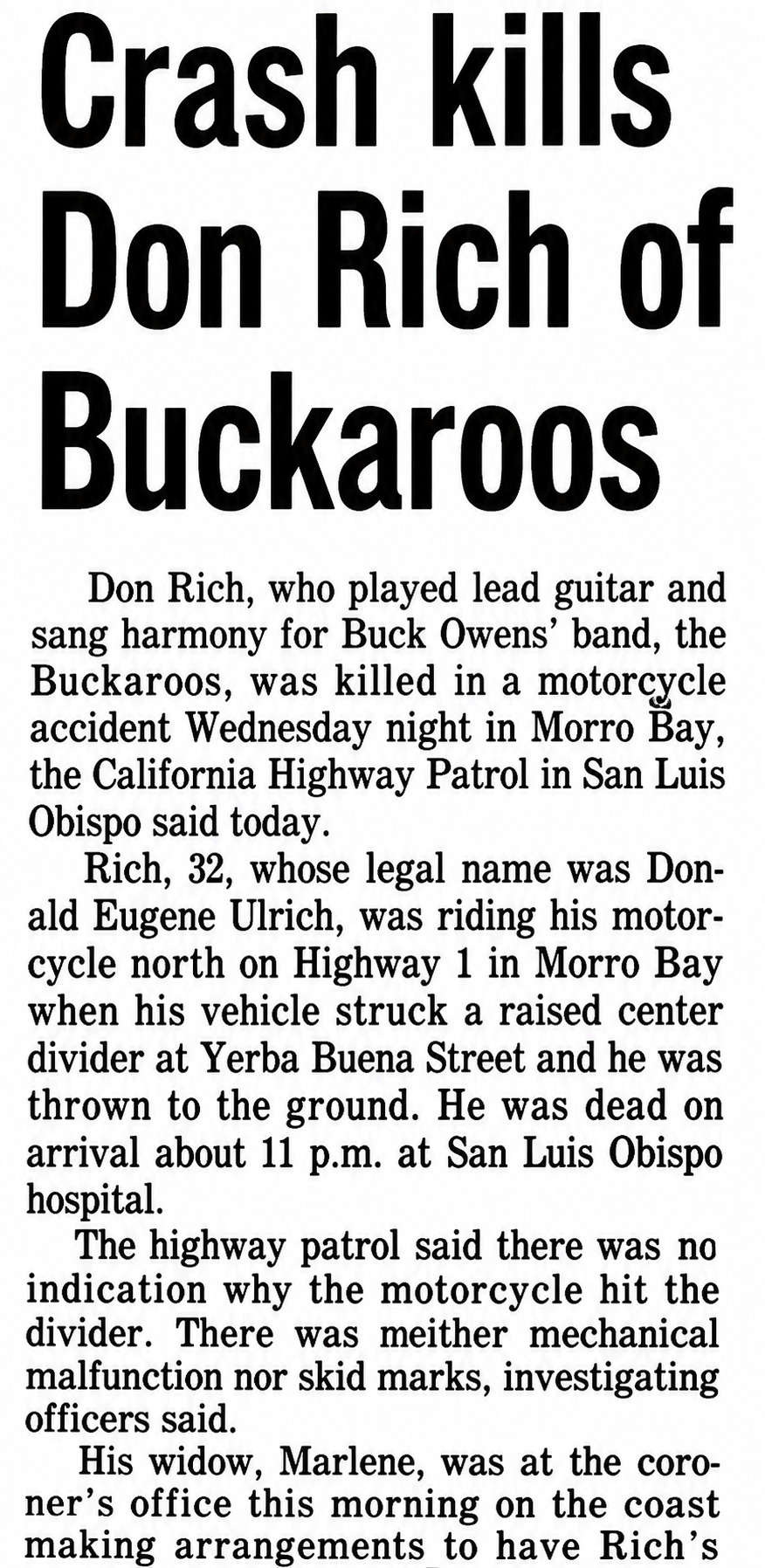
On July 17, 1974, Don finished work at Buck’s Bakersfield studio and left on his motorcycle to meet his family for a vacation in Morro Bay, California. Earlier that day, Buck had suggested that Don not take his bike — drive a car instead. It was something Buck had pleaded with him about for years, this motorcycle riding, something that worried him deeply. Don shrugged it off. He said goodbye to his friend.
That was the last time Buck Owens saw Don Rich alive.
For unknown reasons, Rich’s motorcycle hit a center divider on northbound Highway 1 at Yerba Buena Street in Morro Bay. He was pronounced dead on arrival at Sierra Vista Hospital in San Luis Obispo at 10:55 pm, fifty minutes after the incident was reported.
Nobody knows exactly what happened. There were no skid marks at the crash scene and no mechanical issues initially found with the motorcycle. But years later, the truth came out in the most heartbreaking way possible. One of Don’s sons — who found the blog posts and the fan pages decades after the fact and left a comment that most people missed — revealed that a neighbor who had gone to retrieve the motorcycle discovered that the front wheel of Don’s Harley-Davidson chopper had split apart. A mechanical failure, invisible until someone looked closely. Don Rich did not fall asleep at the wheel. He was not reckless. His wheel broke apart beneath him at speed on the Pacific Coast Highway, and there was nothing in the world he could have done about it.
He was thirty-two years old.
At the time of Rich’s death, he was the only original member still with the Buckaroos. His death marked the end of the Buckaroos’ reign as the top country music band.
It marked more than that. It ended Buck Owens.
Not immediately. Not visibly. But it ended him. It might as well have just been the whole band on that one motorcycle.
The Long Silence
According to Owens’ son Buddy Alan, the accidental 1974 death of Don Rich devastated Buck for years and impaired his creative efforts until his comeback in the late 1980s.
Rich’s death sent Buck first into shock, then an extended depression. He kept going through the motions. He kept filming Hee Haw. He kept releasing records. But something had gone out of the man that he could not locate anymore, and he knew it, and it seems that somewhere in his chest he stopped looking for it.
In a late 1990s interview, Owens said: “He was like a brother, a son, and a best friend. Something I never said before — maybe I couldn’t — but I think my music life ended when he died.”
My music life ended when he died.
He said that twenty-five years after the fact. Twenty-five years of carrying it before he could say it out loud. That is not grief. That is a wound that never scabbed over. That is a man who woke up every morning for a quarter-century and reached for something that was no longer there.
The records he made in the years after Don’s death have a quality to them that I can only describe as hollowness. The freight train had the same parts, played by capable men, but it didn’t move the same way. There was no one standing to Buck’s right who could fill that particular silence. Nobody else could harmonize with him the way Don had. Nobody else could look at a song Buck didn’t believe in and see what it was capable of becoming.
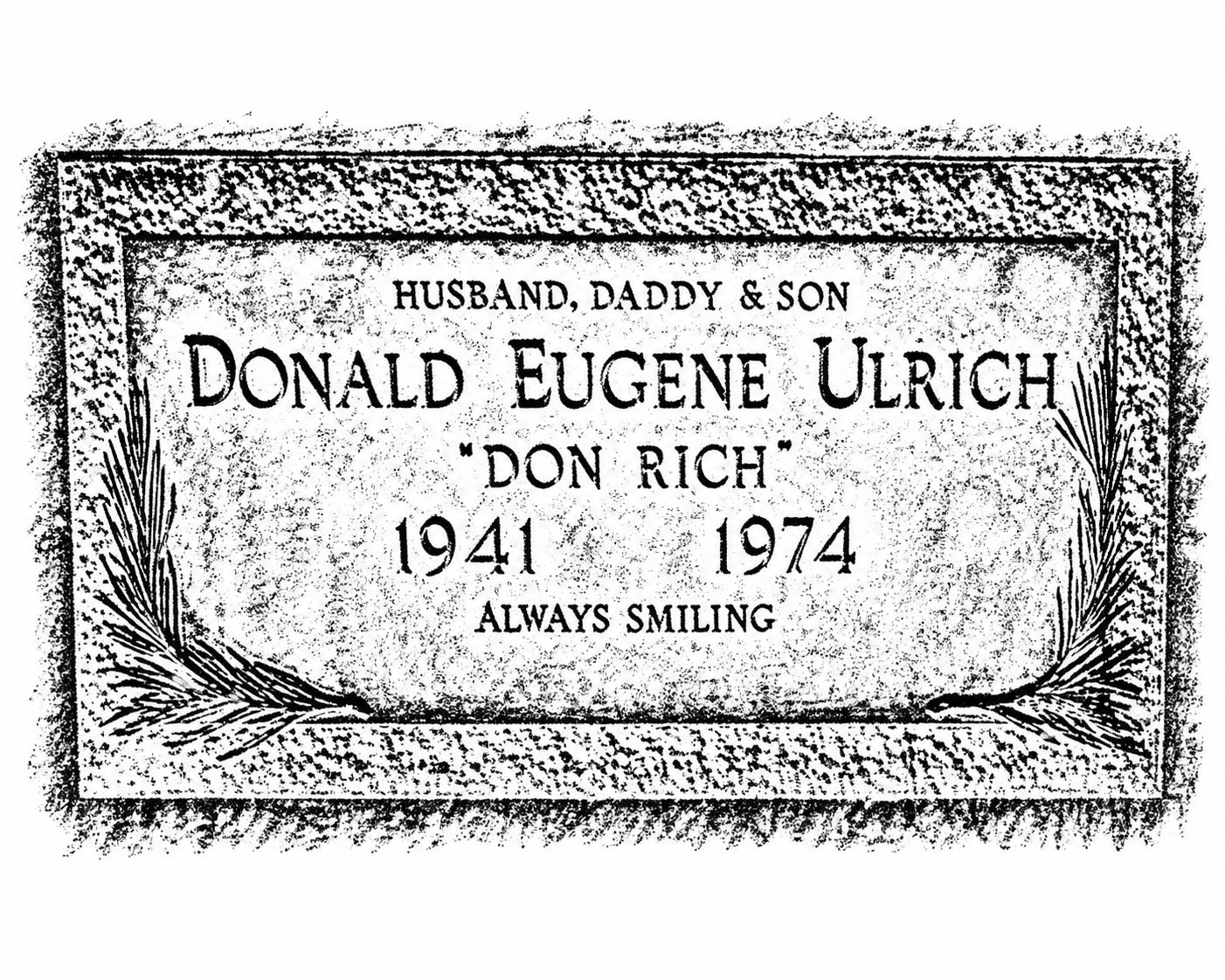
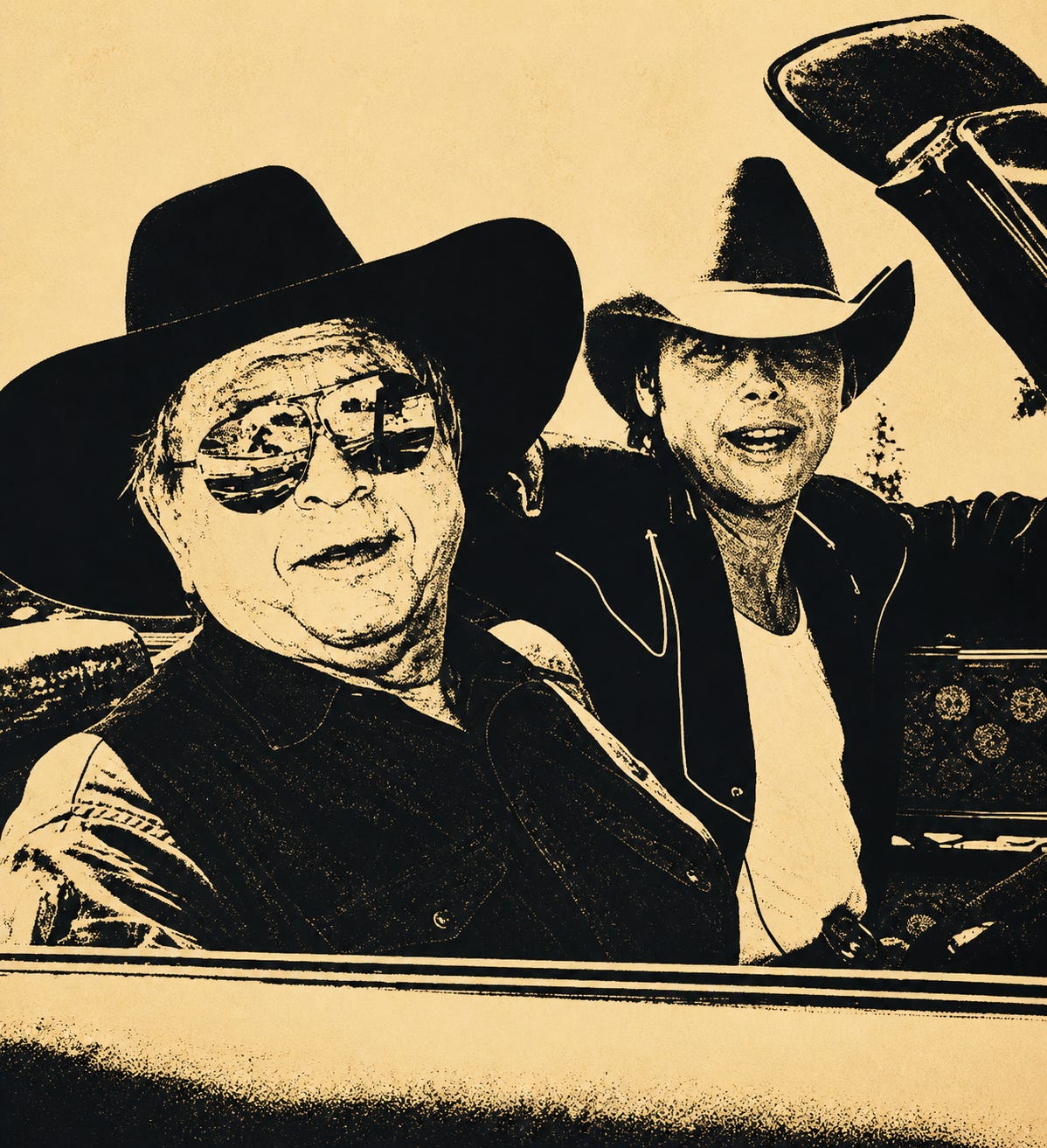
I have always loved he relationship between Dwight and Buck. It seemed like Dwight pulled Buck out of the Don Rich slump that plagued him for decades.
The Kid from Kentucky
In 1987, Dwight Yoakam swung by Buck’s office building in Bakersfield, unannounced. He was in town to play the county fair and came to ask if Buck might come out and sing some songs with him that night.
Yoakam had been talking about Buck Owens in every interview he gave since his first record. He wasn’t hiding the influence. He was wearing it like a coat. Buck had been watching from his Bakersfield remove, half-retired, tending to his business interests, and the energy coming off this young man from Kentucky who had been rejected by Nashville and gone and lit up the Los Angeles punk circuit with a Telecaster and a Bakersfield heart — it stirred something.
The two recorded “Streets of Bakersfield,” which gave Owens his first number-one hit in sixteen years and Yoakam his first number one ever.
Sixteen years. The gap between those two number-one hits is exactly the length of the wound.
Buck came back. Not all the way — you can’t come back all the way from what he lost. But enough. Enough to remember who he was. Enough to stand on a stage again and mean it.
In the early 1990s, Buck Owens built the Crystal Palace, a music venue in Bakersfield — a classy place with a tall stage, good food, and a museum of Buck Owens and Buckaroos memorabilia. He played there weekly into his seventies. He made it his monument. He surrounded himself with the artifacts of what he and Don had built together, and he played the songs in their honor every week until his body wouldn’t let him anymore.
Owens recovered from oral cancer in the early 1990s but had additional health problems near the end of the 1990s and into the 2000s, including pneumonia and a minor stroke in 2004. He kept playing when he could. He kept showing up.
On March 25, 2006, Buck Owens performed at the Crystal Palace. He went home afterward and died in his sleep of a heart attack at the age of seventy-six. Dwight Yoakam sang at his funeral.
What Was Lost and What Remains
Don Rich really is a classic case of a legacy gone scandalously unheralded — he was primarily a sideman, had a selfless approach to his own career, was willing to cede the spotlight to Buck, and died so early in life. He never campaigned for himself. He never made a solo album that got released in his lifetime. He recorded a whole record of George Jones covers that sat in a vault for nearly forty years. He was content — genuinely, not performatively content — to stand to Buck’s right and make the music as good as it could possibly be.
There is something almost unbearable about that level of selflessness in hindsight.
There is a petition that circulates from time to time asking the Country Music Hall of Fame to induct Don Rich. As of this writing, he is not in it. The man whose harmony put Buck Owens in the Hall of Fame. The man whose Telecaster defined the Bakersfield Sound. The man without whom the Beatles might never have covered an American country song. Not in the Hall of Fame.
Someone once framed it this way: it’s as if we recognized only one of the Everly Brothers.
That is exactly what it is. That is precisely what it is.
I want to tell you something about grief, because I believe this story is ultimately about grief — Buck’s grief, specifically, and what it does to a man when the music he makes requires someone else’s soul to complete it.
Buck Owens did not fall apart after Don Rich died. He did not drink himself to death or disappear into the dark. He got up. He went to work. He filmed Hee Haw on schedule. He made records. He honored his contracts. On the surface, he carried on.
But there is a difference between carrying on and being whole. Buck Owens spent twelve years carrying on before Dwight Yoakam showed up and reminded him there was still a reason to mean it. And even then — even with the comeback, the Crystal Palace, the late-career grace — Buck would tell you himself that his music life ended on Highway 1 in Morro Bay on a July night in 1974.
That is what it means to find the right person to make music with. That is what it costs when you lose them.
ABOUT THE AUTHOR:
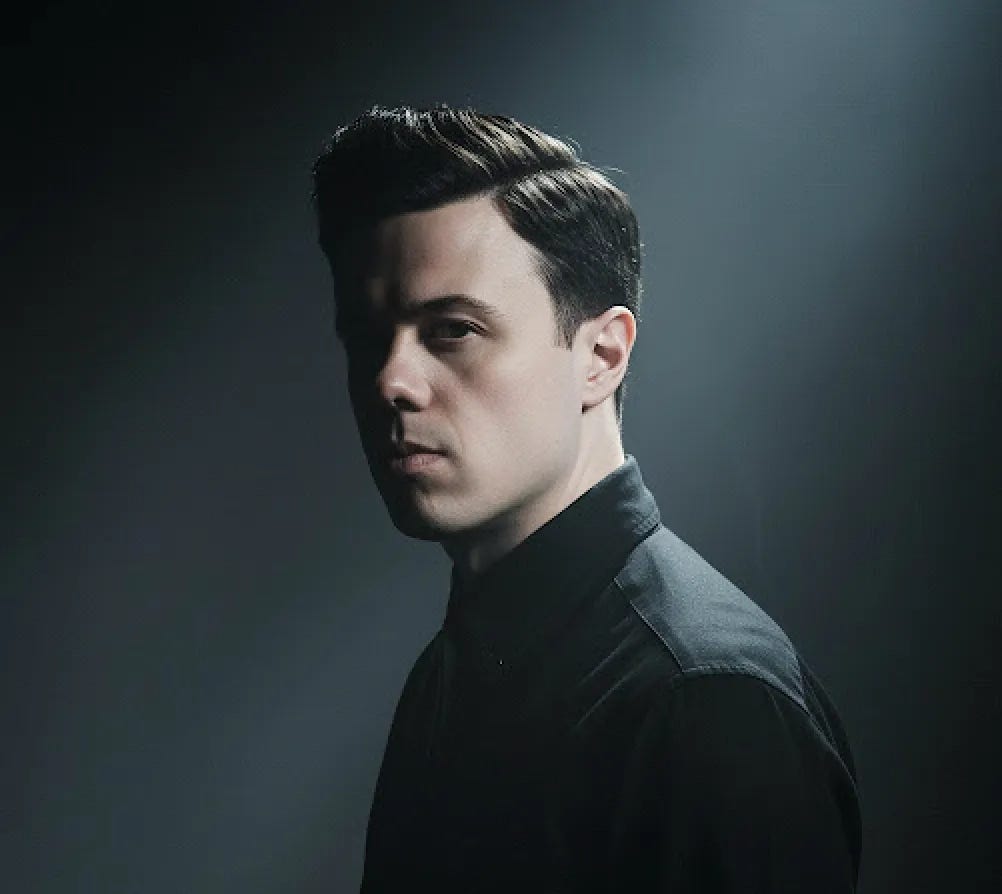
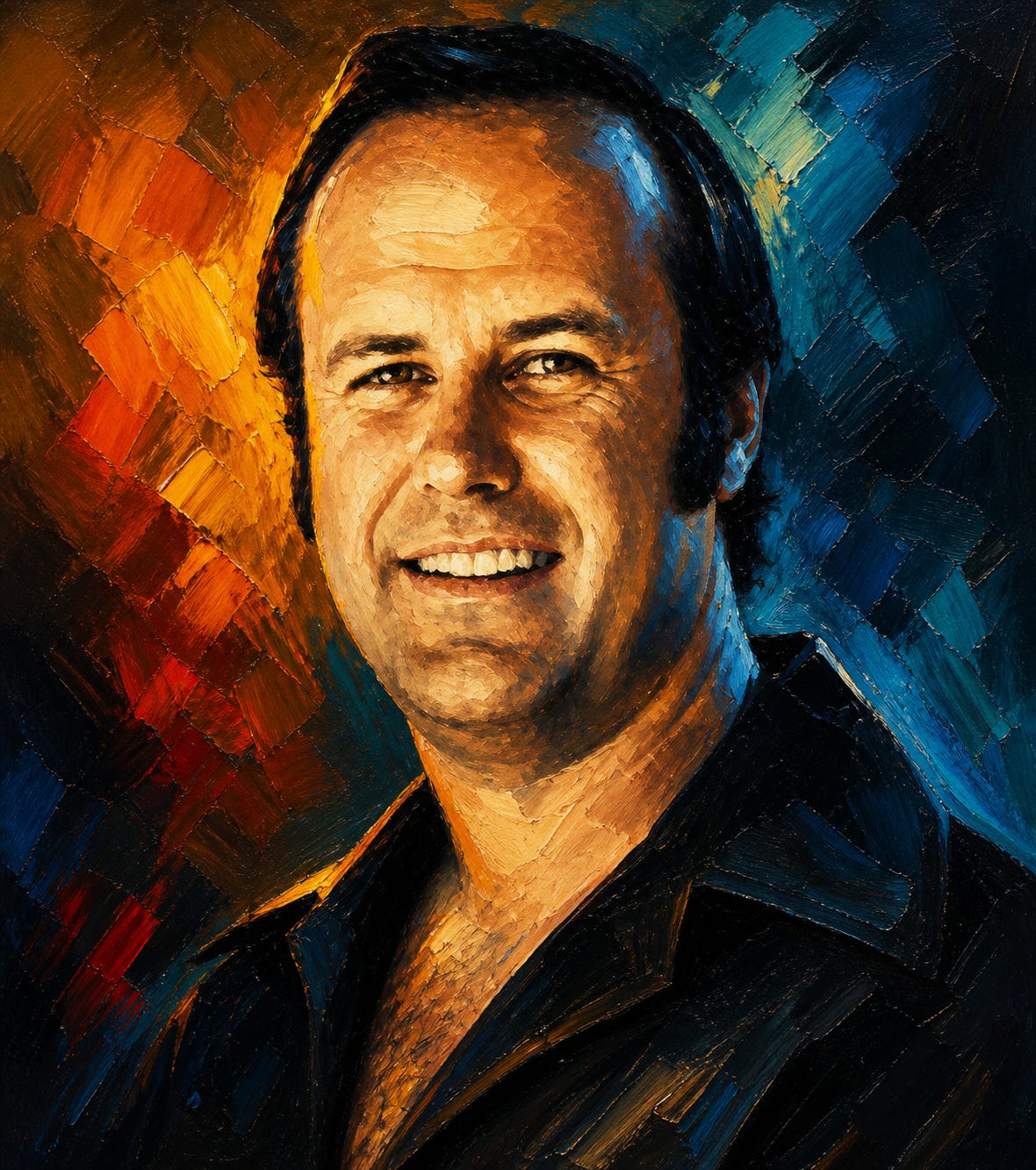
Zachariah Malachi — known as The Count of Country Music — is a singer, musician, actor, and writer based in Nashville, Tennessee. He works somewhere in the tradition between Hank Williams and the end of the world, and has a particular interest in the parts of country music history that the Hall of Fame keeps in the back room. His next record is forthcoming. He has been saying this for some time. He means it.
Don Rich was the power behind the throne no doubt & no, Buck was never the same. Ironically the same could be said of Grandpa Jones after he discovered friend David Akeman - aka Stringbean - murdered in 1973.
A beautiful piece about a brilliant modest man.
Thank you